





















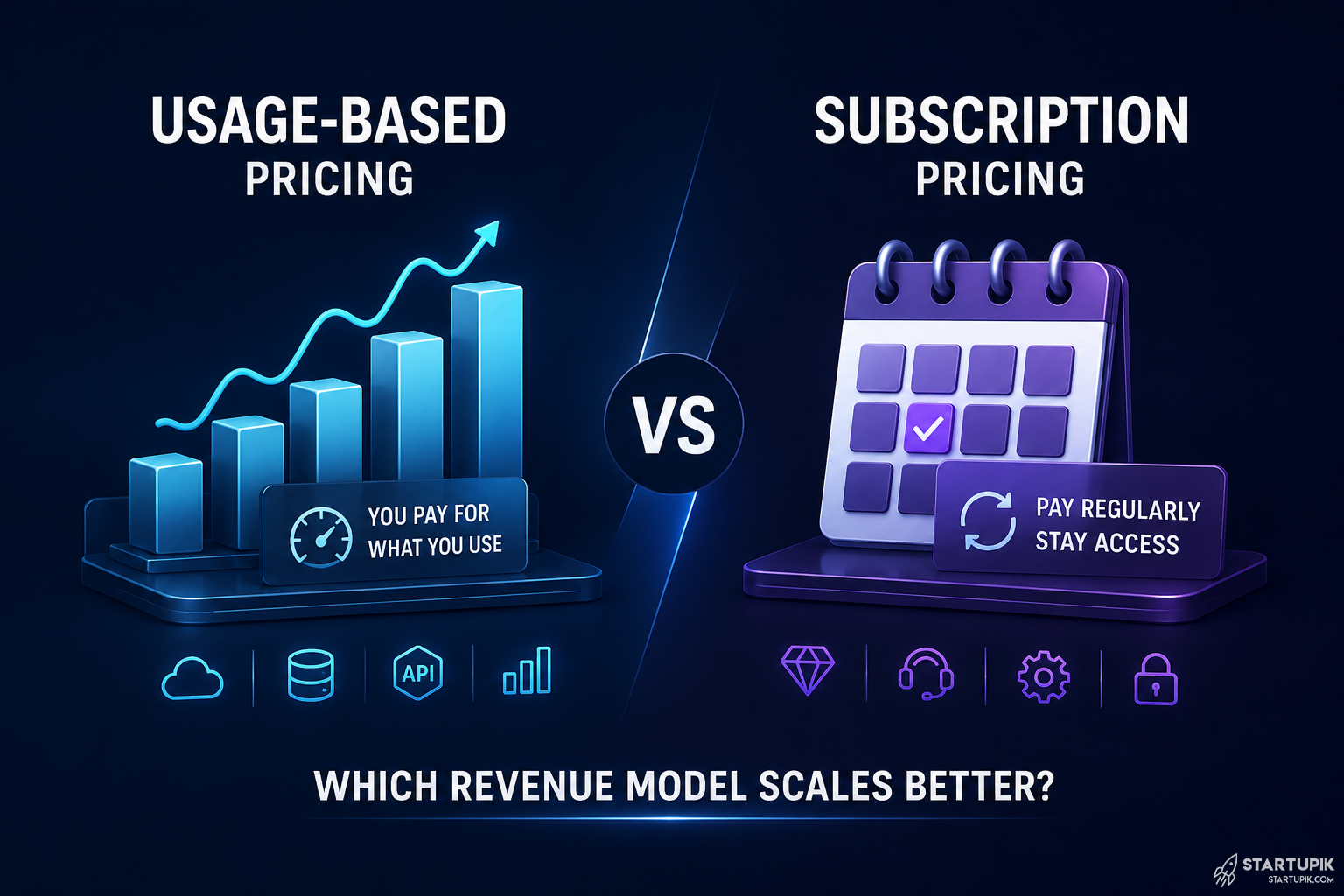
Usage-Based Pricing vs Subscription Pricing: Which Revenue Model Scales Better?
Introduction
Choosing the right pricing model is one of the most consequential decisions a startup founder makes. It shapes your revenue predictability, sales motion, product roadmap, and even which investors get excited about your company. Two models dominate SaaS and modern software businesses today: usage-based pricing and subscription pricing.
Founders compare these two models because they drive fundamentally different growth dynamics:
- Unit economics (LTV, payback period, gross margin) can look radically different.
- Go-to-market strategy (PLG vs sales-led, self-serve vs enterprise) is heavily influenced by pricing.
- Customer acquisition and retention behave differently when customers pay for access vs actual usage.
- Fundraising narratives around ARR, NRR, and scalability are shaped by how you charge.
This article breaks down how each model works, when each scales best, which types of startups should choose each, and how leading companies implement them.
Overview of Model A: Usage-Based Pricing
Usage-based pricing (also called consumption-based or pay-as-you-go) charges customers based on how much they actually use the product. Instead of a flat monthly fee, customers pay per unit of usage: API calls, messages sent, seats actively used, compute hours, gigabytes stored, or transactions processed.
How Usage-Based Pricing Works
Usage-based pricing typically follows this structure:
- Metered units: A clearly defined metric such as API requests, data volume, compute time, or transactions.
- Rate per unit: A price per unit (for example, $0.01 per API call), sometimes with volume discounts.
- Minimums or base fees (optional): Some companies set a minimum spend or base platform fee, then add usage on top.
- Tiered usage: Different price tiers unlock lower per-unit costs as customers scale.
Revenue grows as customer usage grows. In ideal scenarios, your best customers spend more over time without needing a new sales cycle. This model is common in infrastructure, APIs, and products where variable usage is core to value.
Overview of Model B: Subscription Pricing
Subscription pricing charges customers a recurring, usually fixed amount (monthly or annually) for ongoing access to a product or service. Customers pay for access rather than exact usage.
How Subscription Pricing Works
Subscription pricing typically follows this structure:
- Plans or tiers: Different packages (Basic, Pro, Enterprise) with fixed monthly or annual fees.
- Feature gating: Higher tiers unlock more features, integrations, or support.
- Seat-based pricing: Many subscriptions charge per user or per seat, adding predictability for both sides.
- Contract terms: Customers often sign for 12–36 months, providing predictable ARR for the startup.
Revenue scales by adding new customers, upgrading them to higher tiers, or increasing seat counts. This model is dominant in B2B SaaS apps, productivity tools, and many consumer subscription products.
Key Differences Between Usage-Based and Subscription Pricing
The two models differ across predictability, scalability, sales motion, and customer psychology. The table below captures the main contrasts founders should consider.
| Dimension | Usage-Based Pricing | Subscription Pricing |
|---|---|---|
| Revenue Predictability | Variable month to month; harder to forecast, especially early. | High predictability via contracts and fixed ARR. |
| Customer Onboarding | Low friction; easy to start small with low commitment. | More friction; customers often commit to a plan up front. |
| Monetization Driver | Grows with actual product usage and value delivered. | Grows with seat count, plan upgrades, and contract size. |
| Upside Potential | High; power users can grow spend rapidly without new deals. | Moderate; expansion usually requires upgrades or more seats. |
| Downside Risk | Revenue can shrink if usage drops or customers optimize. | More stable; revenue persists until churn or downgrade. |
| Sales Motion | Often product-led growth, self-serve, developer-first. | Common in sales-led motions with clear contract values. |
| Buyer Psychology | Feels fair and aligned to value; can create bill shock if not transparent. | Simple and predictable; may feel expensive for light users. |
| Implementation Complexity | Requires accurate metering, billing infrastructure, and analytics. | Simpler billing; focus on plan management and renewals. |
| Ideal Product Profile | Elastic usage, clear usage metric, frequent value realization. | Stable usage, clear user counts, feature-based differentiation. |
| Investor Perception | Attractive when NRR is high and growth is usage-driven; forecasting scrutiny. | Well-understood; easier to benchmark ARR and retention. |
Advantages and Disadvantages
Pros of Usage-Based Pricing
- Alignment with value: Customers pay in proportion to the value they receive, making it easier to justify spend.
- Lower barrier to entry: Easy to start small with low or no minimum commitment, which can accelerate adoption.
- Natural expansion: As customers grow usage, their spending grows automatically, often driving strong net revenue retention.
- Attractive for developers and technical buyers: Common in APIs, infrastructure, and backend services where consumption is normal.
- Competitive differentiation: Can win deals where flat subscriptions feel misaligned with variable workloads.
Cons of Usage-Based Pricing
- Revenue volatility: Harder to forecast; monthly revenue may fluctuate with seasonality or optimization.
- Billing complexity: Requires robust metering, monitoring, and billing systems; errors can damage trust.
- Customer anxiety: If not communicated well, customers may fear unpredictable bills and cap usage.
- Longer time to meaningful revenue: Customers may start with very low usage, delaying payback unless you have high volume.
- Internal planning challenges: Capacity planning, margin management, and sales targets become more dynamic.
Pros of Subscription Pricing
- Predictable revenue: Fixed recurring payments make ARR and cash flow easier to forecast and plan around.
- Simplicity for customers: Clear monthly or annual price; easy to budget and get internal approvals.
- Stronger upfront commitments: Annual contracts and multi-year deals lock in revenue and reduce short-term churn.
- Proven investor playbook: VCs and growth investors understand subscription metrics deeply.
- Operational simplicity: Billing and financial operations are easier than in complex metered models.
Cons of Subscription Pricing
- Misalignment with value: Heavy users may feel undercharged; light users may feel overcharged, affecting satisfaction.
- Higher adoption friction: Prospects must choose a plan and commit up front, which can slow sign-ups.
- Limited expansion leverage: Upselling often requires explicit plan changes or more seats, needing sales effort.
- Churn risk at renewal cycles: Value evaluation happens at renewal; customers can churn or negotiate discounts.
- Plateauing revenue per customer: Once customers are on the top tier, expansion paths may be limited.
Use Cases: Which Startups Should Choose Each Model?
When Usage-Based Pricing Is a Better Fit
Consider leaning into usage-based pricing if your startup exhibits these characteristics:
- Infrastructure or API products: Developer tools, APIs, cloud services, communications, and data platforms.
- Highly variable workloads: Customers’ usage spikes and drops based on their own growth or seasonal demand.
- Clear, objective metrics: You can measure usage easily and tie it directly to customer value (messages sent, compute time, storage, transactions).
- Product-led growth focus: You want a low-friction free or low-commitment entry point where usage expansion drives revenue.
- Large potential usage tails: A small number of customers could scale to very high usage and spend over time.
Usage-based pricing is especially powerful if your long-term strategy depends on expanding revenue within accounts based on their organic growth rather than constantly closing new logos.
When Subscription Pricing Is a Better Fit
Subscription pricing tends to work best for startups with these traits:
- Business applications: CRM, HR, finance, collaboration, and vertical SaaS tools with predictable daily use.
- Seat- or team-based value: The primary driver of value is how many people use the product, not how intensively they use it.
- Feature-based differentiation: Clear tiers where higher plans unlock advanced features or admin controls.
- Sales-led go-to-market: Contracts, procurement, and annual commitments are a standard part of your sales cycle.
- Need for financial predictability: Early-stage companies that need stable ARR to plan hiring and infrastructure.
Subscription pricing is especially effective when customers can quickly understand and justify a fixed recurring fee to finance and leadership stakeholders.
Hybrid Models
Many scalable startups do not choose one model exclusively. Successful hybrids include:
- Base subscription + usage overage: A fixed platform fee plus additional charges beyond included usage.
- Tiered subscriptions anchored on usage bands: Each plan includes a usage allowance; upgrading is triggered by sustained higher usage.
- Seat-based plus usage for premium features: A per-seat subscription and metered billing on resource-intensive features like AI inference or data storage.
Hybrid models can deliver the predictability investors like with the upside of usage-driven expansion.
Examples of Companies Using Each Model
Companies Using Usage-Based Pricing
- AWS (Amazon Web Services): Charges per compute hour, storage gigabyte, and many other granular metrics, enabling enormous usage-based expansion.
- Twilio: Bills per message, call, or interaction, aligning tightly with customer communication volume.
- Snowflake: Uses consumption-based pricing on compute credits and storage, which has driven very high net revenue retention.
- Stripe: Primarily charges a percentage fee per transaction, with revenue scaling as customer payment volume grows.
- Datadog: Mixes host-based and usage-based pricing for logs, traces, and metrics; usage expansion is a key growth driver.
Companies Using Subscription Pricing
- Salesforce: Classic seat-based subscriptions with multiple tiers for CRM and related products.
- HubSpot: Subscription tiers based on features, contacts, and hubs (marketing, sales, service, CMS, operations).
- Slack: Charges per active user per month with different feature tiers for larger organizations.
- Notion: Per-seat subscriptions with clear plan differentiation for individuals, teams, and enterprises.
- Zoom: Subscription plans based on meeting duration, participant limits, and advanced features.
Companies Using Hybrid Models
- Mailchimp: Combines subscription tiers with usage-based pricing on email sending volume.
- SendGrid (Twilio SendGrid): Tiered subscriptions that include an email volume allowance plus overage fees.
- GitHub: Seat-based tiers plus usage-based components for actions or packages.
Final Verdict: Which Revenue Model Scales Better?
Neither model universally “wins.” The better scaling model depends on your product, market, and go-to-market strategy.
Usage-based pricing tends to scale better when:
- Your product is infrastructure-like or an API with naturally expanding usage.
- Customers’ value is tightly coupled to measurable activity in your product.
- You can build strong net revenue retention through organic usage growth.
- You have or can build the technical and financial capabilities to meter and forecast accurately.
Subscription pricing often scales better when:
- Your product is a business application used in a steady, predictable way.
- Buying decisions involve finance and procurement who prioritize predictability.
- Your sales motion relies on clear contract values and long-term commitments.
- You need stable ARR to support hiring, fundraising, and long-term planning.
For many startups, the highest-scaling strategy is a thoughtful hybrid: a predictable subscription foundation with usage-based components where value truly scales with consumption. That approach lets you tell a clean ARR story to investors, keep buying simple for customers, and still capture the upside of your best users scaling aggressively on your platform.
As a founder, the core question is not “Which model is more popular?” but “How does my customers’ value scale, and how can my pricing mirror that as directly as possible while remaining predictable and easy to buy?” Align your pricing with that answer, and you maximize both scalability and long-term defensibility.




