





















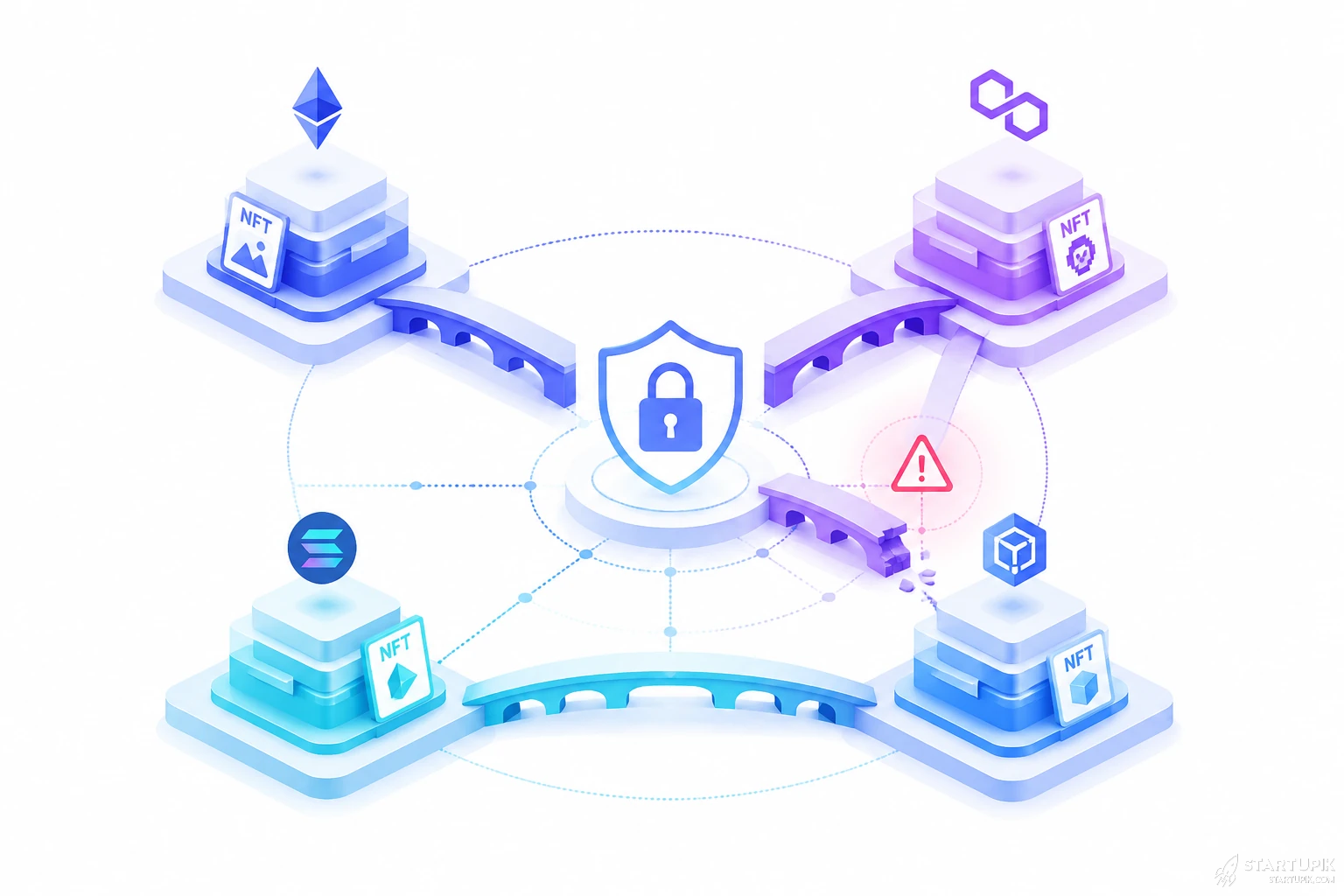
Cross-chain security risks are the main reason many Web3 exploits still happen in 2026. The biggest problems usually come from bridges, message validation, smart contract logic, validator trust assumptions, and wallet interaction flows across multiple blockchains.
As more apps expand across Ethereum, Solana, Arbitrum, Base, BNB Chain, Polygon, Avalanche, and Cosmos ecosystems, the attack surface grows fast. A protocol is no longer only as secure as one chain. It is often only as secure as its weakest cross-chain component.
Quick Answer
- Cross-chain systems are risky because they depend on multiple trust layers, including bridges, relayers, validators, oracles, and smart contracts.
- Bridge exploits remain one of the largest sources of crypto losses, often caused by compromised validator keys, flawed message verification, or contract bugs.
- Wrapped assets create additional risk because users rely on off-chain or external systems to prove reserves and redemption integrity.
- Cross-chain messaging can fail silently when finality assumptions, replay protection, or chain reorg handling are weak.
- Founders should evaluate security by trust model, not just by TVL, audits, or brand reputation.
- In 2026, the safest cross-chain design is usually the one that minimizes asset movement and reduces external dependencies.
What Cross-Chain Security Risks Actually Mean
Cross-chain security risk is the risk that assets, messages, permissions, or application state become unsafe when moving between two or more blockchains.
This matters because each blockchain has its own consensus model, finality rules, validator set, execution environment, and wallet standards. When a protocol tries to connect them, it introduces new points of failure that do not exist in a single-chain app.
For example:
- A bridge locks ETH on Ethereum and mints wrapped ETH on another chain
- A messaging protocol sends governance instructions from one chain to another
- A DeFi app syncs collateral positions across multiple networks
- A gaming app uses NFTs and in-game balances on different chains
Each of these flows depends on correct verification. If that verification breaks, funds or state can be manipulated.
Why Cross-Chain Risk Matters More Right Now in 2026
Right now, many founders are building chain-agnostic products. Users expect access across L1s, L2s, appchains, and modular ecosystems. That pressure has increased adoption of bridge aggregators, intent-based routing, omnichain messaging, and shared liquidity systems.
But growth has outpaced operational maturity in many teams. More integrations mean:
- More smart contracts to audit
- More wallet connection edge cases
- More assumptions about finality and chain state
- More vendor dependencies like LayerZero, Wormhole, Axelar, Hyperlane, Chainlink CCIP, and LI.FI
The result: cross-chain expansion often improves distribution, but it also multiplies failure modes.
Main Cross-Chain Security Risks
1. Bridge Smart Contract Vulnerabilities
Most users think a bridge is just a transfer tool. In practice, it is often a high-value smart contract system holding large pools of assets or minting wrapped tokens based on external proof.
Common issues include:
- Incorrect signature verification
- Poor access control
- Upgradeability abuse
- Unchecked external calls
- Mint and burn logic flaws
- Message replay bugs
When this works: small, simple bridge logic with narrow permissions and well-tested validation paths.
When it fails: complex bridge architectures with emergency admin powers, inconsistent chain adapters, and rushed deployments on new networks.
2. Validator and Multisig Compromise
Many bridges and cross-chain messaging systems use a validator set, guardian network, or multisig to confirm messages. If attackers compromise enough keys, they can approve fake transfers or forged state updates.
This is a major issue in systems that market themselves as decentralized but still rely on:
- Small multisigs
- Centralized operator infrastructure
- Weak key management
- Insider trust
Trade-off: validator-based systems are often faster and easier to deploy than light-client-based systems. But they add social and operational trust assumptions that many users do not fully understand.
3. Wrapped Asset Risk
Wrapped tokens such as bridged USDC, bridged ETH, or synthetic BTC are only valuable if the backing and redemption process remains intact.
Risks include:
- Reserve mismatch
- Bridge insolvency
- Frozen redemption
- Depegging after an exploit
- Confusion between canonical and non-canonical assets
A common startup mistake is treating all versions of an asset as interchangeable. They are not. Bridged USDC on one network may have very different counterparty risk than native USDC issued directly by Circle.
4. Cross-Chain Message Forgery
Not all cross-chain systems move tokens. Some move instructions. This includes governance actions, liquidation triggers, oracle updates, game state, and identity claims.
If a malicious actor can forge or tamper with a message, they may be able to:
- Mint assets without collateral
- Trigger unauthorized withdrawals
- Change governance state
- Manipulate app permissions
This is especially dangerous in omnichain apps where one compromised message can affect several deployed contracts at once.
5. Finality and Reorg Assumption Errors
Different chains have different confirmation and finality models. Ethereum, Bitcoin, Solana, Avalanche, Cosmos zones, and optimistic rollups do not all behave the same way.
If a protocol assumes a transaction is final too early, a reorg or delayed settlement event can invalidate the message after the destination chain already acted on it.
This works well when teams model finality conservatively and adapt per chain.
This breaks when teams use one standard confirmation threshold everywhere for speed or UX.
6. Oracle and Data Dependency Risk
Cross-chain applications often rely on price feeds, proof relays, off-chain watchers, API services, and routing engines. If any of these dependencies fail, the protocol may process bad information.
Examples:
- Using stale prices to mint or liquidate assets
- Routing through a compromised bridge path
- Reading incorrect proof data due to indexer issues
- Executing based on delayed chain state
Protocols using Chainlink, Pyth, RedStone, custom relayers, or internal oracles need to model these dependencies as part of security, not just infrastructure.
7. Upgrade and Governance Risk
Many cross-chain protocols are upgradeable. That is practical, but dangerous.
If admins can change core bridge contracts, validator sets, routing logic, or mint permissions quickly, users are exposed to:
- Malicious upgrades
- Governance attacks
- Compromised admin wallets
- Poorly tested hotfixes
Trade-off: upgradeability helps teams respond to incidents. But the more emergency power retained by the core team, the less trust-minimized the protocol is.
8. Liquidity Fragmentation and Settlement Risk
Cross-chain products often look functional in demos but fail under stress because liquidity is fragmented across chains.
This creates:
- Incomplete redemptions
- Bridge queue delays
- Slippage spikes
- Failed exits during volatility
Security is not only about code exploits. If users cannot safely exit or settle during market stress, that becomes an operational security failure.
9. Wallet and User Flow Exploits
Cross-chain UX is still confusing. Users often sign approvals, bridge requests, permit messages, and destination chain transactions without understanding what each step does.
Attackers exploit this through:
- Phishing interfaces
- Malicious bridge front ends
- Approval draining
- Fake destination chain confirmations
- Confusing token symbols and chain labels
This is especially relevant for startups integrating MetaMask, WalletConnect, Phantom, Rabby, Coinbase Wallet, or embedded wallets into multi-chain flows.
How Cross-Chain Systems Usually Work
Most cross-chain systems follow one of these models:
| Model | How It Works | Main Risk | Typical Trade-off |
|---|---|---|---|
| Lock-and-mint bridge | Asset is locked on source chain and wrapped on destination chain | Custody and proof verification failure | Simple UX, but wrapped asset dependency |
| Burn-and-release bridge | Wrapped asset is burned to release original asset | Redemption logic and reserve management | Useful for return flows, but operationally sensitive |
| Liquidity network | Liquidity providers front assets on destination chain | LP insolvency or routing manipulation | Fast transfers, but less deterministic under stress |
| Validator-based messaging | External validators attest to source chain events | Key compromise or collusion | Scalable, but trust-heavy |
| Light client bridge | Destination verifies source chain proofs on-chain | Complex implementation bugs | Higher trust minimization, more complexity and cost |
| Intent-based routing | Resolvers fulfill user outcome across chains | Solver trust and execution edge cases | Better UX, but more hidden infrastructure assumptions |
Real-World Startup Scenarios
Scenario 1: DeFi Lending App Expands to Three Chains
A lending protocol launches on Ethereum, Arbitrum, and Base. It wants users to post collateral on one chain and borrow on another.
What works:
- Simple collateral rules per chain
- Conservative oracle design
- Independent liquidation logic per market
What fails:
- Assuming collateral state sync is always instant
- Using one global risk engine without delay buffers
- Treating bridged assets as identical to native assets
This design can look capital efficient but become fragile during volatility.
Scenario 2: NFT Game Uses Omnichain Assets
A game lets users move avatars and items between Polygon, Immutable-style infrastructure, and an L2. The team focuses on gasless UX.
What works:
- Non-financial items with recoverable state
- Strong replay protection
- Signed actions scoped by chain and asset type
What fails:
- Using the same permission model for valuable and low-value assets
- No recovery logic when messages fail mid-transfer
- Trusting front-end status instead of chain-verifiable settlement
Scenario 3: Wallet or Aggregator Adds Bridge Routing
A wallet product integrates LI.FI, Socket, or other route aggregators to let users bridge inside the app.
What works:
- Showing route trust assumptions clearly
- Restricting unsupported token contracts
- Using simulation and transaction preview layers
What fails:
- Optimizing only for cheapest path
- Routing through obscure bridges with shallow liquidity
- Not handling destination failure or refund states well
What Founders Must Check Before Using Cross-Chain Infrastructure
- Trust model: Is it light-client-based, validator-based, multisig-controlled, or liquidity-network-based?
- Upgradeability: Who can change contracts, validators, or routing rules?
- Asset type: Is the token native, canonical, wrapped, synthetic, or issued by a third party?
- Finality handling: How does the system treat chain reorgs, delayed state, and optimistic challenge periods?
- Failure recovery: What happens if the source transaction succeeds but the destination action fails?
- Operational security: How are signer keys managed? Is there HSM usage, MPC, or hardware wallet segregation?
- Liquidity resilience: Can users exit during market stress?
- Audit quality: Was the exact deployed architecture audited, not just a core library?
- Monitoring: Are there on-chain alerts, circuit breakers, message anomaly detection, and incident response playbooks?
Legal and Operational Considerations
Cross-chain risk is not only technical. It affects operations, user support, treasury management, and even compliance posture.
Custody and Asset Representation
If your app accepts bridged or wrapped assets, you need clear internal rules on what counts as valid collateral, treasury holdings, or settlement units.
A finance team that treats bridged tokens as equivalent to native reserve assets can misprice risk badly.
Incident Response
When a bridge or messaging protocol is compromised, teams need fast decision paths:
- Pause deposits?
- Disable one chain only?
- Block specific wrapped assets?
- Recalculate collateral factors?
If these controls are not designed before launch, the team usually reacts too slowly.
User Disclosure
If users bridge through your product, they should know:
- Which provider is used
- What asset form they will receive
- What trust assumptions apply
- What happens if settlement fails
That is not just better UX. It reduces support chaos and reputational damage.
Practical Checklist for Reducing Cross-Chain Security Risk
- Use fewer chains than your growth deck suggests
- Prefer canonical assets where possible
- Separate financial logic from cross-chain messaging logic
- Add rate limits on cross-chain minting, withdrawals, and governance actions
- Require chain-specific confirmation thresholds
- Implement replay protection and message nonce tracking
- Design for partial failure, not just success paths
- Run tabletop incident drills for bridge exploit scenarios
- Monitor signer changes, validator anomalies, liquidity drain events, and unusual mint activity
- Do not market a system as trustless if users still depend on a small operator set
Common Mistakes Teams Make
- Choosing bridge partners by brand alone
- Assuming audits equal safety in production
- Ignoring differences between wrapped and native liquidity
- Launching on too many chains too early
- Using one security model for tokens, governance, and messaging
- Optimizing UX without modeling failure states
- Underestimating wallet approval and phishing risk
The most expensive mistake is usually not a coding bug. It is a bad architecture decision made for distribution speed.
Expert Insight: Ali Hajimohamadi
Most founders evaluate cross-chain infrastructure like a growth channel. That is the wrong frame. A new chain integration is closer to adding a new banking partner with its own failure modes, settlement timing, and trust exposure.
The contrarian view is simple: more chains do not automatically mean more market access. In many early-stage products, each added chain reduces security clarity faster than it increases revenue.
My rule is this: if your team cannot explain the exact failure path of a bridge exploit in one page, you should not make that integration core to user funds. Distribution can be reversible. Cross-chain trust mistakes usually are not.
When Cross-Chain Designs Make Sense
- Wallets that need user access across major ecosystems
- Consumer apps where assets are low value and state can be recovered
- Protocols with strong treasury, monitoring, and incident response maturity
- Infrastructure platforms building chain abstraction or routing layers as a core product
When They Usually Do Not
- Early DeFi startups with limited security budget
- Teams without in-house smart contract review capability
- Apps holding user treasury or collateral but relying on opaque bridge partners
- Products expanding cross-chain only for marketing optics
FAQ
Are cross-chain bridges inherently unsafe?
No. But they are structurally riskier than single-chain systems because they introduce additional trust assumptions, infrastructure dependencies, and verification logic. Safety depends on the bridge design, operator model, and failure handling.
What is the biggest cross-chain security risk?
The biggest risk is usually invalid message acceptance. That can come from compromised validator keys, weak proof verification, smart contract bugs, or bad finality assumptions.
Are light-client bridges safer than multisig bridges?
Often yes in theory, because they reduce external trust. But they can also be harder to implement correctly and more expensive to maintain. Better security design can still fail if the implementation is poor.
Why do wrapped assets add risk?
Wrapped assets depend on another system for custody, minting, redemption, and proof of backing. If that system fails, the wrapped token can lose parity or become unrecoverable.
How should startups evaluate a cross-chain provider?
Start with trust model, upgrade controls, signer security, audit scope, incident history, liquidity depth, chain support quality, and failure recovery design. Do not evaluate by TVL or marketing alone.
Is cross-chain messaging safer than cross-chain asset bridging?
Not necessarily. Messaging systems can be just as dangerous because forged or replayed instructions can change app state, governance, or mint logic even without moving tokens directly.
What is the safest approach for an early-stage Web3 startup?
Usually it is single-chain first, then selective expansion with minimal asset movement. Add cross-chain features only where they clearly improve user value and where the team can manage the operational risk.
Final Summary
Cross-chain security risks are not just bridge bugs. They include validator compromise, wrapped asset instability, message forgery, reorg assumptions, liquidity failures, upgrade risk, and wallet-level exploitation.
For founders, the key question is not “Can we go multi-chain?” It is “What new trust assumptions are we adding, and can we survive their failure?”
In 2026, the strongest cross-chain strategy is usually not maximum expansion. It is controlled interoperability: fewer dependencies, clearer trust boundaries, and better failure planning.




