




















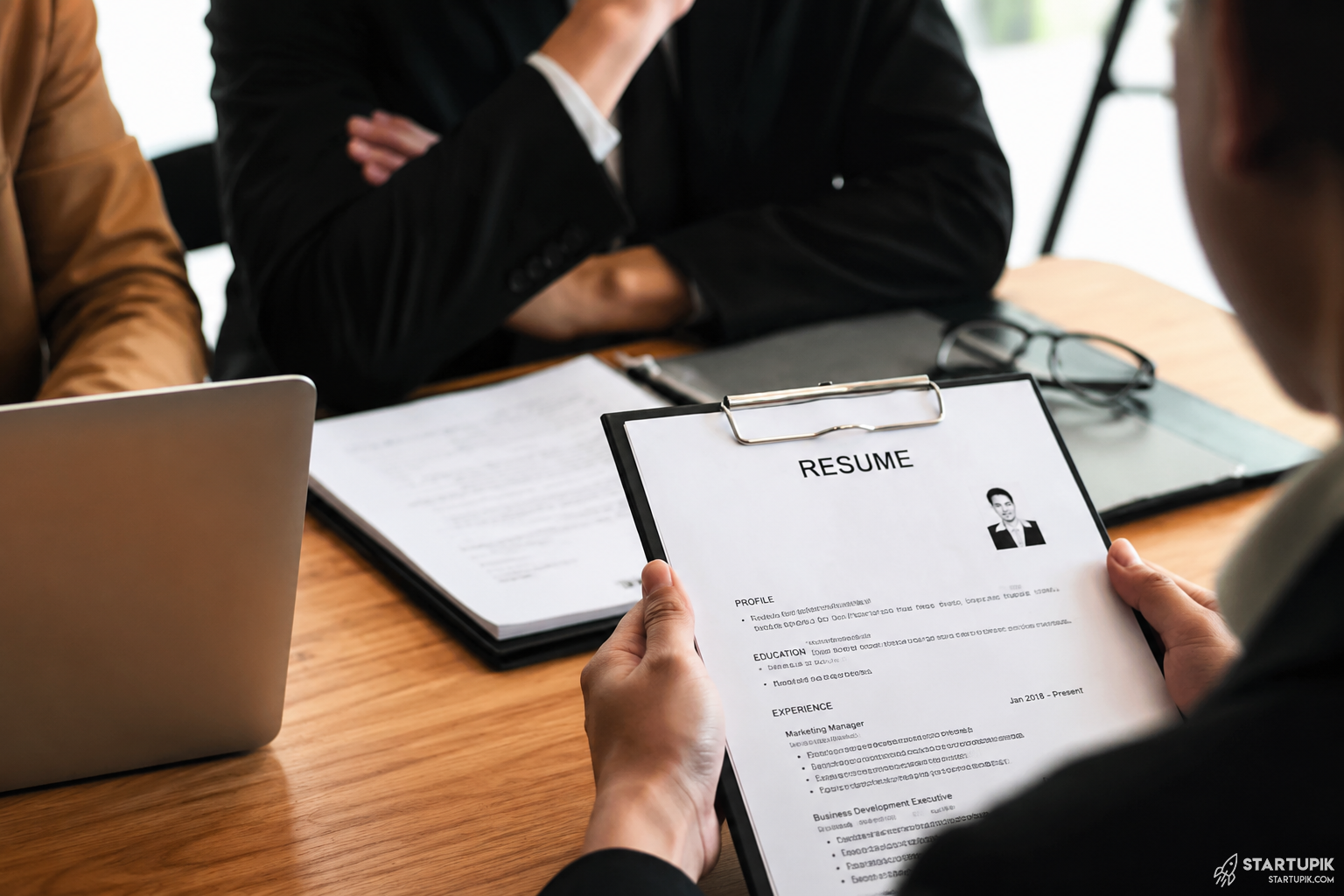
AI is changing startup hiring forever by shifting how founders source, screen, assess, and onboard talent. In 2026, the biggest change is not just automation. It is that early-stage teams can now hire faster with less recruiter overhead, evaluate real skills earlier, and run leaner teams by combining human talent with AI systems.
That said, AI-driven hiring works best when startups use it to improve decision quality, not just speed. It fails when founders over-automate judgment, trust weak signals, or optimize for resume volume instead of role fit.
Quick Answer
- AI reduces hiring time by automating sourcing, resume screening, interview scheduling, and candidate follow-up.
- Startups now assess skills earlier using AI-generated work tests, coding simulations, and role-specific evaluation workflows.
- Hiring teams are getting smaller because founders use AI recruiters, ATS automation, and interview copilots instead of building large talent functions.
- Job descriptions and candidate matching are improving through tools like LinkedIn Recruiter, Ashby, Greenhouse, Workable, and AI sourcing platforms.
- Bias risk has not disappeared because AI systems can amplify bad data, weak scorecards, and misleading patterns.
- The biggest winners are startups with clear hiring systems, not startups that blindly add AI tools to a broken recruiting process.
Why This Matters Now
Right now, startup hiring is under pressure from both sides. Founders need to move faster, but capital is tighter, teams are leaner, and every hire carries more risk.
At the same time, AI adoption has accelerated across recruiting software, HR tech, CRM-style talent pipelines, sourcing platforms, and internal people operations. What changed recently is that AI is no longer just a resume filter. It now touches the full hiring workflow.
In 2026, a seed-stage startup can run a hiring process that used to require a recruiter, a coordinator, a sourcing specialist, and multiple hiring managers. That changes the economics of building a team.
How AI Is Reshaping Startup Hiring
1. Sourcing is becoming data-driven and continuous
Founders no longer need to wait for inbound applicants or manually search LinkedIn for hours. AI sourcing tools scan profiles, portfolios, GitHub activity, public work history, and role signals at scale.
This works especially well for roles with visible output, such as:
- Software engineers
- Product designers
- Growth marketers
- Developer relations hires
- Sales development reps
It works less well for roles where context matters more than public credentials, such as:
- Chief of staff
- Early-stage product leaders
- Enterprise partnership hires
- Regulated fintech operators
Why? Because these roles depend heavily on judgment, ambiguity handling, stakeholder trust, and company-stage fit. AI can find profiles, but it still struggles to understand political skill and founder compatibility.
2. Resume screening is losing importance
One of the biggest shifts is that startups are relying less on resumes as the main decision input. AI makes it easier to move from credential screening to proof-of-work screening.
Instead of asking, “Did this person work at Stripe, Coinbase, or Notion?” founders can now ask:
- Can they solve the actual problem?
- Can they write clearly?
- Can they handle startup ambiguity?
- Can they ship fast with limited structure?
AI helps generate structured take-home tasks, mock sales scenarios, coding challenges, product critiques, and writing tests. This is a major improvement for startups that care more about execution than pedigree.
Trade-off: if every company auto-generates generic assignments, candidates see repetitive tests and drop off. The best startups use AI to customize assessments, not mass-produce lazy ones.
3. Hiring cycles are shrinking
Speed matters in startup hiring because top candidates often leave the market in days, not weeks. AI helps reduce lag across the process.
Common time-saving use cases include:
- Auto-drafting role descriptions
- Scheduling interviews
- Summarizing interview notes
- Creating candidate scorecards
- Writing follow-up emails
- Updating ATS records automatically
For lean teams using Ashby, Greenhouse, Lever, Workable, or Rippling, this can remove many low-value admin tasks. The result is not just efficiency. It is often a better candidate experience because communication is faster and more consistent.
When this works: when the startup already knows what “good” looks like for the role.
When it fails: when the company moves quickly without aligning on hiring criteria, causing fast but poor decisions.
4. Small startups can operate with more hiring leverage
This is one of the most important structural changes. A 10-person startup can now recruit like a much bigger company.
With AI support, founders can:
- Build talent pipelines earlier
- Run outreach at scale
- Standardize interview questions
- Track candidates more reliably
- Compare feedback across interviewers
That creates more leverage per hiring manager. It also reduces dependence on expensive external recruiters for every role.
But there is a trade-off. If every startup uses the same AI outreach templates and sourcing logic, candidate messages start to feel identical. Top talent notices quickly.
Where AI Is Actually Used in the Hiring Workflow
| Hiring Stage | How AI Is Used | Best For | Main Risk |
|---|---|---|---|
| Role design | Drafting job descriptions, leveling, competency mapping | Early-stage founders without HR support | Vague or unrealistic role definitions |
| Sourcing | Candidate discovery, profile ranking, outreach suggestions | Technical, GTM, and operational roles | Overlooking non-obvious candidates |
| Screening | Resume parsing, qualification filters, screening questions | High-volume applicant pipelines | False negatives and biased filtering |
| Assessment | Test generation, coding evaluations, work sample analysis | Skills-based hiring | Generic tests with low signal |
| Interviewing | Question generation, note summarization, scorecard support | Structured interview teams | Shallow consensus around AI summaries |
| Ops and coordination | Scheduling, reminders, pipeline updates, follow-ups | Lean hiring teams | Over-automation harming candidate experience |
| Onboarding | Training flows, documentation guidance, FAQ assistants | Fast-growing startups | Poor onboarding if company knowledge is weak |
What This Looks Like in Real Startup Scenarios
Seed-stage SaaS startup hiring its first growth marketer
The founder uses AI to draft the job description, build a scorecard, source candidates from LinkedIn, and generate a paid acquisition case study.
This works if the founder already knows whether the company needs demand generation, lifecycle marketing, SEO, or paid social. It fails if “growth” is still undefined and the hiring process tests the wrong skill set.
Fintech startup hiring compliance and operations talent
AI can help with screening and coordination, but it is less reliable in assessing regulatory judgment. In fintech, especially with payments, card issuing, KYC, AML, or BaaS workflows, the cost of a bad hire is high.
Here, AI should support process efficiency, not replace deep human evaluation. Domain expertise still matters more than keyword matching.
AI startup hiring engineers
This is where AI-based hiring often performs best. Founders can evaluate coding, system design, debugging style, model integration knowledge, and shipping velocity through structured tests.
But there is a new challenge in 2026: candidates also use AI heavily. So companies must design exercises that reveal thinking quality, not just polished outputs generated with copilots or LLMs.
The Biggest Changes Founders Should Understand
Hiring is moving from credential-based to capability-based
This is a healthy shift for many startups. A candidate without a famous company on their resume can now compete through execution.
That is especially useful for:
- Remote-first startups
- Global hiring teams
- Bootstrapped companies
- Startups hiring outside elite talent hubs
It is less useful if the role requires strong institutional knowledge, regulated experience, or high-trust network access.
Hiring teams are becoming operating systems, not just people functions
The best startup hiring setups now look more like workflow systems. ATS, sourcing, communication, scorecards, meeting notes, and onboarding data are increasingly connected.
This matters because hiring quality often breaks at the handoff points:
- Founder to recruiter
- Recruiter to hiring manager
- Interview team to decision-maker
- Offer stage to onboarding
AI can reduce friction across those transitions. But if the underlying process is unclear, the startup simply automates confusion.
Candidate signal is getting noisier
AI helps employers. It also helps candidates. Applicants now use ChatGPT, Claude, Gemini, resume optimizers, interview simulators, and AI writing tools to present themselves better.
That means polished communication is no longer a strong differentiator by itself. Founders need better signal sources:
- Live problem-solving
- Past work breakdowns
- Decision-making explanations
- Contextual references
- Trial projects where appropriate
Benefits of AI in Startup Hiring
- Lower recruiting overhead for small teams
- Faster time-to-hire in competitive markets
- Better process consistency across interviewers
- Stronger documentation inside ATS and HR systems
- More scalable sourcing without adding headcount
- Earlier skills validation instead of over-relying on resumes
Limitations and Risks
- Bias does not disappear when bad historical patterns train the system
- Good candidates get filtered out when models over-index on keyword similarity
- Founder intuition can get weaker if teams rely too much on summaries and scores
- Candidate experience can feel robotic when outreach and communication are over-automated
- Compliance risks exist in some jurisdictions around automated employment decisions
- Assessment quality drops when every role uses generic AI-generated tests
When AI Hiring Works Best
- When the role has clear outputs
- When the startup has defined scorecards
- When founders know the difference between must-haves and nice-to-haves
- When AI handles admin and pattern detection, not final judgment
- When the hiring workflow is already structured
When AI Hiring Fails
- When the company does not understand the role itself
- When AI is used to screen for prestige instead of performance
- When teams confuse speed with hiring quality
- When candidate communication becomes generic and impersonal
- When a startup uses automation to hide weak management discipline
Expert Insight: Ali Hajimohamadi
Most founders think AI will help them hire faster. The bigger shift is that AI exposes whether they ever had a real hiring system in the first place.
If your scorecards are vague, your interviews inconsistent, and your role definition unstable, AI does not fix that. It just lets you make bad decisions at higher speed.
A rule I’ve seen hold up: only automate a hiring step after you can explain why your current human version works.
The contrarian point is simple: startups do not usually lose candidates because they lack tools. They lose them because they cannot define what “great” looks like early enough.
How Founders Should Adapt in 2026
Build role scorecards before touching tools
Start with the role, not the software. Define expected outcomes in the first 90 to 180 days.
For example:
- First sales hire: pipeline created, meetings booked, feedback loop to founder
- Product designer: shipped flows, usability improvements, collaboration quality
- Backend engineer: reliability, shipping cadence, system ownership
Use AI for compression, not delegation
Use AI to compress repetitive work. Do not delegate core judgment too early.
Good uses:
- Drafting interview kits
- Comparing notes across interviewers
- Organizing applicant pipelines
- Generating task prompts
Bad uses:
- Blindly auto-rejecting edge-case candidates
- Treating summary scores as final truth
- Replacing nuanced founder interviews with templates
Redesign assessments for the AI-native candidate market
Candidates now use AI in preparation and execution. Instead of banning that entirely, design assessments that reveal reasoning.
Better approaches include:
- Ask candidates to explain trade-offs
- Use live critique sessions
- Review prior work deeply
- Test adaptation under changing constraints
Keep the human moments human
Top candidates still decide based on trust, ambition, manager quality, and company trajectory. AI cannot replace that.
The highest-leverage human touchpoints are:
- Founder vision conversations
- Role clarity discussions
- Honest expectation setting
- Offer-stage conviction building
Tools Commonly Used in AI-Driven
- LinkedIn Recruiter for sourcing and talent search
- Ashby for ATS, scheduling, analytics, and workflow automation
- Greenhouse for structured hiring systems
- Lever for ATS and CRM-style recruiting workflows
- Workable for SMB and startup hiring automation
- Rippling for HR operations and onboarding flows
- GitHub for public engineering signal
- CoderPad and HackerRank for technical assessments
- Notion for hiring docs and scorecard collaboration
FAQ
Will AI replace recruiters at startups?
No. AI will reduce recruiter workload and automate coordination, sourcing, and documentation. But strong recruiters still matter for candidate judgment, closing, process design, and founder calibration.
Is AI hiring more fair?
Not automatically. It can improve consistency, but it can also encode bias if the inputs, scorecards, or training logic are weak. Structured hiring design matters more than AI alone.
Should early-stage startups use AI hiring tools?
Yes, if they are hiring repeatedly or struggling with process overhead. No, if they still lack role clarity and are looking for software to fix basic decision-making problems.
What roles benefit most from AI-based hiring?
Roles with measurable outputs benefit most, including engineering, growth, design, SDR, and some operations roles. Executive, compliance-heavy, and highly contextual leadership hires still need deeper human evaluation.
How does AI affect candidate behavior?
Candidates increasingly use AI for resumes, applications, outreach, and interview prep. That makes surface polish easier to fake, so startups need more robust evaluation methods.
Can AI help reduce hiring costs?
Yes. It can reduce recruiter spend, shorten hiring cycles, and improve pipeline efficiency. But bad hires remain expensive, so cost savings only matter if decision quality stays high.
What is the biggest mistake founders make with AI hiring?
They automate too early. Many founders use AI before defining the role, assessment criteria, and interview process. That creates a faster but less accurate hiring system.
Final Summary
AI is changing startup hiring forever because it shifts recruiting from manual, resume-heavy, and recruiter-dependent workflows to faster, skills-based, system-driven hiring.
For startups, the upside is real: lower overhead, better process consistency, and faster execution. But the gains only hold when founders use AI to strengthen a clear hiring framework.
The startups that win in 2026 will not be the ones with the most hiring tools. They will be the ones that combine clear role design, strong evaluation logic, and selective automation. AI improves hiring leverage. It does not replace hiring judgment.




