





















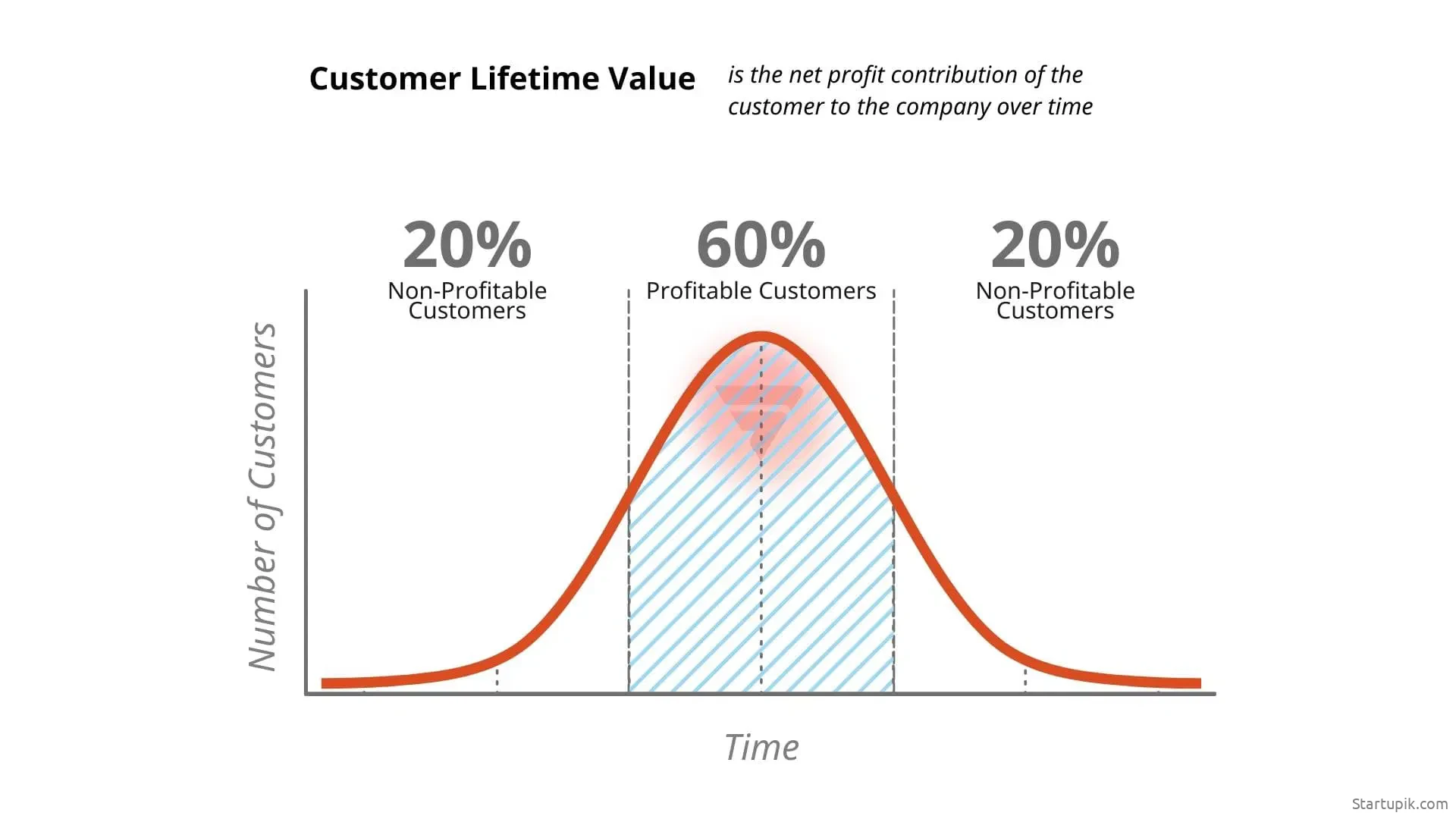
Customer Lifetime Value (LTV) Explained: How Much a Customer Is Worth
Introduction
For startups and SaaS companies, growth is not just about signing up new users. It is about understanding how much value each customer will generate over time. That is where Customer Lifetime Value (LTV) becomes a critical startup metric.
LTV tells you how much revenue (and profit) an average customer brings in over the entire period they use your product. It underpins decisions about how much you can afford to spend on customer acquisition, which segments to target, what pricing model to use, and how aggressively you can invest in growth.
Investors care deeply about LTV because it shows whether your business model is scalable and capital efficient. Founders and operators use it to calibrate marketing, sales, and product strategies. If you do not understand your LTV, you are effectively flying blind.
Definition
Customer Lifetime Value (LTV) is the total net revenue (or profit) you expect to earn from a typical customer over the entire duration of your relationship with them.
In simple terms:
LTV answers the question: “On average, how much money will one customer generate for my business before they churn?”
For SaaS and subscription businesses, LTV is usually calculated using recurring revenue and churn. For transactional businesses (e.g., ecommerce), it is based on order frequency, average order value, and retention.
Customer Lifetime Value (LTV) Formula
There are many ways to compute LTV. For early-stage SaaS startups, a practical and widely used formula is:
LTV = ARPA × Gross Margin % ÷ Churn Rate
Formula Components
| Component | Meaning | How to Measure |
|---|---|---|
| ARPA | Average Revenue per Account (per period, usually per month) | Total recurring revenue in period ÷ number of active customers |
| Gross Margin % | Percentage of revenue left after direct costs of serving customers | (Revenue − Cost of Goods Sold) ÷ Revenue |
| Churn Rate | Rate at which customers cancel or stop paying | Customers lost in period ÷ customers at start of period |
Important: Be consistent with the time period you use. If ARPA is monthly, churn rate must also be monthly. If ARPA is annual, use annual churn.
This formula effectively estimates:
- How much profit you earn per customer per period (ARPA × Gross Margin %)
- How long they stay (1 ÷ Churn Rate, in periods)
Their product is your estimated lifetime value.
Example LTV Calculation for a SaaS Startup
Imagine an early-stage B2B SaaS startup that sells a project management tool on a subscription basis.
Inputs
| Metric | Value | Notes |
|---|---|---|
| Average Monthly Revenue per Account (ARPA) | $80 | Blended across all paying accounts |
| Gross Margin | 80% | After hosting, support, and other direct costs |
| Monthly Customer Churn Rate | 3% | 3 out of 100 customers cancel each month |
Step-by-Step Calculation
- Profit per customer per month = ARPA × Gross Margin = $80 × 80% = $64
- Expected customer lifetime (in months) = 1 ÷ Churn Rate = 1 ÷ 0.03 ≈ 33.3 months
- LTV = $64 × 33.3 ≈ $2,131
In this scenario, the average customer is worth about $2,100 in gross profit over their lifetime.
If this startup’s average Customer Acquisition Cost (CAC) is $500, then:
- LTV:CAC ratio = 2,131 ÷ 500 ≈ 4.3 : 1
That is a strong signal that the company can profitably invest more in customer acquisition, as long as cash flow and payback periods are under control.
Customer Lifetime Value Benchmarks
Absolute LTV values vary heavily by industry, price point, and customer segment, so investors focus more on ratios and relationships than raw numbers.
LTV to CAC Ratio Benchmarks
| LTV:CAC Ratio | Interpretation |
|---|---|
| < 1 : 1 | Unsustainable; you lose money acquiring customers |
| 1–2 : 1 | Weak; business is fragile and highly sensitive to small changes |
| ~3 : 1 | Healthy target for many SaaS companies |
| 4–5 : 1 | Very strong; often indicates room to spend more on growth |
| > 5 : 1 | Potential under-investment in acquisition (leaving growth on the table) |
Other Investor Considerations
- Payback period: How many months to recover CAC from gross profit. < 12 months is often considered good in SaaS; < 18 months is usually acceptable for enterprise.
- Churn thresholds: Monthly logo churn under 3% is a common target for SMB SaaS; for mid-market and enterprise, annual churn under 10% is typical.
- Segment-specific LTV: Higher LTV for specific verticals or company sizes can justify focused go-to-market strategies.
How to Improve Customer Lifetime Value (LTV)
Improving LTV comes down to three levers: increase revenue per customer, extend customer lifetime, and improve gross margin.
1. Increase Revenue per Customer
- Refine pricing: Move from flat pricing to tiered plans that reflect value and usage.
- Upsell and cross-sell: Add premium features, add-ons, or adjacent products.
- Monetize power users: Usage-based or seat-based pricing can capture more value from heavy users.
2. Extend Customer Lifetime (Reduce Churn)
- Improve onboarding: Help new users reach “time to value” quickly with guided setups and in-app walkthroughs.
- Invest in Customer Success: Proactive check-ins, QBRs, and health scoring help prevent silent churn.
- Increase product stickiness: Embed your product into customer workflows and systems to raise switching costs.
- Gather feedback aggressively: Use NPS, churn interviews, and user research to fix the reasons customers leave.
3. Improve Gross Margin
- Optimize infrastructure costs: Tune cloud usage, storage, and third-party tools.
- Scale support efficiently: Use self-service documentation, in-app help, and automation.
- Rationalize vendor spend: Consolidate tools and renegotiate contracts as you scale.
4. Target Higher-LTV Segments
- Analyze LTV by cohort: industry, company size, geography, acquisition channel.
- Shift marketing and sales focus toward segments with higher retention and expansion potential.
- Adjust product roadmap to better serve your highest-LTV customers.
Common Mistakes When Calculating LTV
Founders often misinterpret LTV, which can lead to over-spending or under-investing. Common pitfalls include:
- Using revenue instead of gross profit: Ignoring Cost of Goods Sold inflates LTV. Always apply a realistic gross margin.
- Mixing time periods: Combining monthly ARPA with annual churn (or vice versa) produces meaningless results.
- Relying on tiny datasets: Early-stage companies with few customers and short history will have highly unstable churn and LTV estimates. Treat early numbers as directional, not precise.
- Ignoring expansion revenue: If existing customers often upgrade or add seats, a simple LTV model may underestimate real value. Consider using net revenue retention (NRR) and cohort analysis.
- Assuming lifetime is infinite: Using very low churn (e.g., 0.5%) can mathematically produce unrealistic lifetimes. Cap assumed lifetime (e.g., at 5–7 years) or cross-check with cohort retention curves.
- Not segmenting: Aggregating all customers into a single LTV hides huge differences between segments and channels. LTV by segment is more actionable than a single global number.
Related Metrics
Customer Lifetime Value does not live in isolation. To get a full picture of your SaaS unit economics, track these related metrics:
- Customer Acquisition Cost (CAC): The average cost to acquire one paying customer.
- LTV:CAC Ratio: Compares customer value to acquisition cost, showing whether growth is efficient.
- Churn Rate (Logo and Revenue): Measures customer and revenue loss over time.
- ARPU/ARPA (Average Revenue per User/Account): Indicates how much revenue you generate per customer.
- Customer Payback Period: Time required to recover CAC from gross profit.
Key Takeaways
- Customer Lifetime Value (LTV) quantifies how much an average customer is worth over the full relationship.
- For SaaS, a practical formula is: LTV = ARPA × Gross Margin % ÷ Churn Rate, using consistent time periods.
- Investors look for a healthy LTV:CAC ratio (around 3:1 or better) and reasonable payback periods.
- You can raise LTV by increasing revenue per customer, reducing churn, improving gross margin, and targeting higher-LTV segments.
- Avoid common errors such as ignoring gross margin, mixing time units, and over-trusting early, noisy data.
- Track LTV alongside CAC, churn, ARPU, and payback period to build a robust understanding of your startup’s unit economics.




