ARR (Annual Recurring Revenue) Explained: Formula, Examples, and Why It Matters
Introduction
For SaaS and subscription startups, few metrics are as central as ARR (Annual Recurring Revenue). It is the clearest snapshot of how much predictable, renewable revenue your business can expect to generate each year from existing contracts and subscriptions.
Investors use ARR to benchmark traction, value your company, and compare you to other startups. Founders and operators use it to plan hiring, runway, and growth investments. Understanding exactly how to calculate ARR—and how to grow it in a healthy way—is essential if you are building a recurring revenue business.
Definition
Annual Recurring Revenue (ARR) is the value of your subscription-based, predictable revenue normalized to a one-year period.
In simpler terms:
ARR is the total value of all active recurring contracts and subscriptions, expressed as revenue per year.
Key points about ARR:
- It includes only recurring revenue (subscriptions, maintenance, recurring service fees).
- It excludes one-time payments, setup fees, hardware sales, and any non-recurring revenue.
- It is typically used for B2B SaaS and subscription businesses with at least yearly or monthly contracts.
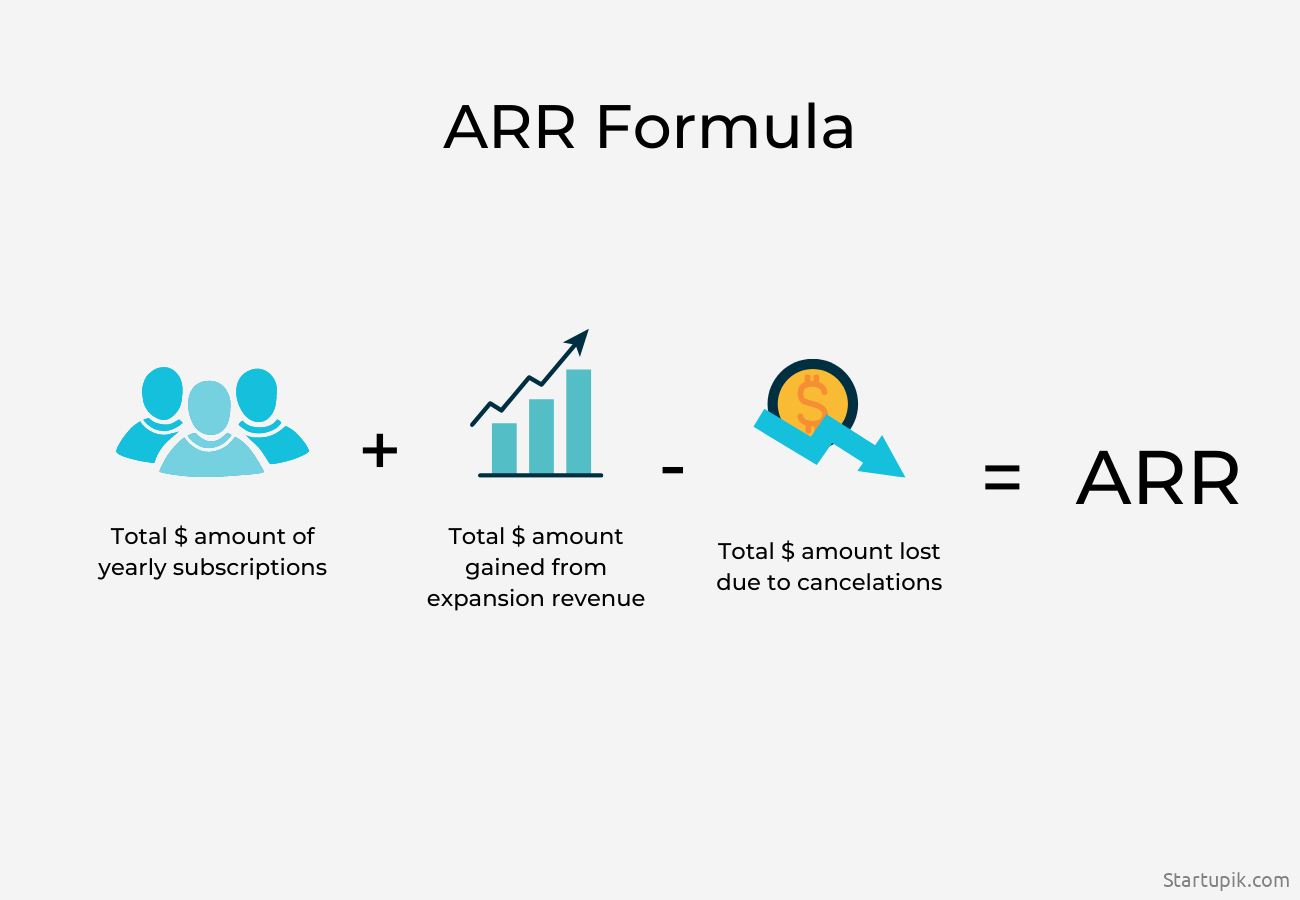
ARR Formula
Basic ARR Formula
If your startup charges customers on a monthly subscription basis, the most common way to calculate ARR is:
ARR = MRR × 12
Where:
- MRR (Monthly Recurring Revenue) is your total recurring revenue per month from all active subscriptions.
Example of components:
- New MRR: from new customers added this month.
- Expansion MRR: upgrades, add-ons, or increased seats from existing customers.
- Churned MRR: revenue lost from cancellations.
- Contraction MRR: downgrades or fewer seats from existing customers.
After calculating your net MRR for the month, multiply by 12 to annualize it into ARR.
Customer-Level ARR Formula
Another way to express ARR is by summing annual contract values across all customers:
ARR = Σ (Annualized Recurring Revenue per Customer)
For each customer:
- Customer ARR = Monthly Subscription Price × 12 (for monthly contracts)
- Customer ARR = Annual Contract Value (for yearly contracts)
ARR vs. MRR
ARR and MRR track the same underlying thing (recurring revenue) but on different time scales:
- MRR is better for short-term trends, product experiments, and early-stage startups.
- ARR is better for strategic planning, hiring, fundraising, and valuation discussions.
Example Calculation
Imagine a SaaS startup with the following subscription structure in a given month:
- 80 customers on a $100/month plan
- 20 customers on a $300/month plan
- 5 customers cancel this month:
- 4 from the $100 plan
- 1 from the $300 plan
Step 1: Calculate MRR Before Churn
Before churn, suppose you had:
- 84 customers on $100/month
- 21 customers on $300/month
Monthly Recurring Revenue (before churn):
- 84 × $100 = $8,400
- 21 × $300 = $6,300
Total MRR (before churn) = $8,400 + $6,300 = $14,700
Step 2: Apply Churn
- 4 customers churn from $100/month → 4 × $100 = $400 MRR lost
- 1 customer churns from $300/month → 1 × $300 = $300 MRR lost
Churned MRR = $400 + $300 = $700
Net MRR = $14,700 − $700 = $14,000
Step 3: Convert to ARR
ARR = MRR × 12 = $14,000 × 12 = $168,000
This means your startup currently generates $168,000 in Annual Recurring Revenue from active subscriptions.
ARR Benchmarks for Startups
ARR levels and growth rates send strong signals to investors. While every market is different, the following table gives rough benchmarks used in SaaS fundraising discussions:
| Stage | Typical ARR Range | Indicative Traits |
|---|---|---|
| Pre-Seed / Early | $0 – $250K ARR | Finding product–market fit, early pilots, small paying base. |
| Seed | $250K – $1M ARR | Early traction, repeatable sales motions starting to emerge. |
| Series A | $1M – $3M+ ARR | Clear product–market fit, scalable acquisition channels. |
| Series B | $5M – $15M+ ARR | Multiple channels working, growing sales team, expansion revenue. |
| Growth / Later Stage | $20M+ ARR | More focus on efficiency, international expansion, product breadth. |
Growth rate matters as much as absolute ARR:
- Early-stage (sub-$1M ARR): 100%+ year-over-year growth is often expected for venture-backed startups.
- $1M–$10M ARR: 70–100%+ YoY is considered strong, depending on market.
- $10M–$20M ARR: 40–70% YoY can still be attractive, particularly with good unit economics.
How to Improve This Metric
Improving ARR is not only about adding more customers. Sustainable ARR growth comes from a combination of acquisition, retention, and expansion.
1. Acquire the Right Customers
- Refine your ideal customer profile (ICP) so you focus on segments with higher willingness to pay and lower churn.
- Double down on proven acquisition channels (e.g., outbound sales, partnerships, content marketing) instead of spreading budget too thin.
- Align pricing and packaging with your ICP’s value drivers to close deals faster.
2. Increase Average Contract Value (ACV)
- Introduce tiered pricing with clear value steps that encourage customers to choose higher plans.
- Offer add-ons (features, seats, integrations, support tiers) to grow revenue per account.
- Encourage annual or multi-year contracts with discounts or bonuses to secure longer-term ARR.
3. Reduce Churn and Improve Retention
- Invest in onboarding to help new customers realize value quickly and avoid early churn.
- Monitor product usage and proactively reach out to accounts with declining engagement.
- Use success plans and regular business reviews for high-value accounts.
4. Drive Expansion Revenue
- Implement usage-based pricing or per-seat models where revenue grows with customer success.
- Run targeted upsell and cross-sell campaigns to move customers to higher tiers.
- Align Customer Success and Sales incentives around Net Revenue Retention (NRR) to prioritize expansion.
Common Mistakes with ARR
Founders often misinterpret ARR, which can mislead both internal planning and external investors.
- Including non-recurring revenue.
- Setup fees, one-time consulting projects, or hardware sales should not be included in ARR.
- Counting contracts shorter than one month as ARR.
- True ARR assumes ongoing recurring revenue. Transactional or usage-only revenue without contracts should be treated carefully.
- Using bookings instead of live subscriptions.
- Signed deals that have not yet started (or are contingent) should not be fully counted in current ARR.
- Ignoring churn and downgrades.
- Founders sometimes quote “ARR” based only on new sales and don’t subtract churn or contraction. ARR must reflect net recurring revenue.
- Double counting expansion.
- Ensure upgrades and add-ons are counted once—either in the new plan value or as separate expansion MRR, not both.
- Not updating ARR regularly.
- In fast-growing SaaS startups, ARR can change significantly month over month. Stale ARR numbers distort decisions.
Related Metrics
To fully understand the health of your recurring revenue, track ARR alongside these related SaaS metrics:
- MRR (Monthly Recurring Revenue): Recurring revenue per month; more granular than ARR for trend analysis.
- Logo Churn Rate: Percentage of customers who cancel in a given period.
- Revenue Churn (or Net Dollar Retention / NRR): Measures how your recurring revenue from existing customers grows or shrinks over time.
- LTV (Customer Lifetime Value): The total revenue you expect from a customer over their lifetime.
- CAC (Customer Acquisition Cost): The fully loaded cost to acquire a new customer; critical for understanding payback on ARR growth.
Key Takeaways
- ARR (Annual Recurring Revenue) tracks the predictable, subscription-based revenue your SaaS startup earns on a yearly basis.
- Use ARR = MRR × 12 or sum annualized recurring revenue per customer, excluding one-time and non-recurring fees.
- Investors look at both ARR level and growth rate to judge traction, especially around key fundraising stages.
- Healthy ARR growth comes from a combination of acquiring the right customers, increasing ACV, reducing churn, and driving expansion.
- Avoid common mistakes such as including non-recurring revenue, ignoring churn, or relying on bookings instead of live subscriptions.
- Track ARR together with related metrics like MRR, churn, NRR, LTV, and CAC to get a complete picture of your startup’s financial health.