





















Introduction
Smart contracts are one of the foundational building blocks of the crypto economy. They power decentralized finance, NFT marketplaces, token launches, onchain games, DAO governance systems, and a growing share of blockchain-based infrastructure. For founders, developers, and investors, understanding smart contracts is no longer optional if they want to evaluate how Web3 products are built, where risks emerge, and what can realistically be automated onchain.
People search for smart contracts because the term is used everywhere in crypto, often without enough explanation. In practice, a smart contract is not a legal contract in the traditional sense. It is software deployed on a blockchain that executes predefined logic when specific conditions are met. That simple idea has major consequences: assets can move without a central intermediary, protocols can run continuously, and business rules can become transparent and verifiable at the infrastructure level.
For beginners, the challenge is separating the hype from the actual mechanism. Smart contracts are powerful, but they are also constrained by security, cost, user experience, legal ambiguity, and the limits of blockchain architecture. The real value lies in understanding where they work well and where they do not.
Background
The concept of smart contracts predates modern blockchains. The term was originally popularized by computer scientist Nick Szabo in the 1990s as a way to describe digital agreements enforced through code. However, the practical breakthrough came when blockchains evolved from simple value-transfer systems into programmable platforms.
Bitcoin introduced decentralized digital money, but its scripting environment was intentionally limited. Ethereum expanded the model by enabling general-purpose programmable contracts that developers could deploy on a shared blockchain. That shift created a new category of internet application: software that runs on decentralized infrastructure rather than on a company-controlled server.
Today, smart contracts exist across multiple ecosystems, including Ethereum, Solana, BNB Chain, Avalanche, Base, Arbitrum, Optimism, Polygon, and others. Different chains offer different trade-offs in performance, fees, tooling, decentralization, and developer experience. But the core idea remains the same: code is deployed to the chain, users interact with it through transactions, and the network validates and records the outcomes.
In startup terms, smart contracts introduced a new operational layer for digital products. Instead of building every workflow inside a private backend, teams can move parts of their business logic into public, auditable, composable infrastructure.
How It Works
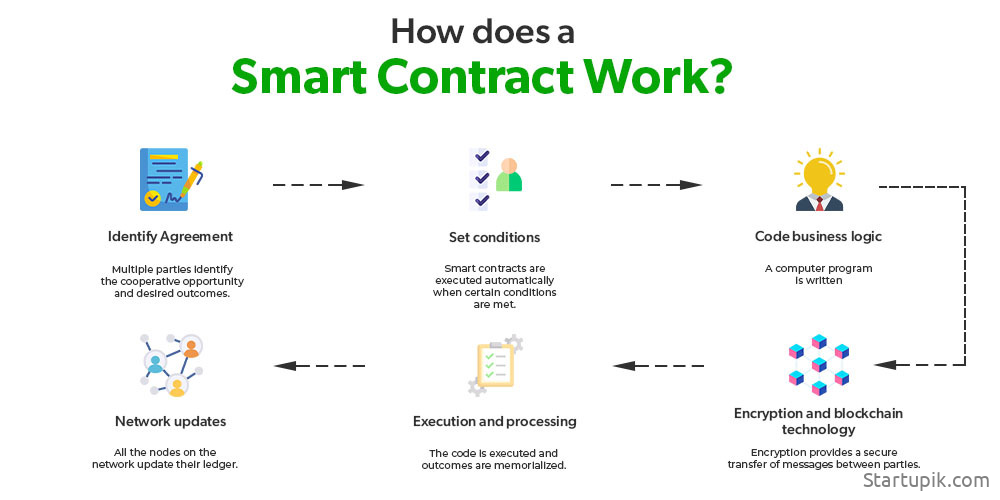
A smart contract is essentially a program stored on a blockchain. Once deployed, it has an address and can hold assets, process inputs, and interact with other contracts. Users do not log into the contract directly; they send transactions through wallets or applications that call its functions.
Core operating model
- Deployment: A developer writes contract code, usually in a language such as Solidity for Ethereum-compatible chains, then deploys it to a blockchain.
- Functions: The contract exposes methods such as transfer, swap, mint, vote, lend, or claim.
- Transactions: Users submit signed transactions through a wallet. The blockchain processes the transaction and updates the contract state.
- Consensus: The network verifies that the transaction follows protocol rules and that the resulting state change is valid.
- Immutability or controlled upgradeability: Many contracts are difficult to change once deployed, though some are built with upgrade mechanisms.
Example in practice
Imagine a decentralized lending protocol. A user deposits USDC into a smart contract. The contract records the deposit, issues interest-bearing tokens, and allows approved borrowers to access liquidity under specific collateral rules. No loan officer manually approves requests. Instead, the protocol follows the conditions encoded into the contract.
However, smart contracts do not automatically know real-world information. If a contract needs offchain data such as asset prices, sports results, or weather data, it must rely on oracles. This creates an important design dependency, because the quality of the contract is often tied to the quality of the external data source.
Why this matters for builders
Smart contracts reduce the need for centralized operators in some workflows, but they increase the importance of protocol design. Bugs, poor incentive structures, insecure upgrade controls, and weak economic assumptions can create major losses. In Web3, product design is often inseparable from security engineering and token mechanics.
Real-World Use Cases
Smart contracts are useful when multiple parties need shared execution logic without depending on a single trusted intermediary. That is why they have become central to several categories of crypto products.
DeFi platforms
DeFi is the most mature smart contract use case. Exchanges like automated market makers use contracts to manage liquidity pools, execute token swaps, and distribute fees. Lending protocols use them to manage collateral, interest rates, liquidation thresholds, and reserve accounting. Derivatives protocols use them for perpetuals, options, and structured products.
Crypto exchanges and settlement layers
Even centralized exchanges increasingly rely on smart contract infrastructure for token issuance, custody integrations, staking products, and proof systems. Onchain settlement is valuable because it is transparent and programmable. Startups building brokerage, wallet, or asset issuance products often integrate directly with contracts rather than building custom ledger systems from scratch.
Web3 applications
NFT platforms, blockchain games, decentralized identity systems, and DAO governance tools use smart contracts to manage ownership, permissions, rewards, and voting rights. In these models, the contract acts as a neutral rules engine that all participants can inspect.
Token economies
Token vesting, staking, rewards distribution, treasury management, and governance execution are common applications. For startups, this is especially important because token operations involve trust-sensitive workflows. Putting them onchain can improve transparency, but only if the contract architecture is well designed and secure.
Market Context
Smart contracts sit at the center of the broader crypto stack. They are not a niche feature; they are the execution layer that connects multiple categories of Web3 products.
- DeFi: The entire category depends on contracts for trading, lending, collateralization, and yield strategies.
- Web3 infrastructure: Rollups, wallet frameworks, account abstraction systems, oracle networks, and cross-chain protocols all interact with smart contracts.
- Blockchain developer tools: Testing frameworks, contract monitoring, simulation platforms, indexing services, and auditing tools exist because smart contract development requires specialized tooling.
- Crypto analytics: Onchain analytics firms analyze smart contract interactions to track user behavior, protocol activity, token flows, and governance decisions.
- Token infrastructure: Issuance standards such as ERC-20, ERC-721, and ERC-1155 are implemented through contracts, making them core to tokenized business models.
For investors, the smart contract layer is where protocol risk and value capture often concentrate. For founders, it is where product defensibility can emerge through composability, liquidity design, and infrastructure integration. But it is also where mistakes are hardest to reverse.
Practical Implementation or Strategy
For startup teams, the key question is not whether smart contracts are interesting. It is whether they are strategically necessary for the product being built.
When to use smart contracts
- When users need verifiable ownership of assets or positions.
- When core logic benefits from transparency and shared execution.
- When the product depends on composability with other onchain protocols.
- When reducing intermediary risk is central to the value proposition.
How founders should approach implementation
- Start with the minimum onchain surface area: Only put logic onchain that truly benefits from decentralization.
- Use battle-tested standards: Reuse audited token, access control, and governance modules instead of inventing everything from scratch.
- Design for failure: Include pause mechanisms, timelocks, multisig controls, and clear admin models where appropriate.
- Audit early: Security review should begin during architecture design, not after deployment.
- Model incentives: In DeFi and token systems, economics can fail even when code works as intended.
- Plan upgrade strategy carefully: Upgradeable contracts add flexibility but also introduce governance and trust assumptions.
Typical startup playbook
A practical path for many teams is to combine an offchain application layer with an onchain execution layer. The user interface, analytics, notifications, and customer support remain offchain, while asset custody, settlement, rewards, and key protocol rules run onchain. This hybrid model is often more scalable and user-friendly than attempting full decentralization from day one.
Advantages and Limitations
Advantages
- Transparency: Contract logic and transaction history can be inspected publicly.
- Automation: Rules execute without manual intervention once conditions are met.
- Composability: Protocols can interact with each other like financial building blocks.
- Reduced intermediary dependence: Users can transact directly with protocol logic.
- Global accessibility: Anyone with a wallet and network access can often participate.
Limitations and risks
- Security vulnerabilities: Exploits in contract code can result in irreversible losses.
- Oracle dependence: If offchain data is wrong or manipulated, contract execution can fail economically.
- Scalability and fees: Onchain operations may become expensive during network congestion.
- Immutability challenges: Bugs are harder to patch than in traditional software.
- Regulatory uncertainty: Some smart contract applications may create legal and compliance exposure.
- User experience friction: Wallet management, gas fees, and transaction signing remain barriers for mainstream adoption.
The most important beginner insight is this: a smart contract is not inherently trustworthy just because it is onchain. Trust depends on code quality, governance structure, security processes, economic design, and the assumptions around dependencies such as bridges and oracles.
Expert Insight from Ali Hajimohamadi
From a startup strategy perspective, smart contracts make the most sense when decentralization is part of the product’s core utility, not just its branding. If a startup needs trust-minimized asset custody, open liquidity integration, tokenized incentives, or programmable ownership, then smart contracts can create real structural advantages. In those cases, they are not just a technical component; they become part of the business model.
Founders should avoid adopting smart contracts simply to appear innovative or to fit into a Web3 narrative. If the product can operate more efficiently with a conventional backend and users do not benefit from onchain transparency or self-custody, then forcing a smart contract architecture often creates unnecessary complexity. Many early-stage teams underestimate audit costs, protocol maintenance, governance design, and the reputational damage that follows a security incident.
For early-stage startups, the strategic advantage of smart contracts is that they allow small teams to launch products on top of existing financial and infrastructure rails. A startup can integrate wallets, stablecoins, decentralized exchanges, and lending primitives without building those systems from zero. That dramatically shortens time to market and opens up new forms of composability-driven growth.
At the same time, one of the biggest misconceptions in crypto is treating smart contracts as a substitute for business discipline. Code does not fix weak unit economics, poor demand, or unclear market positioning. In fact, onchain products are often more exposed because every flaw in incentives or execution becomes visible in real time.
Long term, smart contracts are likely to become a core layer of Web3 infrastructure, especially as account abstraction, modular blockchains, better developer tooling, and more scalable execution environments mature. The winners will not necessarily be the startups that put everything onchain, but the ones that understand exactly which parts of their product benefit from trust-minimized execution and which parts should remain flexible in the application layer.
Key Takeaways
- Smart contracts are blockchain-based programs that execute predefined logic without relying on a centralized operator.
- They are the core execution layer behind DeFi, tokens, DAOs, NFT systems, and many Web3 applications.
- They work best when transparency, composability, self-custody, and verifiable execution are strategically important.
- For startups, the right approach is usually selective onchain design, not putting every feature onchain.
- Security, incentive design, oracle dependencies, and upgrade strategy are critical to successful implementation.
- Smart contracts are powerful, but they are not automatically safe, efficient, or legally simple.
Concept Overview Table
| Category | Primary Use Case | Typical Users | Business Model | Role in the Crypto Ecosystem |
|---|---|---|---|---|
| Smart Contracts | Automating onchain rules, transactions, and asset management | Developers, crypto startups, protocols, investors, DAOs, Web3 users | Protocol fees, token incentives, infrastructure services, transaction-based revenue | Core execution layer for DeFi, token systems, Web3 apps, and blockchain infrastructure |
Useful Links
- Ethereum: Smart Contracts Overview
- Solidity Official Website
- Solidity Documentation
- OpenZeppelin Contracts Documentation
- OpenZeppelin Contracts GitHub
- Hardhat Developer Documentation
- Foundry Book
- Chainlink Smart Contracts Educational Resources




