




















Introduction
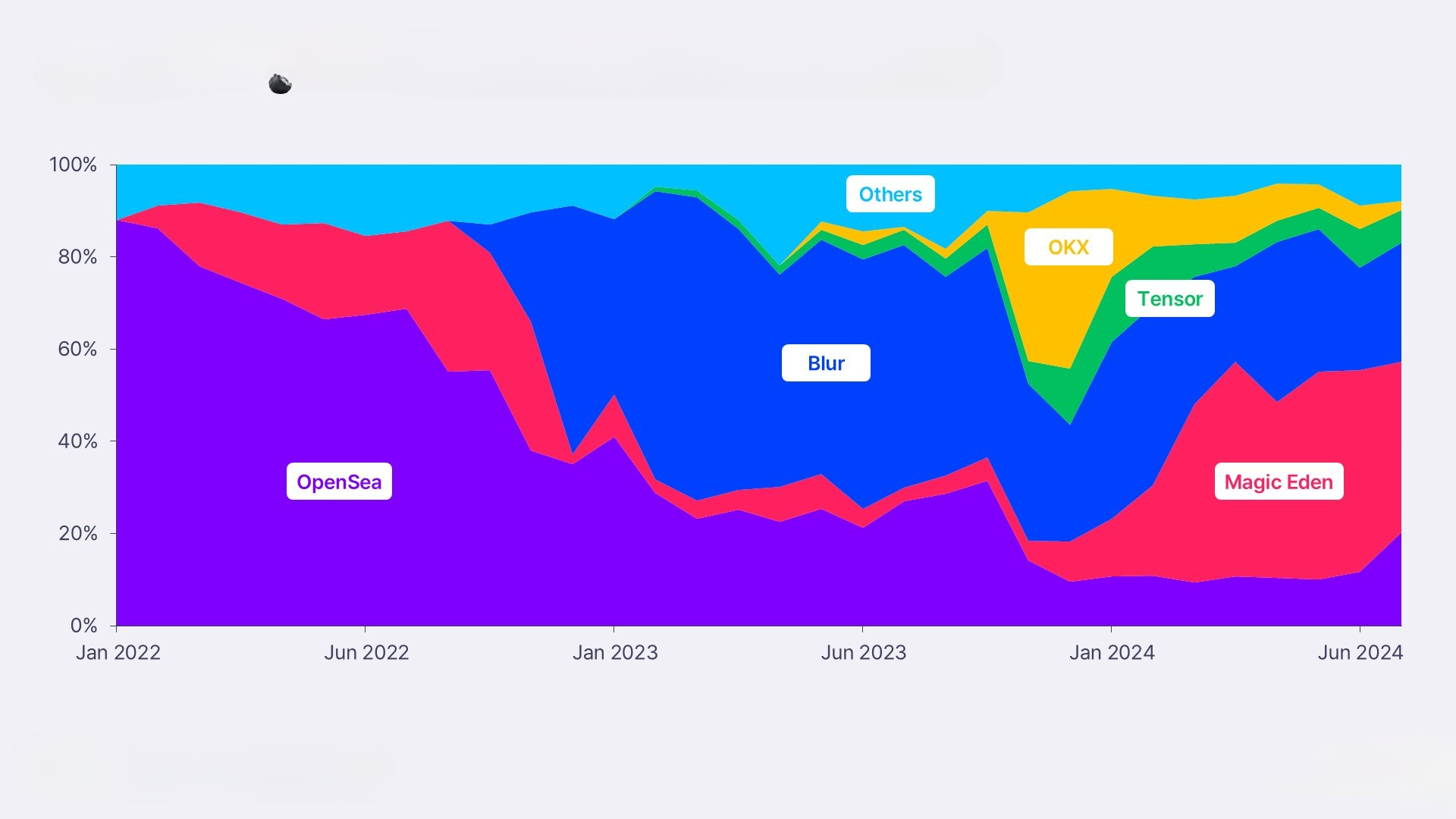
OpenSea, Blur, and Magic Eden are three of the most important NFT marketplaces, but they serve different types of users. This comparison is for collectors, traders, creators, brands, and teams that need to choose the right marketplace based on liquidity, audience, chains, creator tools, and trading style.
This is not a general review. It is a decision guide. If you want to know which NFT marketplace is better for beginners, active traders, multi-chain creators, or growth-focused projects, this article will help you choose faster.
Quick Verdict: Which One Should You Choose?
- Choose OpenSea if you want the easiest starting point, broad brand recognition, and a marketplace that works well for casual collectors and creators.
- Choose Blur if you are a high-volume trader who cares about speed, floor sweeping, portfolio management, and pro trading workflows.
- Choose Magic Eden if you want strong multi-chain support and a marketplace that is especially relevant for Solana and cross-chain NFT activity.
- Best for beginners: OpenSea.
- Best for scaling active trading: Blur.
- Best for multi-chain NFT projects and Solana-focused users: Magic Eden.
Side-by-Side Comparison
| Feature | OpenSea | Blur | Magic Eden |
|---|---|---|---|
| Pricing | Platform fees and creator economics can vary by collection and network; generally simple for mainstream users | Built for competitive trading economics; often attractive for pro traders focused on execution | Fee structure varies by chain and collection; flexible for multi-chain ecosystems |
| Ease of use | Very easy for beginners | More advanced and trader-centric | Moderate; easier than pro trading tools, but more ecosystem-dependent than OpenSea |
| Scalability | Good for broad audience reach and established collections | Strong for high-frequency trading and portfolio-level execution | Strong for multi-chain growth, especially Solana-centered expansion |
| Integrations | Broad wallet and ecosystem familiarity | Strong fit for advanced trading workflows and market-monitoring behavior | Good cross-chain reach with strong relevance in Solana and expanding ecosystems |
| Best use case | Beginners, casual collectors, mainstream NFT launches | Pro traders, flippers, liquidity-driven users | Solana users, multi-chain collectors, projects wanting broader chain optionality |
OpenSea: Overview
OpenSea is the most familiar NFT marketplace for mainstream users. It has long been the default place for discovering, buying, selling, and launching NFTs across major ecosystems.
What it does
It offers a broad NFT marketplace experience with support for discovery, collection pages, creator activity, listings, and basic portfolio actions.
Strengths
- Strong brand recognition
- Easy onboarding for first-time users
- Broad user base and strong marketplace familiarity
- Good default option for creators who want reach without a steep learning curve
Weaknesses
- Less optimized for power traders than Blur
- Can feel slower for users who need aggressive trading workflows
- Not always the first choice for users who prioritize deep trading analytics and execution speed
Best for
- Beginners
- Casual collectors
- Creators launching accessible collections
- Brands that want a recognizable marketplace presence
Blur: Overview
Blur is built for serious NFT traders. It focuses on speed, market visibility, and execution efficiency rather than beginner-friendly discovery.
What it does
It gives traders tools to manage listings, sweep floors, compare markets, and react faster to price movements across collections.
Strengths
- Excellent for active and high-volume trading
- Fast interface and trading-first workflow
- Useful for users who make decisions based on market movement, not just collection aesthetics
- Better fit for portfolio management and execution-heavy behavior
Weaknesses
- Not ideal for complete beginners
- Less focused on discovery and mainstream browsing
- Can feel too specialized for creators who mainly want audience exposure
Best for
- Professional NFT traders
- Flippers and liquidity-focused users
- Users managing multiple positions across collections
- Advanced Ethereum NFT participants
Magic Eden: Overview
Magic Eden became especially well known through Solana NFTs, but its bigger advantage today is its broader multi-chain direction. It is often a strong option for users who do not want to stay tied to one ecosystem.
What it does
It supports NFT trading across multiple chains and serves both collectors and creators who want access beyond a single blockchain community.
Strengths
- Strong position in Solana NFTs
- Useful for multi-chain marketplace strategy
- Good fit for projects that want to reach different crypto audiences
- More ecosystem-flexible than a marketplace with a narrower user focus
Weaknesses
- User experience can depend on the chain and collection type
- May not match Blur for advanced trading speed
- May not match OpenSea for mainstream familiarity in some user segments
Best for
- Solana users
- Multi-chain creators and collectors
- Projects testing audience demand across ecosystems
- Teams that do not want to commit to one chain too early
Key Differences That Matter
- OpenSea vs Blur: OpenSea is better for accessibility. Blur is better for execution. If you browse and collect, OpenSea makes more sense. If you trade actively and need speed, Blur is the better choice.
- OpenSea vs Magic Eden: OpenSea is stronger as a mainstream default. Magic Eden is stronger if chain strategy matters, especially if Solana or cross-chain growth is part of your plan.
- Blur vs Magic Eden: Blur is a trading machine. Magic Eden is a marketplace strategy choice. Pick Blur for trading edge. Pick Magic Eden for ecosystem reach.
- Audience matters more than features: The best marketplace is often the one where your buyers already are.
- Trading style changes the answer: A creator launching a collection and a trader sweeping floors should not pick the same platform by default.
Which Tool is Best for Different Use Cases?
For startups
- Best choice: OpenSea if you want lower onboarding friction and a familiar marketplace for customers.
- Best choice: Magic Eden if your startup is building around Solana or wants to test multiple chains.
For enterprise and brands
- Best choice: OpenSea for brand familiarity and easier communication with mainstream users.
- Consider Magic Eden if your campaign depends on multi-chain communities.
For developers and crypto-native teams
- Best choice: Magic Eden if chain flexibility matters.
- Best choice: Blur if the product is closely tied to active NFT market behavior and trading incentives.
For non-technical users
- Best choice: OpenSea because it is easier to understand and navigate.
For pro traders
- Best choice: Blur because the workflow is built around trading speed and market action.
For Solana-first users
- Best choice: Magic Eden.
Pros and Cons
OpenSea
- Pros: Easy to use, mainstream recognition, broad audience, good for beginners
- Cons: Less optimized for advanced trading, not the strongest choice for execution-heavy users
Blur
- Pros: Fast, trader-focused, strong for volume and market execution
- Cons: Harder for beginners, less ideal for casual discovery, more specialized
Magic Eden
- Pros: Strong Solana position, multi-chain potential, useful for ecosystem diversification
- Cons: Experience can vary by chain, less beginner-friendly than OpenSea, less trading-specialized than Blur
Alternatives to Consider
- Rarible if you want another established NFT marketplace with creator-facing relevance.
- Tensor if you are focused on Solana trading and want a more trader-oriented experience in that ecosystem.
- LooksRare if you want to explore additional Ethereum-native marketplace options.
- Foundation if your focus is curated digital art rather than broad marketplace liquidity.
Common Mistakes When Choosing Between These Tools
- Choosing based only on brand name instead of where your buyers or sellers actually are.
- Using Blur when you are a beginner and do not need pro trading tools.
- Using OpenSea for a strategy that depends on trading speed and deep market execution.
- Ignoring chain strategy when comparing OpenSea and Magic Eden.
- Assuming the best marketplace for collectors is also the best one for creators.
- Not testing marketplace fit with a small launch or limited collection before going all in.
Frequently Asked Questions
Which NFT marketplace is best for beginners?
OpenSea is usually the best choice for beginners because it is easier to navigate and more familiar to mainstream users.
Is Blur better than OpenSea?
Blur is better for active traders. OpenSea is better for beginners, casual collectors, and mainstream accessibility.
Is Magic Eden only for Solana NFTs?
No. It is strongly associated with Solana, but it has expanded into a broader multi-chain marketplace.
Which NFT marketplace has the best liquidity?
It depends on the chain, collection, and user segment. Blur is often strong for trader-driven liquidity, while OpenSea remains important for broad marketplace reach.
What is the best NFT marketplace for creators?
OpenSea is often the easiest starting point. Magic Eden can be better if your creator strategy is multi-chain or Solana-led.
Should I list NFTs on more than one marketplace?
Often yes, if your strategy benefits from broader exposure. But the right answer depends on your chain, audience, and how fragmented your liquidity becomes.
Expert Insight: Ali Hajimohamadi
One mistake I see often is people comparing NFT marketplaces as if they are interchangeable storefronts. They are not. In practice, your choice changes who sees your collection, how fast you can react to market movement, and even what kind of users you attract.
If I were advising a founder, I would not start with feature lists. I would start with three questions: Who is the buyer, what chain strategy matters, and is this a trading product or a collecting product? That usually makes the answer clear very quickly.
OpenSea is the safer default when you need broad accessibility. Blur wins when speed and liquidity behavior drive outcomes. Magic Eden is the smarter choice when chain optionality is part of your strategy. The wrong decision is usually not picking the weaker tool. It is picking a marketplace that does not match your audience behavior.
Final Thoughts
- Choose OpenSea if you want the simplest path for beginners, brands, and broad audience reach.
- Choose Blur if your success depends on active trading, speed, and market execution.
- Choose Magic Eden if Solana or multi-chain growth is central to your plan.
- Do not choose based only on popularity. Choose based on user type and chain strategy.
- Creators and traders should not default to the same marketplace.
- If you are unsure, test demand with a smaller launch before committing fully.
- The best marketplace is the one that matches your audience, workflow, and growth model.




