





















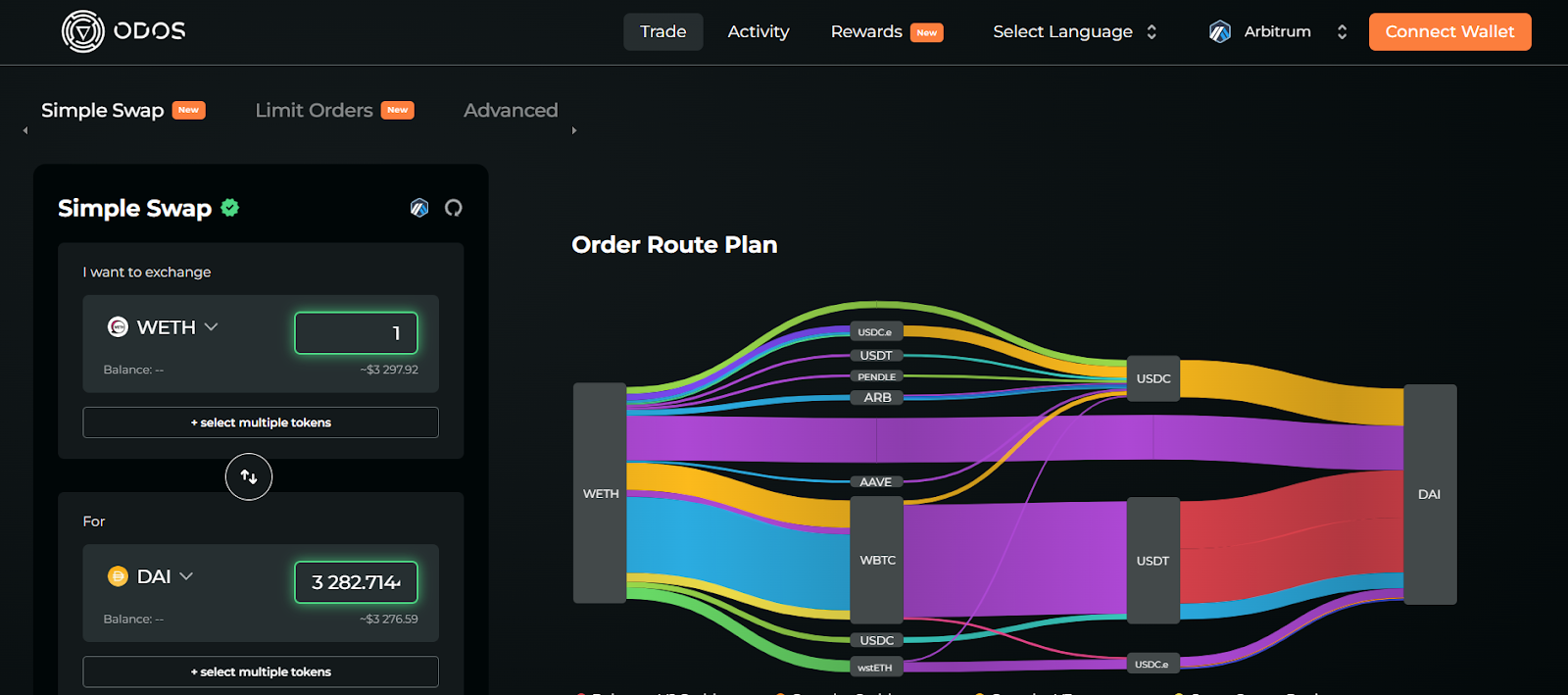
Odos is a smart order routing aggregator built for decentralized token swaps. If you want the best execution across multiple DEXs, chains, and liquidity sources, Odos aims to find a more efficient route than a single-pool trade.
That matters because large swaps, long-tail assets, and cross-venue liquidity often produce worse prices when users trade through only one protocol. Odos solves this by splitting orders across routes and optimizing for output, gas, and execution efficiency.
Quick Answer
- Odos is a decentralized swap aggregator that finds optimized trading routes across multiple liquidity sources.
- It can split one swap into multiple paths to reduce slippage and improve final token output.
- Odos is most useful for larger trades, fragmented liquidity markets, and complex multi-token swaps.
- Better routing does not always mean better net execution if gas costs are high relative to trade size.
- Protocols, wallets, and DeFi apps can integrate Odos to improve swap performance without building routing logic from scratch.
What Is Odos?
Odos is a smart routing aggregation protocol for decentralized exchanges. Its core job is simple: find the most efficient way to swap tokens across available onchain liquidity.
Instead of sending your order to a single DEX like Uniswap, Balancer, or Curve, Odos can break the swap into smaller pieces and execute them across multiple venues. This helps improve price execution when liquidity is fragmented.
In practice, Odos is not just a “price finder.” It is an execution optimizer. It considers route composition, liquidity depth, token pair availability, and transaction cost.
How Odos Works
1. It scans multiple liquidity sources
Odos looks across supported decentralized exchanges and liquidity pools. These may include AMMs, concentrated liquidity venues, and other onchain trading sources depending on the chain.
The goal is to identify where liquidity exists for the token pair or intermediate hops needed to complete the trade.
2. It builds possible routing paths
For a simple swap like USDC to ETH, there may be several possible routes. For example:
- USDC → ETH on one pool
- USDC → WETH across two or three venues
- Split order: 40% on one DEX, 60% on another
Odos evaluates these options and determines which combination produces the best expected result.
3. It optimizes for net output, not just headline price
This is the critical point many users miss. The best route on paper is not always the best route after gas. A multi-hop or split trade can improve price but still reduce net output if execution becomes too expensive.
Odos attempts to optimize the final received amount, taking transaction cost into account.
4. It executes the route onchain
Once the route is selected, the user signs and submits the transaction. The swap is then executed through the smart contracts that coordinate the chosen route.
For the user, this feels like one swap. Under the hood, it may touch multiple liquidity pools and protocols.
Why Odos Matters in DeFi
DeFi liquidity is fragmented by design. Assets trade across many AMMs, chains, and pool configurations. That fragmentation creates inefficiency for users who rely on a single venue.
Odos matters because it helps solve three practical problems:
- Slippage on medium and large swaps
- Poor pricing in long-tail or thin markets
- Execution complexity for apps that need best-route swap infrastructure
For traders, this can mean better fills. For wallets and DeFi products, it means they can offer stronger swap execution without building a routing engine internally.
Where Odos Works Best
Large swaps
If a user swaps a large amount through a single pool, price impact can become severe. Odos works well here because it can spread order flow across multiple pools and reduce slippage.
Fragmented liquidity pairs
Some assets do not have one dominant liquidity venue. Liquidity may be distributed across Uniswap, Curve, Balancer, Camelot, or chain-specific DEXs. Aggregation helps capture that fragmented depth.
Multi-token portfolio actions
Odos has also become known for handling more complex swap patterns, including multi-input and multi-output flows in some implementations. This is useful for treasury rebalancing, vault workflows, and portfolio management tools.
Embedded swap infrastructure
Wallets, trading terminals, and DeFi dashboards can integrate Odos to improve user execution quality. This is often faster than building and maintaining a custom routing stack.
When Odos Works vs When It Fails
When it works well
- Trade size is large enough for routing gains to outweigh gas cost
- Liquidity is spread across several protocols
- Asset pair has meaningful price impact on single-pool execution
- Product teams need broad coverage across DeFi venues
When it can fail or underperform
- Small swaps where extra routing complexity adds unnecessary gas
- Fast-moving markets where quoted execution changes before confirmation
- Low-liquidity tokens with high volatility or poor pool quality
- Chains where liquidity source coverage is limited
A common mistake is assuming aggregation always improves execution. It often does, but not universally. On very small trades, a direct pool swap may produce better net output because the gas profile is simpler.
Key Benefits of Odos
- Better price execution: Splits flow across sources instead of relying on one pool.
- Lower slippage: Especially useful for larger transactions.
- Broader liquidity access: Pulls liquidity from multiple DeFi venues.
- Developer leverage: Lets apps integrate routing without building a full aggregator stack.
- Complex swap support: Useful for advanced treasury and portfolio workflows.
Trade-Offs and Limitations
No routing aggregator is universally better in all conditions. Odos has clear advantages, but there are trade-offs.
| Factor | Advantage | Trade-Off |
|---|---|---|
| Routing complexity | Can improve execution across fragmented liquidity | May increase gas and contract interactions |
| Order splitting | Reduces slippage on larger trades | Not always worth it for small swaps |
| DEX aggregation | Access to more liquidity sources | Dependent on supported integrations per chain |
| Developer integration | Faster go-to-market for wallets and dApps | External dependency for core swap execution |
| Advanced workflows | Supports more sophisticated swap patterns | Can be harder for non-technical users to evaluate |
Who Should Use Odos?
Good fit
- Active DeFi traders executing medium or large swaps
- Wallets that want better in-app swap execution
- Treasury teams rebalancing across assets
- DeFi dashboards embedding swap features
- Protocols needing routing without building an internal solver
Not always the best fit
- Users making very small swaps
- Apps that only support one tightly controlled liquidity venue
- Teams that need full in-house control over routing, pricing, and execution infrastructure
Real-World Startup Scenario
Imagine a wallet startup launching on Arbitrum and Base. The team wants a swap feature, but building a routing engine means integrating dozens of DEX contracts, pricing models, quote systems, and monitoring tools.
Using Odos can cut months off the roadmap. The wallet can focus on onboarding, fiat ramps, and retention while outsourcing route optimization to a battle-tested aggregator.
But there is a trade-off. If swaps become a major revenue line, the startup may later want custom routing logic, selective liquidity inclusion, or differentiated execution. At that point, dependency on an external aggregator can become a strategic constraint.
Expert Insight: Ali Hajimohamadi
Most founders think better routing is a UX feature. In reality, it becomes a margin decision once your product scales. If you own none of the execution layer, you usually cannot control monetization, preferred liquidity relationships, or fallback behavior during volatile markets.
The pattern many teams miss is this: aggregators are perfect for reaching product-market fit, but dangerous to treat as permanent infrastructure without a clear threshold for when to internalize routing. My rule is simple: if swaps affect retention or revenue, measure dependency risk before you measure quote quality.
Odos vs Swapping on a Single DEX
| Category | Odos | Single DEX |
|---|---|---|
| Liquidity access | Multiple sources | One protocol or pool set |
| Slippage handling | Often better on larger trades | Can be worse if pool depth is limited |
| Gas efficiency | Can be higher or lower depending on route | Usually simpler execution |
| Integration speed | Fast for teams needing swap infrastructure | Faster only if app is designed around one venue |
| Execution control | Shared with aggregator logic | Higher direct control |
Security and Operational Considerations
Routing quality is only one part of the picture. Teams also need to evaluate smart contract risk, integration reliability, and transaction failure behavior.
- Review supported chains and venues carefully
- Understand approval patterns and token handling
- Monitor failed swaps, stale quotes, and fallback behavior
- Assess contract audits and protocol reputation
For end users, a better quote is not helpful if transaction reliability is poor. For product teams, execution observability matters as much as pricing quality.
How to Decide If Odos Is Right for Your Product
- Use it if you need fast access to optimized DeFi swaps across multiple venues.
- Use it if your users make trades large enough for routing improvements to matter.
- Avoid over-relying on it if swap execution is your long-term competitive moat.
- Benchmark net output, not quoted output alone.
- Test by chain, token category, and transaction size.
The right decision is rarely ideological. It is operational. Compare route quality, gas costs, integration speed, and strategic dependency.
FAQ
What does Odos do?
Odos is a decentralized swap aggregator that finds optimized trading routes across multiple DEXs and liquidity sources to improve token swap execution.
How is Odos different from a DEX like Uniswap?
Uniswap is a trading venue. Odos is a routing layer that can use Uniswap alongside other venues to find a potentially better route for the same trade.
Does Odos always give the best swap price?
Not always in every scenario. It often improves execution, but small swaps or high-gas routes may reduce net benefit compared to a direct single-pool swap.
Who benefits most from using Odos?
Medium-to-large traders, wallets, DeFi apps, and treasury teams benefit most because fragmented liquidity and slippage matter more in those contexts.
Is Odos useful for small swaps?
Sometimes, but not always. For very small trades, route complexity can add gas cost that offsets price improvement.
Can developers integrate Odos into a wallet or dApp?
Yes. Odos can be used as swap infrastructure for wallets, dashboards, and DeFi applications that want optimized routing without building their own aggregator stack.
Final Summary
Odos is best understood as an execution optimization layer for DeFi swaps. It helps users and applications access fragmented liquidity more efficiently by routing trades across multiple sources instead of relying on one DEX.
Its value is strongest when slippage is meaningful, liquidity is spread out, or the product needs better swap performance fast. Its weakness appears when gas costs outweigh routing gains, or when a team becomes too dependent on third-party execution infrastructure.
For traders, Odos can improve fills. For founders, it is a strategic shortcut with real upside, but also a dependency that should be measured early if swaps are core to the business.




