Minimum Viable Product (MVP) Explained: How Startups Build Products Fast
Introduction
In the startup world, speed and learning are everything. You rarely have the time or money to build a perfect product before launching. That is where the concept of a Minimum Viable Product (MVP) comes in.
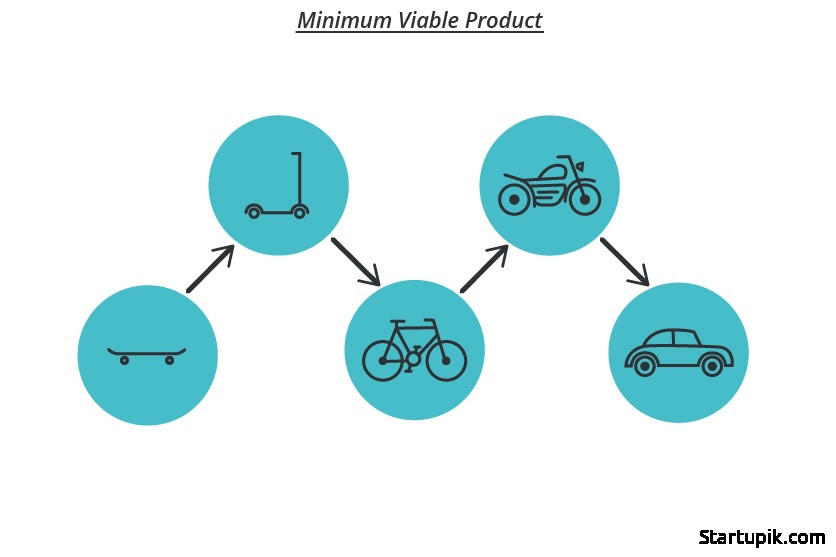
An MVP helps founders test their ideas quickly in the real market, using the smallest possible version of the product that still delivers value. Instead of spending months or years building a full-featured solution, you ship something simple, see how users respond, and then improve based on real feedback.
For startup founders, tech professionals, and entrepreneurs, understanding MVPs is essential. It reduces risk, saves capital, and increases your chances of finding product–market fit. In the Startupik community and across the broader startup ecosystem, the MVP is one of the most used and misunderstood concepts.
Definition
A Minimum Viable Product (MVP) is the simplest version of a product that can be released to early customers to start learning. It:
- Solves a core problem for a specific group of users
- Includes only the essential features needed to test key assumptions
- Is good enough for people to use, but not fully polished or complete
- Is designed to collect feedback and data as quickly as possible
The goal of an MVP is not to launch a half-broken product. The goal is to launch a focused product that lets you learn whether your idea is worth scaling.
How It Works
1. Start with a Clear Hypothesis
Every MVP starts with a hypothesis about your product and customers. For example:
- Problem: “Remote teams struggle to track tasks across different tools.”
- Solution hypothesis: “A simple, shared task board will reduce confusion and save time.”
- Customer: “Early-stage startups with fully remote teams.”
Your MVP exists to test whether this hypothesis is true in the real world.
2. Prioritize a Single Core Value
Instead of building everything, you choose one main job your product must do well. Ask:
- What is the one key problem we are solving?
- What is the minimum feature set required to solve it?
For a task management tool, this might be just:
- Create tasks
- Assign tasks
- Mark tasks as done
You skip complex reporting, integrations, and automation in the MVP.
3. Build the Smallest Testable Product
The MVP can take different forms depending on the idea and resources:
- Concierge MVP: You manually perform the service behind the scenes.
- Wizard of Oz MVP: Users see a working interface, but the back end is manual.
- Landing page MVP: A simple page explaining the product with a sign-up or “buy” button.
- Prototype or demo: Clickable mockups or partial functionality.
- Basic functional product: A stripped-down version of the final product.
The key is to minimize development time while still learning something real about demand and user behavior.
4. Launch to a Small, Targeted Audience
An MVP is not for “everyone.” You launch it to a small group of early adopters who:
- Feel the problem strongly
- Are willing to try new tools
- Are open to giving feedback
This could be a specific Slack community, a targeted email list, a group of Startupik readers, or a niche industry segment.
5. Measure, Learn, and Iterate
Once your MVP is live, you watch how people use it and ask:
- Do users come back after the first try?
- Which features do they actually use?
- Where do they drop off or get confused?
- Would they pay for this? How much?
You then iterate:
- Keep what works
- Remove or simplify what does not
- Add new features only when they are clearly needed
This build–measure–learn cycle continues until you reach product–market fit or decide to pivot.
Real-World Examples
Many well-known tech companies started with very simple MVPs before growing into global products.
| Company | Early MVP Approach | What They Learned |
|---|---|---|
| Dropbox | A simple demo video showing how file sync would work, before the full product existed. | Validated strong interest in cross-device file syncing from early adopters. |
| Airbnb | Founders rented out their own apartment with a basic website and photos. | Proved that strangers were willing to pay to stay in someone’s home. |
| Uber (UberCab) | A simple app in San Francisco that let users request black cars via SMS and later an app. | Confirmed demand for on-demand rides and willingness to pay a premium. |
| Zappos | Founder took photos of shoes in local stores and sold them online, buying from the store only after an order. | Validated that people would buy shoes online before building inventory and logistics. |
| Buffer | A landing page that explained the product and collected emails, plus a fake pricing page to test willingness to pay. | Showed that users wanted social media scheduling enough to pay for it. |
All of these companies avoided building a complex product upfront. Instead, they used MVPs to test demand and refine their ideas before scaling.
Why It Matters for Founders
For founders, the MVP mindset offers several advantages:
- Reduces risk: You test key assumptions before investing heavily in development, marketing, or infrastructure.
- Saves time and money: You avoid building features nobody uses.
- Faster market entry: You get into the hands of real customers quickly, before competitors.
- Better investor story: You can show traction, usage data, and learning instead of just a pitch deck.
- Customer-driven roadmap: Your product evolves based on real user behavior, not internal guesses.
Founders should think of an MVP as the first step in a learning journey, not a one-time launch. The goal is to move from idea to evidence as fast as possible.
Common Mistakes
Despite its popularity, many founders misunderstand the MVP concept. Here are some common mistakes and better approaches.
| Common Mistake | What Founders Do | Better Approach |
|---|---|---|
| Confusing MVP with a low-quality product | Release something buggy, unreliable, and frustrating to use. | Build a small but solid product that does one thing well and works reliably. |
| Adding too many features | Try to impress users and investors with a long feature list. | Focus on the single core use case that solves the main problem. |
| Building in isolation | Spend months coding without showing the product to real users. | Share early versions, prototypes, or demos to get continuous feedback. |
| No clear hypothesis or metrics | Launch something vague and hope users will like it. | Define what you want to learn (e.g., activation rate, retention, willingness to pay) before building. |
| Ignoring negative signals | Explain away poor usage or low retention as “marketing problems.” | Use negative data to consider a pivot or adjust your target market or value proposition. |
Another frequent mistake is assuming an MVP is only for early-stage startups. In reality, even larger companies and later-stage startups can use MVPs to test new features, pricing models, or markets before going all-in.
Related Terms
Understanding MVPs is easier when you know a few related startup concepts:
- Product–Market Fit: The point where your product satisfies strong demand from a clearly defined market.
- Lean Startup: A methodology focused on rapid experimentation, validated learning, and iterative product development.
- Pivot: A structured change in product, target customer, or business model based on what you learn from the market.
- Prototype: A preliminary model or mockup of a product, often used before building a full MVP.
- Early Adopters: The first group of users who are willing to try new products and give feedback, even when they are not perfect.
Key Takeaways
- A Minimum Viable Product (MVP) is the simplest version of your product that delivers real value and allows you to learn.
- The goal of an MVP is to test assumptions quickly, not to ship a broken or low-quality product.
- Real companies like Dropbox, Airbnb, Uber, Zappos, and Buffer all began with very simple MVPs.
- Founders should use MVPs to reduce risk, save time, and build based on real customer feedback.
- Avoid common mistakes such as overbuilding, ignoring data, and confusing “minimum” with “sloppy.”
- Think of the MVP as the beginning of a continual build–measure–learn cycle that leads you towards product–market fit.