





















Introduction
The Layer 2 ecosystem sits on top of base blockchains, mainly Ethereum, to improve scalability, reduce transaction costs, and support more users and applications without fully sacrificing security. It matters because demand for onchain activity keeps rising, while Layer 1 capacity remains limited, expensive, or fragmented.
This ecosystem is not just about faster transactions. It is a full market structure with protocol teams, rollup frameworks, bridges, wallets, developer platforms, applications, liquidity networks, users, and capital providers. Together, these players shape where value, users, and innovation move next in Web3.
This guide is for founders, investors, operators, analysts, and ecosystem builders who want a strategic map of how Layer 2 works, who the key players are, where the competition is, and where startup opportunities still exist.
Ecosystem Overview (Quick Summary)
- Layer 2s scale blockchain usage by moving execution off the base chain while settling or proving state back to it.
- The ecosystem is led by rollups, especially optimistic rollups and zero-knowledge rollups.
- Core value comes from four things: cheaper transactions, faster UX, app scalability, and access to Ethereum liquidity and security.
- Major categories include protocols, infrastructure, developer tools, bridges, wallets, DeFi apps, gaming, and analytics.
- Competition is shifting from pure technology to distribution, liquidity, developer adoption, and ecosystem incentives.
- The biggest startup opportunities are in interoperability, user abstraction, vertical applications, data tooling, and L2-specific infrastructure.
- The long-term winners will likely combine strong technical architecture, sticky applications, and coordinated ecosystem growth.
How the Ecosystem Is Structured
Infrastructure Layer
This is the base of the Layer 2 stack. It includes the protocols and systems that make scaling possible.
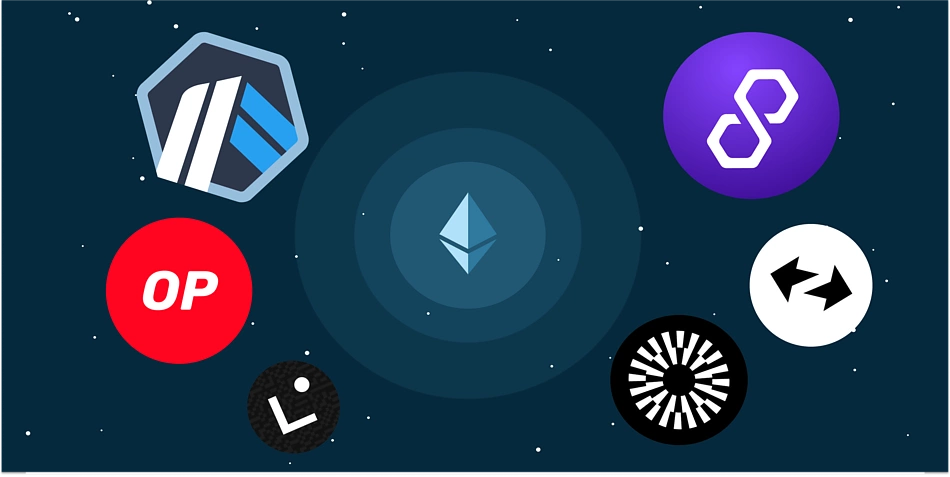
- Rollup protocols: Networks such as Arbitrum, Optimism, Base, zkSync, Starknet, and Scroll execute transactions offchain or in separate environments and publish proofs or data to Ethereum.
- Data availability: Some Layer 2s rely directly on Ethereum calldata or blobs. Others use modular data availability layers to reduce costs.
- Sequencers: These order transactions and produce blocks. Today, many are centralized, which improves speed but creates trust and censorship concerns.
- Provers and fraud-proof systems: ZK rollups use validity proofs. Optimistic rollups use challenge windows and fraud proofs.
- Bridges and messaging layers: These connect Layer 2s with Ethereum and with each other, allowing asset movement and cross-chain application logic.
This layer matters because it defines security assumptions, cost structure, transaction finality, and developer constraints.
Application Layer
This is where end-user demand appears. Applications are what convert technical throughput into real ecosystem activity.
- DeFi: DEXs, lending markets, derivatives, stablecoin rails, and yield products are often early liquidity anchors.
- Consumer apps: Social, payments, creator tools, and onchain identity products benefit from lower costs and better UX.
- Gaming and NFTs: High-frequency actions need lower transaction fees, making Layer 2 a natural home.
- Enterprise and payments: Some Layer 2s are positioning for fintech, B2B settlement, and institutional transaction flows.
The application layer determines whether a Layer 2 becomes an actual economy or stays a technical shell.
Developer Tools
Developer experience is a major competitive factor in the Layer 2 market.
- RPC and node providers: They give teams reliable chain access.
- Indexing and data platforms: They make chain data usable for apps, dashboards, and analytics.
- SDKs and smart contract tooling: These reduce integration time and improve deployment speed.
- Wallet infrastructure and account abstraction: These make onboarding simpler and help apps hide blockchain complexity.
- Security tooling: Audits, simulation tools, monitoring, and formal verification reduce operational risk.
A Layer 2 with weak tooling often struggles to attract serious builders, even if its protocol design is strong.
Users / Demand Side
No ecosystem grows from infrastructure alone. Demand comes from multiple user groups.
- Retail users want lower fees, faster confirmations, and familiar apps.
- Traders and liquidity providers care about execution quality, bridge speed, and TVL depth.
- Developers look for distribution, grants, technical support, and ecosystem fit.
- Enterprises and institutions care about compliance options, settlement reliability, and predictable costs.
The strongest Layer 2s build loops where developers attract users, users attract liquidity, and liquidity attracts more developers.
Capital / Funding Layer
Capital is a hidden but critical part of the ecosystem structure.
- Foundation grants help early builders launch.
- Venture funding backs infrastructure, middleware, and apps.
- Token incentives bootstrap users, liquidity, and protocol activity.
- Market makers and liquidity providers support exchange depth and DeFi growth.
- Ecosystem funds help specific chains attract strategic projects.
Capital often decides which ecosystems gain momentum early, but long-term strength still depends on product-market fit and retention.
Key Players in the Ecosystem
1. Core Protocols
| Name | What They Do | Why They Matter |
|---|---|---|
| Arbitrum | Optimistic rollup ecosystem with broad DeFi adoption and a strong developer base. | One of the most liquid and active Layer 2 networks. Important for DeFi, infra, and ecosystem governance models. |
| Optimism | Optimistic rollup and broader ecosystem framework through the OP Stack. | Influential because it is not only a chain but also a scaling framework powering multiple rollup deployments. |
| Base | Layer 2 built on OP Stack with strong distribution through Coinbase. | Shows how distribution can become a major growth advantage in Layer 2 competition. |
| zkSync | ZK rollup focused on scalable payments, DeFi, and account abstraction. | Important in the race toward zero-knowledge infrastructure and better user experience. |
| Starknet | ZK-rollup ecosystem with its own technical stack and Cairo programming model. | Matters for performance, proof innovation, and long-term ZK-native scalability. |
| Scroll | ZK-rollup focused on EVM compatibility. | Important for developers who want Ethereum-like tooling with ZK-based scaling. |
| Polygon zkEVM / AggLayer | ZK scaling efforts plus broader interoperability vision. | Relevant because Polygon is positioning around chain aggregation, enterprise reach, and app distribution. |
2. Tools and Infrastructure
| Name | What They Do | Why They Matter |
|---|---|---|
| OP Stack | Modular framework for launching Layer 2 chains. | Helps standardize rollup deployment and creates ecosystem alignment across OP-based networks. |
| Arbitrum Orbit | Framework for launching customizable chains on Arbitrum infrastructure. | Extends Arbitrum from one chain to a broader rollup ecosystem. |
| Polygon CDK | Toolkit for launching ZK-powered chains. | Important for teams building application-specific or enterprise-oriented scaling environments. |
| Alchemy | Developer infrastructure, node access, APIs, and scaling support. | Reduces complexity for developers building across Layer 2 ecosystems. |
| Infura | RPC and blockchain infrastructure services. | Provides critical connectivity for wallets, apps, and backend services. |
| The Graph | Indexing protocol for onchain data. | Essential for data access, dashboards, search, and app experiences. |
| LayerZero | Cross-chain messaging protocol. | Important for interoperability between Layer 2 networks and broader multichain applications. |
| Wormhole | Cross-chain communication and bridging infrastructure. | Supports asset transfers and chain-to-chain application connectivity. |
3. Applications / Startups
| Name | What They Do | Why They Matter |
|---|---|---|
| Uniswap | Decentralized exchange deployed across multiple Layer 2s. | Acts as a liquidity anchor and often signals serious ecosystem maturity. |
| Aave | Lending and borrowing protocol. | Brings deep DeFi utility and capital efficiency to Layer 2 markets. |
| GMX | Perpetual trading platform with strong traction on Layer 2. | Shows how specialized DeFi apps can shape a chain’s identity and user profile. |
| Velodrome / Aerodrome | DEX and liquidity coordination models tied to Optimism and Base ecosystems. | Important examples of chain-aligned application growth. |
| Friend.tech | Social application that used Layer 2 infrastructure for consumer-scale activity. | Demonstrated how consumer apps can generate bursts of demand beyond DeFi. |
| Immutable | Gaming-focused scaling environment and tooling. | Represents vertical specialization in gaming and digital asset infrastructure. |
4. Supporting Services
| Name | What They Do | Why They Matter |
|---|---|---|
| Safe | Smart contract wallet and treasury management. | Critical for DAOs, teams, and institutions operating across Layer 2s. |
| Chainlink | Oracle and data infrastructure. | Supports pricing, automation, and secure app functionality on Layer 2. |
| Dune | Analytics and onchain data dashboards. | Important for ecosystem visibility, investor research, and community growth. |
| DefiLlama | Tracks TVL, protocols, bridges, and chain activity. | Widely used to compare ecosystem traction and capital flows. |
| Rabby / MetaMask / Coinbase Wallet | User wallets and chain access layers. | Wallet support strongly affects user onboarding and transaction frequency. |
| Block explorers such as Etherscan ecosystem explorers | Chain visibility, contract verification, and transaction tracking. | Foundational for transparency, debugging, and user trust. |
How It All Connects
The Layer 2 ecosystem works as a coordinated stack rather than a single product.
- Core protocols provide the scaling environment and settlement model.
- Infrastructure providers make those environments usable for developers through APIs, indexing, bridging, and tooling.
- Applications attract users, liquidity, and transaction volume.
- Wallets and UX layers turn protocol complexity into usable experiences.
- Analytics, oracles, and security services support trust, visibility, and operational reliability.
- Capital enters through grants, token incentives, venture funding, and market-making support.
The value flow usually looks like this:
- Developers choose a Layer 2 based on tooling, cost, users, grants, and liquidity.
- They build applications that solve a real use case.
- Users bridge assets in and begin transacting.
- Liquidity and activity increase chain relevance.
- More infra and more apps follow.
- The ecosystem gains network effects if retention stays high.
The strongest ecosystems do not just lower fees. They create compounding loops between infrastructure, applications, liquidity, and distribution.
Opportunities for Founders
Layer 2 is no longer an empty frontier. It is becoming crowded at the protocol level. That means the best startup opportunities are often in the gaps between chains, users, and applications.
1. Interoperability and Chain Abstraction
- Users do not want to manually bridge, switch networks, or manage fragmented balances.
- Founders can build chain abstraction layers, cross-rollup routing, unified wallets, and intent-based execution systems.
- This is one of the highest-value categories because fragmentation is rising faster than usability is improving.
2. Account Abstraction and Invisible Web3 UX
- Mainstream users still face wallet friction, gas friction, and recovery issues.
- Opportunities exist in embedded wallets, gas sponsorship, social recovery, and transaction automation.
- The winning products will make Layer 2 feel like a normal internet app.
3. Vertical-Specific Application Ecosystems
- Generic DeFi is highly competitive.
- Better opportunities exist in verticals such as gaming, creator monetization, prediction markets, payments, RWAs, onchain loyalty, and B2B settlement.
- Founders should design around a clear user workflow, not around chain technology alone.
4. Data, Analytics, and Intelligence Layers
- As more Layer 2s launch, data becomes harder to normalize and compare.
- Teams can build products for multi-rollup analytics, wallet intelligence, liquidity mapping, sequencer monitoring, or app-level attribution.
- This is especially attractive for B2B SaaS models serving protocols, funds, and ecosystem teams.
5. Security and Risk Infrastructure
- Bridges, cross-chain messaging, smart contracts, and rollup components all introduce new attack surfaces.
- There is room for simulation tools, runtime monitoring, bridge-risk scoring, incident response, and insurance-linked products.
- As capital concentration grows, security budgets will likely rise with it.
6. Institutional and Enterprise Rails
- Institutions need stable infrastructure, compliance pathways, and predictable execution.
- Opportunities include permissioned transaction flows, reporting layers, settlement tools, treasury systems, and tokenized asset infrastructure.
- The key is not just compliance. It is reliability and integration with existing enterprise workflows.
7. Appchains and Custom Rollup Services
- Some projects will not want to compete for blockspace on general-purpose chains.
- Service providers can help teams launch custom rollups, manage infrastructure, handle upgrades, and integrate interoperability.
- This market grows as frameworks like OP Stack, Orbit, and CDK mature.
Challenges in This Ecosystem
Technical Barriers
- Fragmented liquidity: Assets and users are spread across many Layer 2s.
- Bridge risk: Cross-chain infrastructure remains one of the biggest attack surfaces in crypto.
- Sequencer centralization: Many Layer 2s still rely on centralized operators.
- Complexity: Finality, proofs, withdrawal periods, and chain-specific behavior confuse users and developers.
- Data availability dependence: Cost and performance can change based on base-layer conditions.
Market Risks
- Incentive-driven growth can create temporary activity without real retention.
- User loyalty is weak when switching costs are low and rewards move elsewhere.
- Revenue capture is still evolving for many Layer 2 business models.
- Token design can distort priorities if short-term farming dominates ecosystem behavior.
Competitive Pressure
- Layer 2s compete not only with each other, but also with high-performance Layer 1s.
- Frameworks are making chain creation easier, which increases supply of new ecosystems.
- Distribution is becoming more important than pure technical differentiation.
- Applications may choose chain-agnostic strategies, reducing the moat of any single Layer 2.
How This Ecosystem Compares
Compared with Layer 1 ecosystems, Layer 2 ecosystems usually benefit from access to Ethereum security, assets, and developer mindshare. That is a major advantage.
However, Layer 2s often face more fragmentation, bridge dependence, and narrative overlap. In contrast, some Layer 1s offer a more unified environment with one canonical user base and one liquidity zone.
The strategic difference is simple:
- Layer 1 ecosystems often compete on base performance and sovereignty.
- Layer 2 ecosystems compete on scaling architecture, Ethereum alignment, interoperability, and distribution.
Future of the Ecosystem
The Layer 2 market is moving into a new phase. Early growth was driven by lower fees and a few leading DeFi deployments. The next phase will be shaped by ecosystem design.
- More rollups will launch, especially app-specific and brand-driven chains.
- Interoperability will become a core battleground, not a side feature.
- User abstraction will improve, reducing visible chain complexity.
- ZK technology will continue advancing, especially as proof systems become cheaper and faster.
- Layer 2 frameworks will mature, shifting competition from infrastructure creation to ecosystem orchestration.
- Distribution channels such as exchanges, wallets, fintech apps, and large consumer platforms will matter more.
- Real applications, not empty chain metrics, will define durable winners.
In the long run, users may not care which Layer 2 they are using. They will care whether the app is fast, cheap, safe, and liquid. That means the ecosystem will increasingly reward teams that hide infrastructure complexity behind strong product experiences.
Frequently Asked Questions
What is a Layer 2 ecosystem?
A Layer 2 ecosystem is the full network of protocols, tools, applications, users, and capital built around a Layer 2 blockchain or rollup environment. It includes far more than the chain itself.
Why are Layer 2 ecosystems important for Ethereum?
They help Ethereum scale by moving execution away from the base chain while still relying on Ethereum for settlement or security. This allows more users and applications to operate at lower cost.
What are the main types of Layer 2 networks?
The main categories are optimistic rollups and ZK rollups. Both aim to scale activity, but they differ in how they prove transaction correctness.
What makes one Layer 2 ecosystem stronger than another?
The strongest ecosystems usually combine five things: strong developer tooling, deep liquidity, useful applications, effective distribution, and a clear growth strategy.
Where are the biggest startup opportunities in Layer 2?
The biggest opportunities are in interoperability, account abstraction, chain abstraction, vertical applications, security tooling, and institutional transaction infrastructure.
What is the biggest risk in the Layer 2 market?
One major risk is fragmentation. Users, liquidity, and developers are spread across many chains, which can weaken network effects and create poor user experience.
Will Layer 2s replace Layer 1s?
Not entirely. Layer 2s and Layer 1s will likely coexist. Layer 2s are especially strong where Ethereum security and liquidity matter, while Layer 1s may remain attractive for sovereign ecosystems and alternative performance models.
Expert Insight: Ali Hajimohamadi
The Layer 2 market is shifting from a technology race to a coordination race. Early winners gained attention through throughput, lower fees, or proof design. The next winners will be the ecosystems that coordinate developers, liquidity, users, and distribution most effectively.
For founders, this changes positioning. Building another generic DeFi app on a crowded Layer 2 is rarely enough. The stronger move is to solve a structural bottleneck that appears as the market fragments. That includes cross-rollup UX, embedded onboarding, liquidity routing, vertical-specific app infrastructure, and data systems that help capital move more intelligently.
There is also a timing advantage now. The market has enough Layer 2 activity to validate demand, but it is still early in terms of user abstraction and ecosystem consolidation. Founders who build products that make multi-rollup complexity disappear can sit one layer above protocol competition and benefit regardless of which individual chain wins share.
In practical terms, the best-positioned startups will do three things well:
- Choose a wedge tied to a real user workflow, not just blockchain ideology.
- Build distribution into the product from day one through ecosystem partnerships, wallets, exchanges, or embedded channels.
- Design for a future where users do not think in chains, but infrastructure still needs to interoperate under the hood.
The opportunity is no longer just to build on Layer 2. It is to build the companies that make the entire Layer 2 landscape usable, investable, and scalable.
Final Thoughts
- Layer 2 is now a full ecosystem category, not just a scaling feature.
- Protocols alone do not win; ecosystems win through applications, liquidity, tooling, and distribution.
- Fragmentation is both the biggest challenge and the biggest startup opportunity.
- Founders should target structural gaps such as interoperability, UX abstraction, and vertical-specific infrastructure.
- Investors should look beyond TVL and evaluate retention, developer activity, and ecosystem coordination.
- The next phase of growth will reward usability more than raw scalability claims.
- Teams that simplify the multi-rollup world are likely to create the most durable value.
Useful Resources & Links
- Arbitrum
- Optimism
- Base
- zkSync
- Starknet
- Scroll
- Polygon
- Alchemy
- Infura
- The Graph
- LayerZero
- Wormhole
- Uniswap
- Aave
- GMX
- Safe
- Chainlink
- Dune
- DefiLlama
- MetaMask
- Coinbase Wallet




