Bootstrapping Explained: How Founders Build Startups Without Investors
Introduction
In the startup world, most conversations about growth focus on raising venture capital, angel rounds, or seed funding. But many successful companies never raised a cent in the early days. Instead, they grew using the founders’ own savings and the cash the business generated. This approach is called bootstrapping.
Bootstrapping is important because it offers a real alternative to the “raise fast, grow fast” model. For many founders, especially outside major funding hubs, bootstrapping is not just a choice—it’s the most realistic path to building a sustainable startup and keeping control.
What Is Bootstrapping? (Definition)
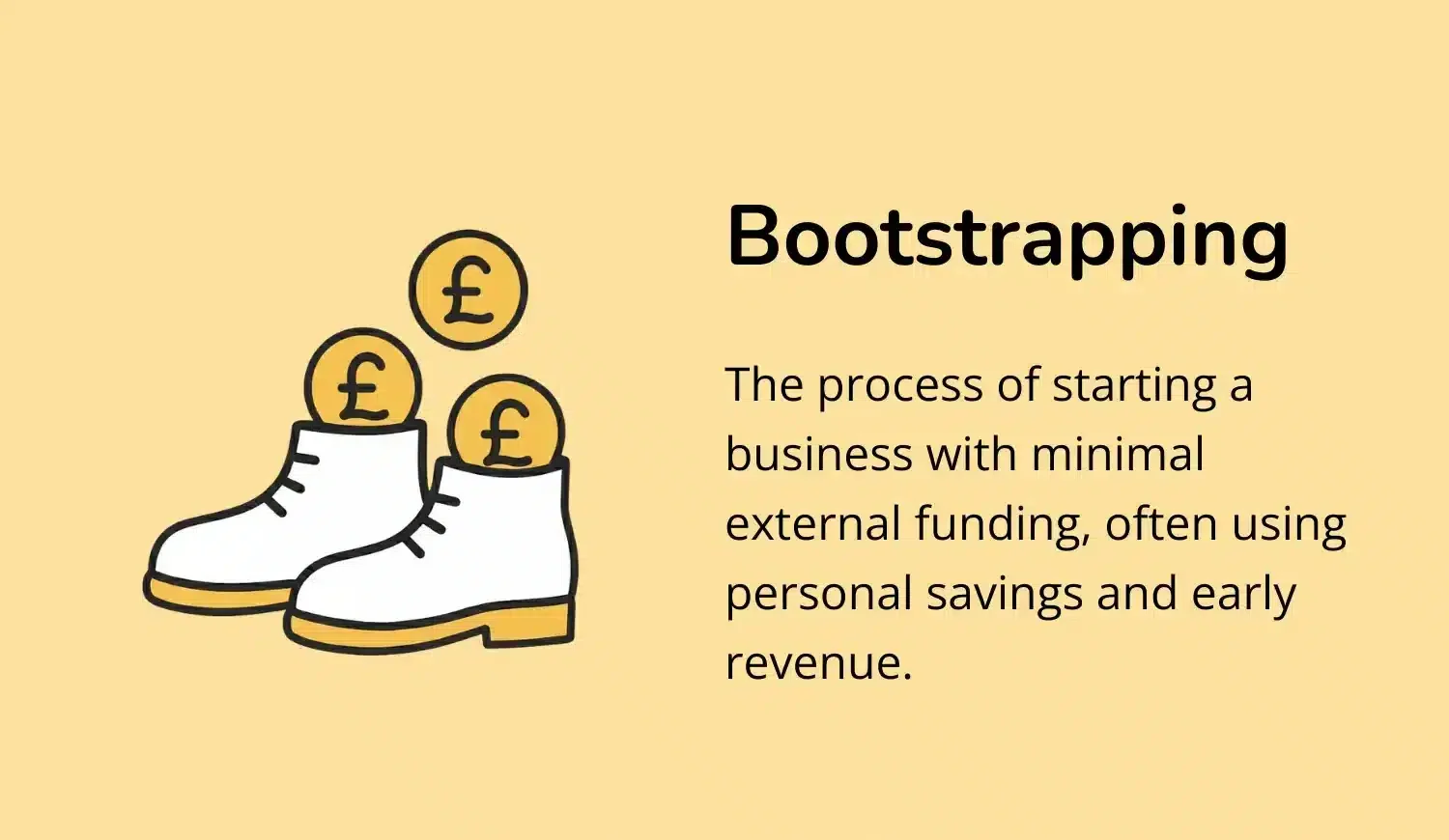
Bootstrapping is when founders build and grow a startup using their own money and the company’s revenue instead of raising external funding from investors like venture capitalists or angels.
In a bootstrapped startup:
- Founders typically invest personal savings or income.
- The business funds growth through customer revenue, not investor cash.
- Founders keep more equity and control over decisions.
- Hiring, marketing, and product development are paced by actual cash flow.
How Bootstrapping Works in Real Startups
Bootstrapping is less about following a rigid formula and more about a mindset: be resourceful, spend carefully, and obsess over customers who will pay. Still, most bootstrapped companies move through similar stages.
1. Funding the First Version
At the beginning, the money usually comes from:
- Personal savings – the founders’ own capital.
- Side jobs or consulting – income that funds early development.
- Friends and family (sometimes) – informal, small-scale support.
The goal is to build an MVP (Minimum Viable Product) quickly and cheaply, then get it in front of real users.
2. Revenue as Your Primary Investor
Once the product is usable, bootstrapped startups focus aggressively on their first paying customers. Revenue then becomes the main fuel for growth:
- Early revenue pays for hosting, basic tools, and initial marketing.
- As monthly recurring revenue (MRR) grows, founders can quit their jobs or reduce consulting time.
- Profits are often reinvested rather than taken out as salary or dividends early on.
3. Lean Operations and Smart Trade-Offs
Bootstrapping forces disciplined decision-making. Founders typically:
- Keep the team very small for as long as possible.
- Use low-cost or free tools for infrastructure, communication, and analytics.
- Focus on profitable customer segments instead of chasing vanity metrics like signups with no clear path to revenue.
- Grow marketing through content, SEO, referrals, and partnerships rather than expensive ads at scale.
4. Optional: Raising Capital Later, On Better Terms
Some bootstrapped startups decide to raise capital later. By that point, they often have:
- Proven revenue and product-market fit.
- Better leverage in negotiations with investors.
- Options: stay independent, or raise selectively for specific growth opportunities.
Bootstrapping vs. Venture-Backed: Key Differences
| Aspect | Bootstrapped Startup | Venture-Backed Startup |
|---|---|---|
| Main Source of Funding | Founders’ savings and revenue | Investors (VCs, angels) |
| Growth Strategy | Profitable, sustainable growth | Hyper-growth, market share first |
| Decision Control | Primarily founders | Shared with investors/board |
| Risk Profile | Lower burn, slower but safer | Higher burn, higher risk/return |
| Exit Pressure | Flexible; no forced timeline | Pressure for large exit or IPO |
Real-World Examples of Bootstrapped Startups
Many well-known tech companies started as bootstrapped ventures before becoming global brands.
- Mailchimp – Bootstrapped for nearly two decades, funded by services work and reinvested profits. It grew into a leading email marketing platform and was acquired by Intuit for $12 billion.
- Basecamp – Project management software company that built a strong, profitable business without relying on traditional VC. Known for its focus on calm, sustainable growth.
- GitHub – Initially bootstrapped using revenue from paid private repositories and consulting before raising outside funding several years later.
- Atlassian – Grew Jira and Confluence largely through product-led growth and revenue before taking institutional funding; famous for minimal sales teams in early years.
- Shutterstock – Founder Jon Oringer started with his own photos and self-funded the marketplace until it became a dominant stock image platform.
These examples show that bootstrapping is not just for “small” businesses; with the right product, market, and discipline, it can lead to large outcomes.
Why Bootstrapping Matters for Founders
For many founders, bootstrapping is not just a fallback—it can be a strategic advantage.
- Control and autonomy: You decide the roadmap, culture, and exit strategy without investor pressure to grow at any cost.
- Higher equity ownership: By not diluting early, founders keep more of the company long-term.
- Customer focus: When your only “investor” is the customer, every feature and decision is tied more directly to value creation.
- Optionality: You can choose to stay independent, raise later, or sell on your own terms.
- Resilience: Bootstrapped companies often have healthier unit economics and are better prepared for downturns because they are used to operating lean.
Founders should think of bootstrapping as one option in their funding strategy, not a lesser path. The key question is: Does your business model require massive upfront capital, or can you reach traction with a lean approach?
Common Mistakes When Bootstrapping
Bootstrapping has its own risks and misconceptions. Avoid these frequent mistakes:
- Underestimating personal financial risk: Draining all personal savings without clear milestones, timelines, or backup plans can be dangerous. Set limits and review them regularly.
- Not charging early enough: Many founders delay monetization in pursuit of user growth. For a bootstrapped startup, revenue is lifeblood. Charge from early stages, even if it’s a low-priced beta.
- Trying to match VC-backed competitors on speed: You likely cannot out-spend them. Instead, differentiate through niche focus, quality, and customer intimacy rather than chasing every feature.
- Refusing all funding on principle: Being bootstrapped doesn’t mean you must stay that way forever. Sometimes a small strategic round can unlock a major growth inflection.
- Burning out the founding team: Long hours plus financial stress and side jobs can lead to burnout. Pace yourself with realistic growth targets and prioritize sustainability.
Related Startup Terms
Understanding bootstrapping is easier if you also know these related concepts:
- Runway: The amount of time your startup can operate before running out of cash, based on current expenses and revenue.
- Burn Rate: How quickly your company is spending cash each month. Critical for both bootstrapped and funded startups.
- MVP (Minimum Viable Product): The simplest version of your product that solves a core problem and can be tested with real users.
- Equity Dilution: The reduction in founders’ ownership percentage when new shares are issued to investors or employees.
- Product-Market Fit: The point where your product solves a real need for a well-defined group of customers who are willing to pay and actively use it.
Key Takeaways
- Bootstrapping means funding your startup through founder capital and revenue instead of external investors.
- It emphasizes profitability, discipline, and customer value rather than growth at any cost.
- Many successful companies like Mailchimp, Basecamp, and GitHub began as bootstrapped startups.
- Bootstrapping gives founders more control, equity, and flexibility over their company’s future.
- Common pitfalls include delaying monetization, ignoring personal financial risk, and trying to compete head-on with heavily funded rivals.
- Founders should evaluate whether their market and business model truly require VC money—or whether a lean, bootstrapped path could be a better fit.