Angel Investors Explained: Who They Are and How They Fund Startups
Introduction
In the early days of a startup, getting money from traditional banks or large venture capital (VC) funds is often impossible. The business is too risky, the product is unproven, and the team has limited track record. This is where angel investors step in.
Angel investors are usually the first serious outside money into a startup. They provide not just cash, but also mentorship, credibility, and access to networks that can dramatically increase a company’s chances of survival. Understanding how angel investors work is essential for any founder planning their fundraising strategy.
What Is an Angel Investor? (Definition)
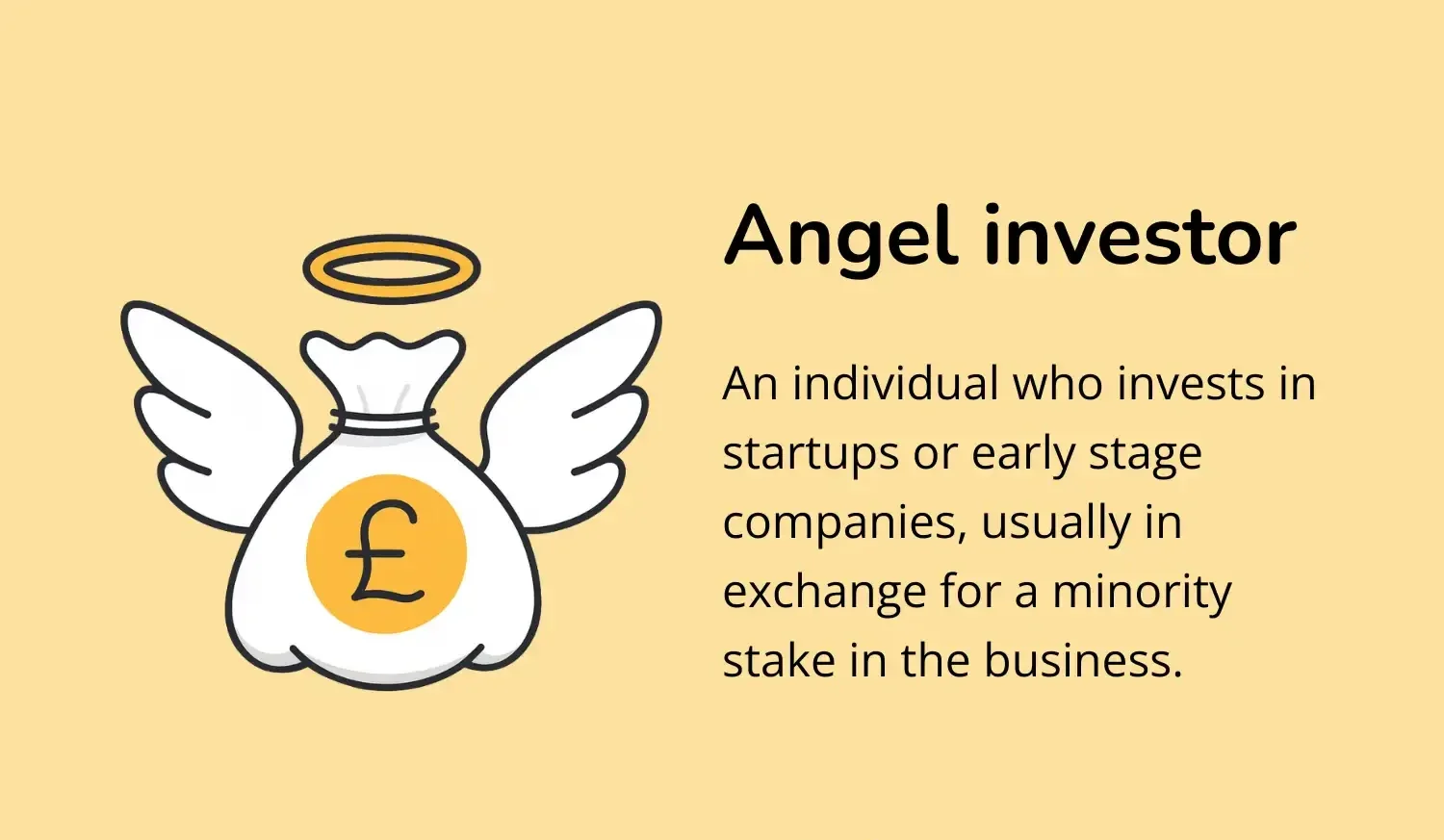
An angel investor is a wealthy individual who invests their own money in early-stage startups, typically in exchange for equity (ownership) in the company or a convertible security (such as a convertible note or SAFE).
Unlike venture capitalists, who invest professionally using other people’s money (from funds), angel investors invest their personal capital, usually at a much earlier and riskier stage of the business.
In simple terms:
- Who: High-net-worth individuals, often former founders or executives
- When: Very early stages (pre-seed, seed)
- What they give: Money, advice, network, credibility
- What they get: Equity or a promise of equity in the future
How Angel Investing Works in Real Startups
Angel investing usually follows a fairly standard pattern, even though every deal is unique. Here is the typical flow:
1. Sourcing and First Contact
- Founders are introduced through referrals, pitch events, accelerators, or cold outreach.
- Angels quickly assess the team, market, and traction (if any).
2. Initial Meetings and Evaluation
- Founders present a pitch deck covering problem, solution, market size, business model, traction, and team.
- Angel investors evaluate:
- How big the opportunity is
- Whether the team can execute
- Early signs of product–market fit
- Competition and differentiation
3. Investment Structure
Angel investments at early stages are commonly done using:
- Equity rounds – Angels buy a percentage of the company at an agreed valuation.
- Convertible notes – A loan that converts into equity in a future priced round, often at a discount.
- SAFEs (Simple Agreement for Future Equity) – A contract giving the right to future equity when a priced round happens, often with a valuation cap and/or discount.
4. Typical Angel Check Sizes
Angel investors can invest alone or as part of a group (an angel syndicate or angel network). Typical amounts:
- Individual angel: from $10,000 up to $250,000
- Angel syndicate or group round: from $100,000 up to $1,000,000 or more
5. Post-Investment Involvement
After investing, angels often:
- Help with strategy and product direction
- Open doors to customers, partners, and future investors
- Provide ongoing mentorship to the founders
Some angels are very hands-on; others are passive and mainly provide capital and occasional advice.
6. Exit and Return
Angel investors make money when the startup has a liquidity event, such as:
- Acquisition by a larger company
- Initial Public Offering (IPO)
- Secondary share sale during later funding rounds
Because many startups fail, angels expect only a few investments to generate very large returns that compensate for losses on others.
Angel Investors vs. Other Funding Sources
Founders often confuse angel investors with other types of early capital. The table below highlights key differences:
| Funding Source | Money From | Stage | Typical Check Size | Key Characteristics |
|---|---|---|---|---|
| Angel Investors | Individuals investing their own money | Pre-seed, Seed | $10k–$250k (per angel) | High risk tolerance, flexible terms, mentorship-focused |
| Venture Capital (VC) | Professional funds investing pooled capital | Seed, Series A and beyond | $500k–$10M+ | More formal process, larger checks, stricter expectations |
| Friends & Family | Personal network | Idea, Pre-seed | $1k–$100k total | Informal, reputation and relationship-based |
| Crowdfunding | Many small investors online | Pre-seed, Seed | Varies widely | Public campaign, marketing-heavy |
Real-World Examples of Angel-Backed Companies
Many globally known startups received crucial early money from angel investors:
- Uber – Received early angel investments from high-net-worth individuals and prominent startup founders who believed in the ride-hailing vision before it was proven.
- Airbnb – Before raising big VC rounds, Airbnb secured early angel capital that helped them refine their product and survive tough periods.
- Facebook – Peter Thiel famously invested $500,000 as an angel in Facebook’s early days, which turned into billions at IPO.
- Google – Andy Bechtolsheim wrote an early $100,000 check to “Google Inc.” before the company even had a proper bank account.
- WhatsApp – Early angel and seed investors supported the company before it was acquired by Facebook for $19 billion.
In each of these cases, angel investors took a significant risk when the startups were still small, unproven, and often pre-revenue. Their capital and networks helped unlock later VC rounds and hypergrowth.
Why Angel Investors Matter for Founders
For founders, angel investors can be the bridge between an idea and a viable, funded company. They matter because they:
- Take early risk when others will not.
- Move faster than most institutional funds with simpler processes.
- Provide expertise based on their own experience building or investing in companies.
- Signal credibility to future investors, talent, and partners.
Founders should think strategically about:
- Investor–founder fit: Does this angel understand your space and stage?
- Value beyond money: Can they help with hiring, customers, or follow-on funding?
- Cap table health: Are you giving away too much equity too early?
- Long-term relationship: You may work with this person for 7–10 years or more.
The right angels can be powerful allies in your startup journey; the wrong ones can create friction and misalignment.
Common Mistakes Founders Make with Angel Investors
Founders often misunderstand or misuse angel investment. Some frequent mistakes include:
- Over-valuing the startup too early
Pushing for an unrealistically high valuation in the angel round can:- Scare away experienced angels
- Make future rounds harder if you cannot justify the valuation jump
- Underestimating dilution
Giving away too much equity to early angels (and friends & family) can leave founders with a small ownership stake by Series A, which may demotivate the team and worry later investors. - Ignoring investor quality
Taking money from anyone who offers it, without checking their reputation or alignment, can lead to:- Unrealistic expectations
- Micromanagement
- Conflicts during tough decisions
- Messy or unclear terms
Not using standard documents (like widely accepted SAFE or note templates) can result in:- Complex cap tables
- Legal disputes
- Red flags for later VC investors
- Poor communication after funding
Founders who fail to send regular updates or ask for help underuse a powerful asset. Good angels want to help, but need information and context.
Related Startup Terms
To understand angel investing in context, it helps to know these related concepts:
- Seed Round: The first significant round of funding, often led by angels or seed funds, used to validate product–market fit.
- Pre-Seed Funding: Very early capital to build an MVP and run first experiments, commonly from angels, accelerators, or friends and family.
- Convertible Note: A debt instrument that converts to equity in a future financing round, typically with a discount and/or valuation cap.
- SAFE (Simple Agreement for Future Equity): A popular, founder-friendly contract used by many startups to raise early-stage angel capital quickly.
- Angel Syndicate: A group of angel investors who pool money into a single investment vehicle to collectively back a startup.
Key Takeaways
- Angel investors are wealthy individuals who invest their own money in early-stage startups in exchange for equity or convertible securities.
- They usually invest at pre-seed or seed stage, when risk is highest and access to traditional funding is limited.
- Beyond capital, angels offer mentorship, network access, and credibility that can unlock later VC rounds.
- Famous startups like Facebook, Google, Uber, Airbnb, and WhatsApp all benefited from early angel investment.
- Founders should optimize not just for valuation, but for alignment, investor quality, and a clean cap table.
- Common mistakes include unrealistic valuations, excessive dilution, poor investor selection, and messy terms.
- Understanding related concepts like seed rounds, SAFEs, convertible notes, and angel syndicates helps founders design smarter fundraising strategies.