

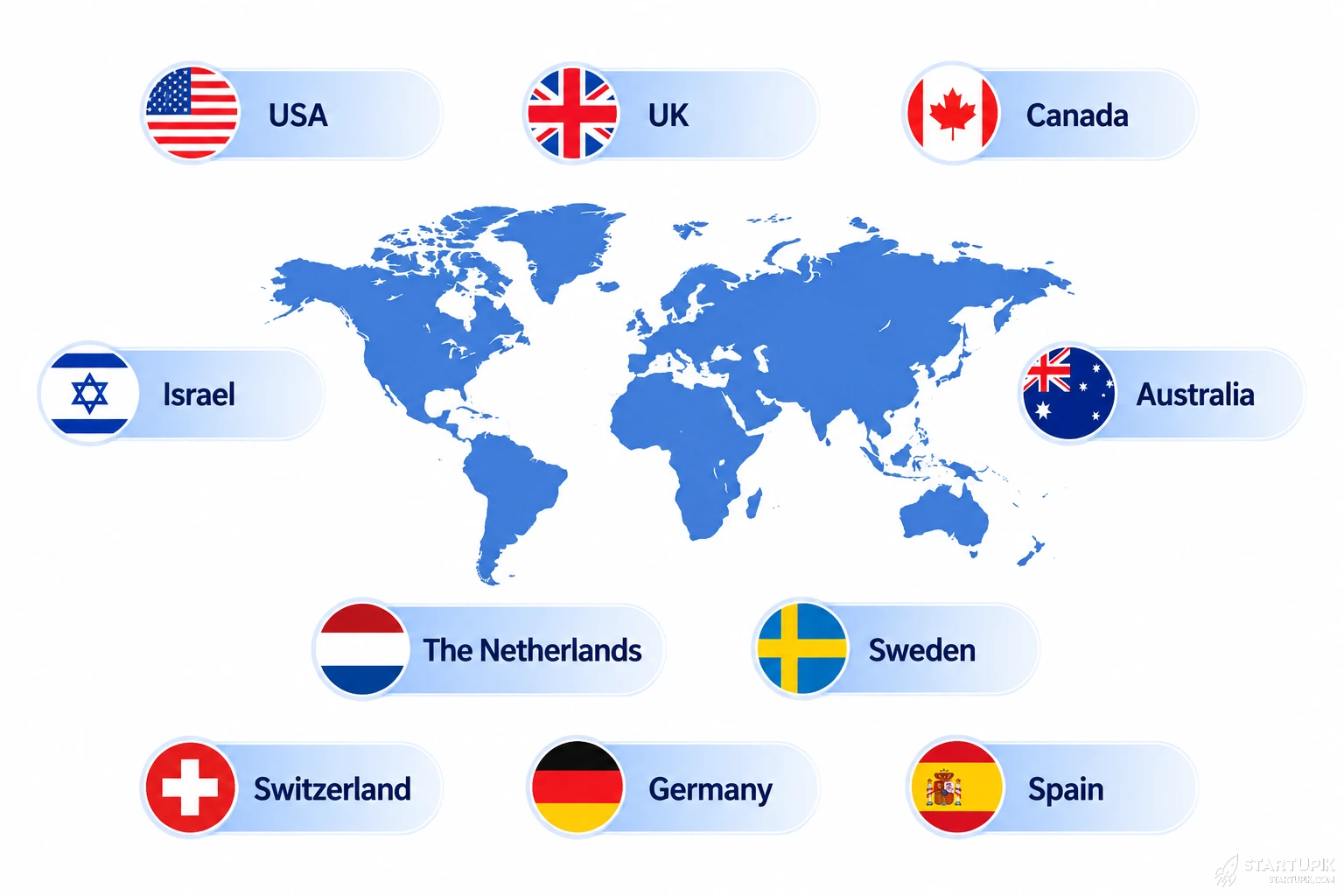
Some countries produce better startups because they combine talent density, risk-tolerant capital, founder-friendly regulation, and fast market feedback. It is not about GDP alone. In 2026, the strongest startup ecosystems are usually the ones that make it easier to start, test, hire, sell, and fail without permanent downside.
Quick Answer
- Better startup countries usually have dense networks of founders, engineers, operators, angels, and early-stage VCs.
- Access to fast customers matters more than population size in many startup ecosystems.
- Regulation shapes startup quality by affecting company formation, equity, taxes, data rules, fintech licensing, and shutdown costs.
- Startup talent compounds locally when experienced employees leave companies like Stripe, Shopify, Revolut, Nubank, or Grab and start new ventures.
- Capital alone is not enough; countries with money but weak operator networks often fund more startups than they help scale.
- Right now in 2026, AI, fintech infrastructure, climate tech, and crypto compliance are rewarding countries with strong technical education and clear regulatory paths.
What Actually Makes One Country Better at Producing Startups?
A country produces better startups when it reduces the friction between idea, validation, funding, and scale. Founders need more than ambition. They need a system that lets them move fast.
The strongest startup ecosystems usually have five things working together:
- Talent pipelines from universities, startups, and large tech companies
- Early adopters willing to try new products
- Seed and Series A capital with real founder support
- Legal and tax structures that do not punish experimentation
- Recycling of experience from successful exits and second-time founders
Countries that lack one or two of these can still produce unicorns. But they usually struggle to produce them consistently.
The Core Drivers Behind Strong Startup Countries
1. Talent Density Beats Raw Population
Large countries do not automatically create better startups. What matters is whether skilled people are concentrated in places where they can collide, work together, and start companies.
That is why relatively small ecosystems like Israel, Singapore, Estonia, and Sweden often outperform bigger markets on a per-capita basis.
- Engineers build faster MVPs
- Product leaders reduce wasted development
- Growth operators find repeatable acquisition channels
- Ex-founders transfer pattern recognition
When this works: technical founders can hire their first 10 people locally and get product feedback from experienced peers.
When it fails: countries educate good talent but lose it to the US, UK, UAE, or remote employers before local startups can absorb it.
2. Capital Quality Matters More Than Capital Volume
A lot of countries now have more angel money, micro funds, and government innovation programs than they did five years ago. But funding quantity is not the same as funding quality.
Strong startup countries usually have investors who understand:
- SaaS metrics like CAC payback and net revenue retention
- Fintech constraints like KYC, AML, sponsor banks, and card network dependencies
- AI economics like inference cost, model switching, and workflow integration
- Web3 risk like custody, smart contract exposure, and token design incentives
Founders do better when investors bring introductions, hiring support, follow-on access, and strategic pressure at the right time.
Trade-off: deep local capital can raise valuations too early. That helps on paper, but it can hurt later if growth does not justify the price.
3. Fast Customer Access Creates Better Companies
The best startup countries often let founders get in front of users quickly. That can come from a wealthy domestic market, a digitally mature user base, or easy access to cross-border customers.
For example:
- B2B SaaS startups do well where businesses already buy software
- Fintech startups do well where payments, banking APIs, and digital identity are mature
- AI tools scale faster where teams already use Notion, Slack, HubSpot, GitHub, Stripe, and OpenAI-based workflows
A founder in a small country can still win if the company is built for global distribution from day one. Estonia and Israel are classic examples.
When this works: products are API-first, self-serve, or remote-sellable.
When it fails: startups depend on local enterprise procurement, offline distribution, or regulated industry sales cycles without institutional support.
4. Regulation Can Either Accelerate or Suffocate Startup Formation
Policy matters more than many people admit. A country can have smart founders and good engineers, but if it is hard to form a company, issue stock options, open bank accounts, or handle compliance, startup output drops.
In 2026, this is especially visible in:
- Fintech with EMI licenses, money transmission rules, and bank partnerships
- AI with data privacy, copyright, and enterprise procurement requirements
- Crypto and Web3 with token rules, stablecoin oversight, travel rule obligations, and VASP registration
Founder-friendly regulation does not mean “no rules.” It means rules are clear, navigable, and proportionate.
Trade-off: highly permissive environments can attract low-quality startups, regulatory arbitrage, and short-term speculation. That boosts startup count, but not startup quality.
5. Culture Around Failure Changes Founder Supply
Some countries produce fewer startups because the social cost of failure is too high. If shutting down a startup damages a founder’s career, family standing, or access to future financing, fewer people take the first leap.
Countries with stronger startup output usually normalize:
- first-time founder mistakes
- pivoting
- shutdowns
- second attempts
- employees leaving stable jobs for early-stage roles
This matters because startup ecosystems are built by repeat participation, not just first wins.
6. Successful Companies Create the Next Wave
One of the clearest patterns in startup ecosystems is the “founder mafia” effect. Former employees of strong startups become new founders, angel investors, and operators.
Examples from recent years across global markets include ecosystems growing around companies like:
- Stripe
- Shopify
- Revolut
- Adyen
- Nubank
- Grab
- UiPath
- Wolt
These companies train people in hiring, product, compliance, scaling, fundraising, and category positioning. Countries without these training grounds often depend too much on theory and too little on operating experience.
Why This Matters More in 2026
Right now, startup quality is being shaped by major shifts in AI, fintech, and crypto infrastructure.
- AI startups need cloud credits, GPU access, enterprise trust, and data governance
- Fintech startups need sponsor banks, compliance talent, and embedded finance partnerships
- Crypto startups need legal clarity, wallet infrastructure, and institutional-grade security
This means startup ecosystems are no longer competing only on talent and capital. They are competing on infrastructure readiness.
A country may have good software talent but still lag if founders cannot access AWS, Google Cloud, Nvidia ecosystems, Stripe, Plaid-like banking rails, or compliant crypto on-ramps.
What the Best Startup Countries Usually Have
| Factor | Why It Helps | When It Breaks |
|---|---|---|
| Dense founder network | Faster intros, hiring, and learning loops | Becomes insular and repetitive |
| Strong technical education | Better product quality and lower early build costs | Talent leaves for foreign employers |
| Founder-friendly regulation | Lower setup friction and clearer compliance path | Overregulation slows iteration |
| Experienced VC and angels | Better strategic support beyond money | Capital chases hype instead of fundamentals |
| Access to enterprise buyers | Faster revenue validation for B2B startups | Long procurement cycles block early traction |
| Local success stories | Creates operators, spinouts, and confidence | One superstar company masks weak ecosystem depth |
Why Some Rich Countries Still Produce Weak Startup Ecosystems
Wealth does not automatically produce strong startups. Some rich countries have large financial resources but weak startup output because the system rewards preservation more than experimentation.
Common reasons include:
- Top talent prefers banking, consulting, or government
- There is capital but not enough startup know-how
- Customers are slow to adopt new tools
- Employment laws make early hiring risky
- Stock option frameworks are unattractive
- Social pressure favors stable careers
This is why some ecosystems produce many pitch decks but few durable companies.
Different Startup Categories Need Different National Advantages
AI Startups
AI companies benefit from countries with strong research talent, cloud access, enterprise buyers, and legal clarity around data use.
Best fit: ecosystems with universities, AI labs, B2B buyers, and high software adoption.
Hard mode: countries where enterprise data is fragmented or legal uncertainty makes adoption slow.
Fintech Startups
Fintech is heavily shaped by licensing, compliance, banking partnerships, and payment rails. A country can look startup-friendly but still be a poor place to build a fintech company if local banks move slowly.
Best fit: markets with open banking, digital identity, clear EMI/payment rules, and strong compliance talent.
Hard mode: markets where startups need years to secure approvals or depend on a few gatekeeper institutions.
Crypto and Web3 Startups
Crypto founders need more than tax friendliness. They need trust. That means legal clarity, custody solutions, audit culture, wallet adoption, and access to institutional-grade providers.
Best fit: jurisdictions that support digital asset businesses without constant rule reversals.
Hard mode: countries that market themselves as crypto hubs but lack banking support and credible enforcement standards.
B2B SaaS Startups
SaaS companies often thrive in countries with export-oriented founders, English-language sales capability, and buyers already comfortable with subscriptions, APIs, and remote procurement.
Best fit: countries whose startups sell internationally from the start.
Hard mode: countries where founders stay too local for too long.
Common Patterns Founders Miss
Founders often overestimate how much country matters at the idea stage and underestimate how much it matters at the scaling stage.
Early on, remote tools reduce location friction. You can build with GitHub, Slack, Figma, AWS, Stripe Atlas, Deel, Mercury, HubSpot, Notion, and OpenAI from almost anywhere.
But later, country-level advantages become more visible:
- hiring senior operators
- raising larger rounds
- getting enterprise credibility
- navigating regulation
- accessing strategic acquirers
So the real question is not just, “Can I start here?” It is, “Can this ecosystem support the company I want to become?”
Expert Insight: Ali Hajimohamadi
The biggest mistake founders make is assuming the best startup country is the one with the most funding headlines. It usually is not.
The better question is: where can you get your second and third unfair advantage after the MVP works?
A country is strong when it helps you recruit your first serious VP, close your first enterprise reference account, and survive your first compliance shock.
Weak ecosystems can still produce breakout startups, but they force founders to become infrastructure builders on top of company builders.
That hidden tax is why many promising startups look efficient early and then stall right when scaling should begin.
How Founders Should Evaluate a Country for Startup Building
If you are choosing where to build, do not rank countries by hype alone. Use a practical filter.
Questions to Ask
- Can I hire technical and commercial talent locally?
- Can I form the company and issue equity easily?
- Are there local customers or easy international access?
- Will investors in this ecosystem understand my category?
- Is regulation clear enough for my business model?
- Can I reach Series A without relocating?
Good Reasons to Build in a Smaller Ecosystem
- Lower hiring costs
- Less competition for talent
- Government grants or R&D support
- Early local visibility
- Strong niche strength in fintech, deep tech, or cybersecurity
Bad Reasons to Build There
- Cheap labor but no operator quality
- Easy incorporation but weak customer access
- Government startup branding without private-market depth
- Abundant seed funding but no follow-on capital
When Great Startup Countries Are Overrated
Top ecosystems are not automatically the right answer for every founder.
Building in places like Silicon Valley, London, Singapore, or Dubai can offer huge advantages. But there are trade-offs:
- Higher talent costs
- More investor noise
- Shorter attention windows
- Greater pressure to scale before fundamentals are ready
For some founders, a hybrid model works better: build the product team in one country, incorporate in another, and sell globally.
This often works well for SaaS and infrastructure startups. It is harder for regulated fintech and crypto products where substance, licensing, and jurisdictional alignment matter more.
FAQ
Do countries really matter for startups in a remote-first world?
Yes. Remote tools reduce early friction, but country-level factors still shape banking, hiring, taxation, regulation, enterprise trust, and later-stage fundraising.
Can a small country produce world-class startups?
Yes. Small countries often perform well when they have strong education, export-oriented founders, digital infrastructure, and concentrated startup networks.
Is access to venture capital the main reason some countries produce better startups?
No. Capital matters, but capital quality matters more. Weak operator support and poor customer access can waste abundant funding.
Why do some countries produce many startups but few successful ones?
Because startup quantity can be boosted by subsidies, hype cycles, or easy seed capital. Success requires customer access, experienced operators, and repeatable scale infrastructure.
Are founder-friendly regulations always good?
Not always. Clear and efficient regulation helps. But overly loose environments can attract low-quality companies, scams, and short-term behavior that weakens ecosystem trust.
Which types of startups are most sensitive to country differences?
Fintech, healthtech, AI enterprise software, and crypto infrastructure are highly sensitive because they depend on compliance, trust, data rules, and institutional partnerships.
Should founders relocate to a top startup country?
Only if the move unlocks a real advantage such as funding access, enterprise sales, hiring, or licensing. Relocating for brand value alone is often overrated.
Final Summary
Some countries produce better startups because they make company building systematically easier. The best ecosystems combine talent, experienced capital, fast customer access, clear regulation, and a culture that recycles failure into future companies.
In 2026, this matters even more because AI, fintech, and crypto startups depend on infrastructure, trust, and compliance as much as code. The strongest startup countries are not just rich or trendy. They are the ones that help founders move from zero to product, from product to scale, and from scale to resilience.
If you are evaluating where to build, do not ask which country looks most exciting. Ask which one removes the most friction for your specific business model.


