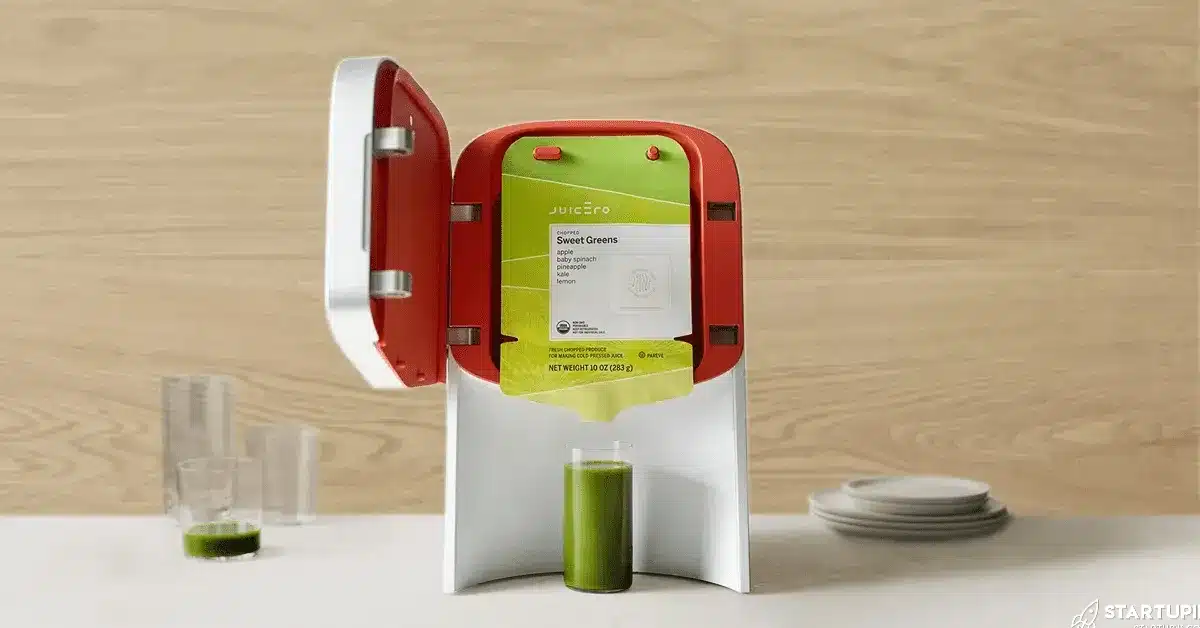
Why Juicero Failed: The $400 Juicer Startup That Became a Silicon Valley Joke
Introduction
Juicero was once a darling of Silicon Valley: a sleek, Wi-Fi–connected juicer backed by top-tier venture capital firms and over $100 million in funding. Marketed as the “Keurig for cold-pressed juice,” it promised fresh, mess-free juice at the push of a button. Within 18 months of launch, it became a cautionary tale and Internet meme, symbolizing everything critics dislike about overfunded, overengineered startups.
This case study breaks down how Juicero rose so quickly, why it failed so dramatically, and what founders and investors can learn from its collapse.
Company Background
Juicero was founded in 2013 in San Francisco by Doug Evans, a passionate raw-food advocate and former CEO of Organic Avenue, a New York-based juice chain. The company’s mission was ambitious: to “bring cold-pressed, farm-fresh juice to every home” through a combination of hardware, software, and a vertically integrated produce supply chain.
The product vision centered around three components:
- The Juicero Press: A countertop, industrial-grade cold-press juicer.
- Proprietary Produce Packs: Pre-cut, vacuum-sealed fruit and vegetable packs sourced from partner farms.
- A Connected Platform: A Wi-Fi–enabled device that scanned QR codes on packs, checked freshness via the cloud, and prevented use of expired packs.
Juicero positioned itself as a premium, health-focused, tech-enabled lifestyle brand aimed at affluent, health-conscious consumers who wanted fresh juice without the hassle of prep or cleanup.
Growth Story
Juicero’s rise was fueled by a compelling narrative and the prestige of its investors. Between 2013 and 2016, the company raised around $118 million from firms including Kleiner Perkins, Google Ventures (GV), and Campbell Soup’s venture arm.
Several factors contributed to its early traction within the tech and investment community:
- A familiar “razor-and-blades” model: Sell the hardware once, profit from recurring produce pack purchases.
- Clean, premium branding: The device looked like high-end kitchen art, appealing to design-conscious early adopters.
- Strong founder narrative: Doug Evans’ personal obsession with juicing and raw foods made for a compelling story.
- Trend alignment: The company rode multiple waves: wellness, smart appliances, subscription commerce, and farm-to-table sourcing.
Juicero launched its first machines to consumers in 2016, initially in a limited set of U.S. markets due to the complexity of its cold-chain logistics. Early adopters praised the convenience and taste, and press coverage highlighted the engineering sophistication of the machine.
What Went Wrong
Despite early buzz, Juicero collapsed quickly once the product hit a broader audience. Its failure stemmed from a combination of misaligned value proposition, overengineering, pricing missteps, and poor strategic judgment.
- Hand-squeezing revelation: In April 2017, Bloomberg published a video showing that Juicero’s proprietary juice packs could be squeezed by hand almost as effectively as by the $400 machine. This undercut the perceived value of the device overnight and turned the company into a viral joke.
- Overbuilt hardware for an underwhelming job: The juicer contained dozens of custom parts, a powerful press mechanism, and Wi-Fi connectivity to perform a task that consumers quickly realized could be done manually.
- High price, low differentiation: At $699 initially (later dropped to $399), the machine’s cost far exceeded the convenience it provided, especially given that the packs were single-use and relatively expensive.
- Narrow use case: The machine worked only with Juicero-branded packs, limiting flexibility and making consumers dependent on a single vendor for supply.
- Public perception spiral: The hand-squeeze story triggered ridicule across media and social platforms, making Juicero synonymous with wasteful Silicon Valley excess.
Once trust and perceived value collapsed, Juicero’s complex, capital-intensive business model was unsustainable.
Timeline of the Failure
| Date | Event |
|---|---|
| 2013 | Juicero founded by Doug Evans in San Francisco. |
| 2014–2015 | Raises major funding rounds from Kleiner Perkins, GV, and others; total funding approaches $118M. |
| Early 2016 | Juicero Press publicly launches in select U.S. markets at a price of approximately $699. |
| Mid–Late 2016 | CEO transition: Doug Evans steps down; Jeff Dunn (ex-Coca-Cola executive) becomes CEO. Voluntary recall of some units due to potential safety issues. |
| January 2017 | Price cut to around $399 to broaden adoption and reduce sticker shock. |
| April 2017 | Bloomberg releases video demonstrating that Juicero packs can be squeezed by hand, sparking widespread mockery. |
| April–August 2017 | Juicero offers refunds, faces intense negative press, and struggles to rebuild credibility and demand. |
| September 2017 | Juicero announces it is suspending operations and shutting down; equipment refunds offered to customers. |
Financial Issues
From a financial perspective, Juicero demonstrated how dangerous it can be to combine capital-intensive hardware with a complex supply chain before achieving clear product-market fit.
Funding and Capital Structure
| Year | Round (Approx.) | Investors (Selected) | Capital Raised (Approx.) |
|---|---|---|---|
| 2013 | Seed | Angel investors, early-stage funds | $5M–$10M |
| 2014 | Series A | Kleiner Perkins, others | ~$25M |
| 2015 | Series B | GV, Artis Ventures, Campbell Soup’s Acre Venture Partners | ~$70M–$80M |
| 2016–2017 | Additional/Bridge | Existing investors | Remaining to total ~$118M |
Most of this capital went into R&D, tooling for the press, supply chain infrastructure, cold-chain logistics, and marketing rather than incremental, market-validated product development.
Revenue and Unit Economics Problems
Juicero followed a classic hardware-plus-consumables model, hoping to earn long-term profits from produce pack sales. But several financial issues emerged:
- High customer acquisition cost (CAC): Convincing consumers to buy a $699 (later $399) device plus ongoing packs required heavy marketing spend.
- Limited addressable market at given price: Only a small portion of households were willing to pay that much for marginal convenience over bottled juice or standard juicers.
- Low utilization risk: Many buyers did not use the machine frequently enough to generate attractive lifetime value (LTV) from pack purchases.
- Supply chain overhead: Managing fresh produce sourcing, pack production, and refrigerated distribution added ongoing fixed and variable costs.
- Refusal refunds and write-offs: After the Bloomberg incident, Juicero offered refunds to customers, further straining finances.
Once growth slowed and negative press hit, the company had no sustainable path to profitability. The high burn rate relative to revenue meant that further funding would require investors to ignore increasingly obvious structural issues.
Strategic Mistakes
Beyond finances, Juicero’s downfall stemmed from deeper strategic misjudgments across product, market, and leadership decisions.
1. Solving a Non-Problem
Juicero assumed there was a large, underserved market of consumers who:
- Drank fresh juice frequently,
- Were dissatisfied with existing juicers and bottled juices, and
- Would pay a premium for slightly more convenience and less mess.
In reality, most consumers either accepted the trade-offs of traditional juicers or were content with bottled juice and smoothies. The incremental benefit of Juicero’s system did not justify the machine’s cost or lock-in to proprietary packs for the majority of potential users.
2. Overengineering the Product
The Juicero press was an engineering showcase: high-tonnage pressing power, multiple sensors, a complex drive system, and cloud connectivity. Yet from a user’s perspective, the core task was pressing pre-cut produce inside a sealed bag. When consumers learned they could do that almost as well by hand, the machine’s advanced engineering felt gratuitous instead of valuable.
Overengineering had two negative effects:
- Increased BOM and manufacturing costs, pushing up the price of the machine.
- Increased risk surface, including recalls and reliability concerns.
3. Misaligned Pricing and Business Model
The business model assumed consumers would accept:
- A high upfront hardware cost.
- Ongoing dependence on Juicero-branded packs.
- Limited flexibility (no ability to juice their own produce).
This created a fragile value proposition. Any challenge to the perceived necessity of the machine (such as the hand-squeezing video) or any dissatisfaction with pack pricing immediately undermined the entire model.
4. Overfunding Before Product-Market Fit
Juicero raised large sums early, which encouraged the company to think in terms of scaling and optimizing rather than learning and iterating. Instead of testing cheaper, less complex prototypes or alternative business models, the team committed to a capital-intensive, vertically integrated approach from the start.
Excess capital can be as dangerous as too little when it locks a company into an unvalidated path and creates pressure to pursue rapid scaling before fundamentals are sound.
5. Underestimating Reputational Risk
In consumer hardware, trust and brand perception are critical. The Bloomberg video did not just highlight a functional flaw; it framed Juicero as emblematic of wasteful, tone-deaf tech culture. The company’s prior marketing claims about proprietary “high tonnage” pressing power sounded ridiculous once the packs were seen being squeezed by hand.
Once the narrative turned, Juicero struggled to respond credibly. Attempts to explain the benefits of the system (food safety, supply chain tracking, etc.) sounded like rationalizations rather than compelling reasons to own the product.
Lessons for Founders
Juicero’s story offers concrete lessons for entrepreneurs and investors, especially in hardware and consumer products.
- Validate the core value proposition with the simplest possible solution. Before building a sophisticated machine, ask: “What is the cheapest, fastest way to test whether people truly want this outcome?” If customers are not desperate for the result, better engineering will not fix that.
- Do not overengineer relative to the problem’s importance. Consumers pay for outcomes, not mechanisms. If a manual solution is almost as good, a heavily engineered device is a liability, not a differentiator.
- Be cautious with razor-and-blades models. Locking customers into proprietary consumables requires overwhelming perceived value and convenience. If the lock-in feels exploitative or fragile, the model backfires.
- Raise in stages tied to learning, not just growth. Significant capital before product-market fit can trap you in a particular solution space. Use early capital to explore alternatives and reduce uncertainty, not to prematurely scale an unproven model.
- Stress-test the narrative. Ask: “What is the most embarrassing or reductive way someone could describe this product?” If “a $400 machine that does what your hands can” is a fair critique, you need to rethink your design and positioning.
- Account for total system complexity. Juicero was not just a juicer; it was a hardware device, a software platform, and an entire produce supply chain. Each added layer of complexity increases operational risk and burn.
- Align leadership with stage and category. Bringing in a big-company executive (e.g., from Coca-Cola) can help with scale, but may not be ideal for early-stage validation and ruthless simplification.
Key Takeaways Summary
- Problem clarity beats engineering brilliance: Juicero built an impressive device for a problem most consumers did not truly have.
- Perceived value must match (or exceed) price and friction: The convenience of pre-packed juice did not justify a $400+ machine plus proprietary packs for most buyers.
- Overfunding can lock in bad decisions: Large early funding rounds encouraged Juicero to commit to a complex, capital-heavy strategy before achieving product-market fit.
- Public narrative is strategic risk: Once the “you can squeeze it by hand” story took hold, Juicero’s brand collapsed faster than its financials alone would have dictated.
- For founders and investors: Focus relentlessly on validated customer pain, simple solutions, and disciplined experimentation before scaling capital, complexity, or hype.
Juicero’s failure is not just a punchline; it is a detailed case in how intelligent people, ample capital, and sophisticated technology can still miss the mark when the fundamental customer value proposition is weak. Founders and investors who internalize these lessons will be better equipped to avoid building the next overengineered, underloved product.