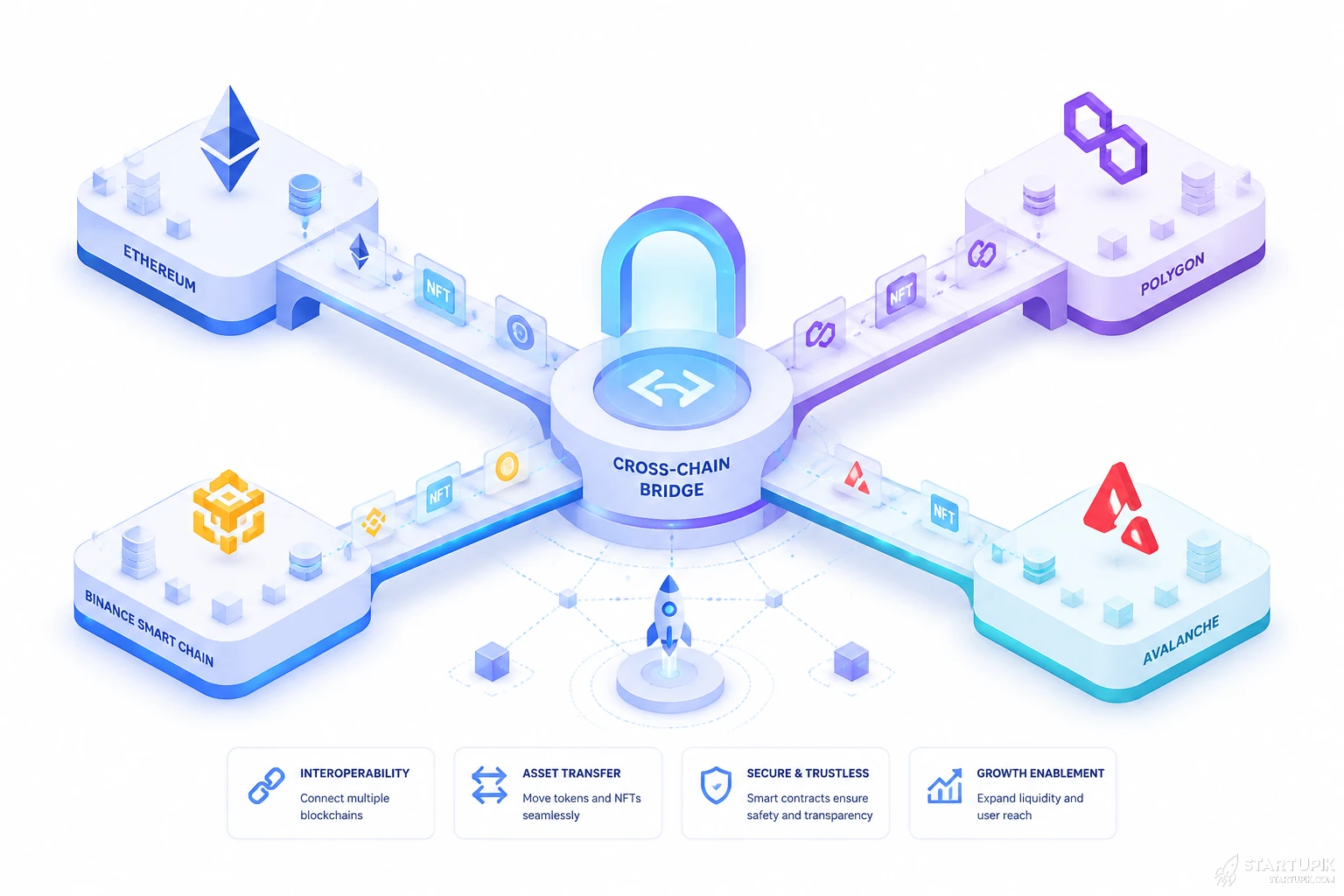
Startups use cross-chain bridges to move assets, liquidity, and users between blockchains. In 2026, this is mostly about growth, cheaper transactions, and reaching ecosystems like Ethereum, Base, Solana, Arbitrum, Polygon, and BNB Chain without rebuilding the whole product on day one. It works best when founders treat bridging as infrastructure with clear security limits, not as a growth hack by itself.
Quick Answer
- Startups use cross-chain bridges to let users move tokens and value across networks such as Ethereum, Arbitrum, Base, Polygon, Optimism, Avalanche, and Solana.
- Common startup use cases include multichain DeFi apps, gaming economies, treasury management, token launches, and payment settlement.
- Bridges reduce friction when users want lower gas fees, faster settlement, or access to liquidity on another chain.
- Main risks are smart contract exploits, wrapped asset failure, low liquidity, poor UX, and compliance issues around token flows.
- Startups usually combine bridges with wallets, RPC providers, indexers, analytics, and on-chain monitoring tools.
- This works well for products with real cross-ecosystem demand, but fails when teams go multichain before they have product-market fit.
Why Startups Care About Cross-Chain Bridges Right Now
Right now, founders are building in a market where users no longer stay on one blockchain. Liquidity is fragmented. Users hold assets on multiple networks. Teams launching only on Ethereum mainnet, for example, often lose users to cheaper ecosystems.
Cross-chain bridges help solve that distribution problem. Instead of forcing users to exit one chain, use a centralized exchange, and re-enter another chain manually, the bridge handles the asset transfer path directly.
In 2026, this matters more because Base, Arbitrum, Optimism, Polygon, Solana, Avalanche, and appchains all compete for builders. Startups are following users, not ideology.
What Cross-Chain Bridges Actually Do
A cross-chain bridge is infrastructure that transfers tokens, messages, or both between separate blockchain networks.
There are a few common models:
- Lock-and-mint bridges: assets are locked on Chain A and a wrapped version is minted on Chain B.
- Burn-and-release bridges: a token is burned on one chain and released on another.
- Liquidity network bridges: liquidity providers front the asset on the destination chain.
- Message-passing protocols: data and instructions move between chains, not just tokens.
For startups, the distinction matters. If a product only needs users to move USDC, a liquidity bridge may be enough. If it needs contracts on multiple chains to coordinate state, the team needs cross-chain messaging, not just asset movement.
How Startups Use Cross-Chain Bridges
1. Expanding to cheaper chains without forcing a full migration
A DeFi startup may launch first on Ethereum for credibility and liquidity, then expand to Base or Arbitrum for lower fees. A bridge lets users bring capital over instead of starting from zero.
Why this works: the startup keeps access to Ethereum-origin users while onboarding them into a cheaper environment.
When it fails: if the destination chain has thin liquidity, poor wallet support, or weak user demand, the expansion becomes overhead, not growth.
2. Bootstrapping multichain liquidity
Token-based startups often need trading activity on more than one network. Bridges help move treasury assets, LP capital, or incentive budgets where liquidity is forming.
Example scenarios:
- a DEX aggregator launching incentives on Arbitrum and Polygon
- a stablecoin startup balancing reserves or distribution across chains
- a new token project coordinating liquidity between Ethereum and BNB Chain
Trade-off: fragmented liquidity can hurt price discovery. More chains do not automatically mean deeper markets.
3. Improving onboarding for retail users
If a user discovers an app on one chain but holds funds on another, bridging inside the onboarding flow can prevent drop-off.
For example, a consumer crypto app on Base may let a user connect MetaMask or Coinbase Wallet, bridge USDC from Ethereum, and start using the app in one session.
This works best when the bridge is embedded and abstracted. If users must switch wallets, sign multiple transactions, and guess gas requirements, conversion falls fast.
4. Powering Web3 games and NFT economies
Gaming startups use bridges when assets originate on one chain but gameplay happens on another. An NFT collection may live on Ethereum for brand value, while in-game actions happen on Immutable, Polygon, or another lower-cost network.
Why founders do this: high-value assets stay on a more established chain, while gameplay runs where fees are lower.
Where it breaks: if asset sync is slow or unreliable, users lose trust. In gaming, latency and failed transfers are product problems, not backend problems.
5. Treasury and operational fund management
Some startups use bridges internally, not as a product feature. They move stablecoins, payroll reserves, market-making capital, or incentive budgets across chains depending on yield opportunities, protocol partnerships, or grant programs.
This is common in crypto-native startups operating across Ethereum L2s and alternative Layer 1s.
Risk: treasury bridges can create concentration risk. One bad bridge choice can expose operating capital, not just user funds.
6. Enabling multichain developer products
Infrastructure startups building wallets, analytics platforms, embedded finance layers, or on-chain automation tools often support several chains from day one. Bridges help create seamless movement between supported ecosystems.
Examples include:
- wallet apps offering in-app swaps and bridging
- payments platforms settling on different chains
- DAO tooling that funds contributors in the chain they prefer
- yield products routing capital to opportunities across networks
Real Startup Workflow Examples
Workflow 1: DeFi app expands from Ethereum to Base
- User connects wallet on Ethereum.
- App detects wallet balances and supported assets such as ETH or USDC.
- Embedded bridge routes funds to Base.
- User receives bridged asset on Base.
- App deposits funds into vaults or liquidity pools on Base.
Why this works: Ethereum remains the acquisition layer, while Base becomes the activity layer.
Workflow 2: NFT startup uses Ethereum for minting and Polygon for utility
- Collection is minted on Ethereum.
- Owners bridge assets or credentials to Polygon.
- Polygon powers loyalty rewards, in-app transactions, or community quests.
- Metadata, access rights, or utility checks update across chains.
Why this works: the startup preserves brand prestige while lowering ongoing user costs.
Workflow 3: Stablecoin payments startup manages liquidity across chains
- Users pay in USDC on multiple chains.
- The startup aggregates inflows.
- Treasury operations bridge balances to chains with the best payout rails or settlement needs.
- Funds are disbursed to vendors, creators, or merchants on their preferred network.
Where it fails: if bridge liquidity is thin during volume spikes, settlement delays can break payment reliability.
Benefits for Startups
- Lower user friction when assets can move without leaving the app
- Access to new user bases across Ethereum, L2s, and alternative chains
- Cheaper transaction environments for high-frequency actions
- Flexible treasury deployment across ecosystems and incentive programs
- Better market reach for tokens, apps, wallets, and financial products
The key point is that bridges are usually a distribution and operations layer. They are rarely the product moat by themselves.
Main Limitations and Risks
Security risk is the biggest issue
Bridges have been one of the most attacked parts of crypto infrastructure. Startups integrating a bridge inherit some of that trust surface, even when they do not build the bridge themselves.
Founders should assess:
- audit history
- validator model
- custody assumptions
- pause controls
- incident response process
- supported asset safety
Wrapped assets can create hidden fragility
Not all bridged tokens are equally reliable. Wrapped versions may trade at discounts, lose liquidity, or become hard to redeem if the bridge is compromised.
This matters for apps that rely on collateral, lending, treasury accounting, or stable-value assumptions.
UX complexity hurts conversion
A startup may think adding a bridge increases reach. In practice, each extra signature, gas step, waiting period, and chain switch reduces completion rate.
When this works: the bridge is integrated into the workflow with clear estimated time, fees, and destination chain details.
When it fails: the user must understand bridging mechanics before getting value from the product.
Compliance and monitoring get harder
For fintech-like crypto products, moving funds across multiple chains creates more operational complexity. Teams may need better transaction monitoring, sanctions screening, wallet intelligence, and accounting processes.
This is especially relevant for startups handling stablecoins, payroll, embedded payments, DAO treasuries, or institutional clients.
When Cross-Chain Bridges Make Sense for Startups
- You already have users or liquidity on one chain and want to expand to another
- Your users hold assets across multiple ecosystems
- Your product has fee-sensitive actions like gaming, trading, or rewards
- You need treasury flexibility across grants, ecosystems, or yield venues
- You are building multichain infrastructure such as wallets, payments, or developer tooling
When Startups Should Avoid or Delay Them
- You do not yet have product-market fit
- Your users mostly live on one chain
- Your team cannot evaluate bridge risk
- You lack support resources for failed transfers and user confusion
- Your core product does not improve just because it is multichain
Many early-stage teams mistake multichain presence for distribution. Often it just multiplies support burden, liquidity fragmentation, and engineering complexity.
How Founders Should Evaluate a Bridge
| Evaluation Area | What to Check | Why It Matters |
|---|---|---|
| Security model | Audits, validator design, trust assumptions, pause controls | Bridge risk becomes product risk |
| Chain support | Ethereum, Base, Arbitrum, Optimism, Polygon, Solana, Avalanche compatibility | Must match where your users already are |
| Asset support | Native ETH, USDC, stablecoins, wrapped assets, token standards | Not every route supports every asset safely |
| Liquidity | Depth, slippage, transfer size limits | Large or volatile transfers can fail economically |
| UX quality | Wallet flows, transaction count, ETA, error handling | Poor UX kills activation |
| Developer tooling | SDKs, APIs, webhooks, docs, monitoring | Integration speed matters for startups |
| Operations | Support, uptime, status page, incident history | Infrastructure reliability affects trust |
Tools and Protocols Startups Commonly Consider
The bridge landscape changes quickly, but startups often evaluate protocols and infrastructure such as LayerZero, Wormhole, Axelar, Across, Stargate, Socket, Hyperlane, Chainlink CCIP, Synapse, Hop Protocol, and deBridge.
The right choice depends on whether the startup needs:
- token transfers
- general message passing
- app-specific interoperability
- wallet-level aggregation
- developer-first SDK support
Founders also pair bridges with adjacent infrastructure such as Alchemy, Infura, QuickNode, Tenderly, Fireblocks, Safe, WalletConnect, Etherscan, Blockscout, Dune, Nansen, Chainalysis, and TRM Labs.
Expert Insight: Ali Hajimohamadi
Most founders think multichain expansion is a growth decision. It is usually a support and liquidity decision first.
If your team cannot explain where liquidity will live, how failed transfers are handled, and which chain owns the primary user relationship, you are not ready to bridge at scale.
A useful rule: launch on one chain, distribute on a second, settle operationally on a third only if each chain has a clear job.
What kills startups is not the bridge fee. It is unclear chain strategy hidden behind “we’re multichain.”
Best Practices for Startups Using Cross-Chain Bridges
- Start with one high-demand route, not every chain pair
- Prefer trusted assets like native tokens or major stablecoins where possible
- Show fees, ETA, and destination clearly before confirmation
- Build user support workflows for pending, failed, or delayed transfers
- Monitor bridge health in real time using alerts and status checks
- Separate treasury bridge logic from retail user flows
- Limit exposure by capping bridge-dependent balances when possible
FAQ
Why do startups use cross-chain bridges instead of launching on one blockchain?
Because users, liquidity, and transaction activity are spread across multiple chains. A single-chain launch is simpler, but bridging helps startups reach more users and cheaper execution environments.
Are cross-chain bridges safe for startup products?
They can be safe enough for specific use cases, but they are not risk-free. Bridge security depends on smart contracts, validator design, liquidity architecture, and operational controls. Startups should treat bridge integration as a high-risk infrastructure decision.
What types of startups benefit most from cross-chain bridges?
DeFi apps, wallets, gaming projects, NFT platforms, payments startups, DAO tooling, treasury products, and multichain infrastructure companies benefit the most. Simple products with a single-chain audience often do not need them early.
What is the biggest mistake founders make with bridging?
They expand to multiple chains before validating user demand on one. That usually creates fragmented liquidity, more engineering work, and more support problems without real growth.
Do startups need to build their own bridge?
Usually no. Most startups integrate existing bridge protocols or aggregators through SDKs and APIs. Building a custom bridge only makes sense for highly specialized infrastructure teams with strong security expertise.
How do bridges affect user onboarding?
They can improve onboarding if the flow is embedded and simple. They hurt onboarding when users need to understand chain mechanics, hold gas on multiple networks, or wait through unclear transfer steps.
What should startups measure after adding a bridge?
Track transfer completion rate, onboarding conversion, average transfer size, support tickets, failed transactions, destination-chain retention, and liquidity utilization. If these metrics do not improve, the bridge may be adding complexity without value.
Final Summary
Startups use cross-chain bridges to move users, assets, and operational capital across blockchain ecosystems. The strongest use cases are DeFi expansion, embedded onboarding, gaming economies, treasury routing, and multichain infrastructure products.
But bridging is not automatically a growth advantage. It works when founders have a clear chain strategy, strong asset support, reliable infrastructure, and real user demand across networks. It fails when teams go multichain too early, ignore liquidity fragmentation, or underestimate security and support costs.
In 2026, the winning approach is not “be everywhere.” It is use the right bridge for the right route, with one clear business reason behind each chain you support.