

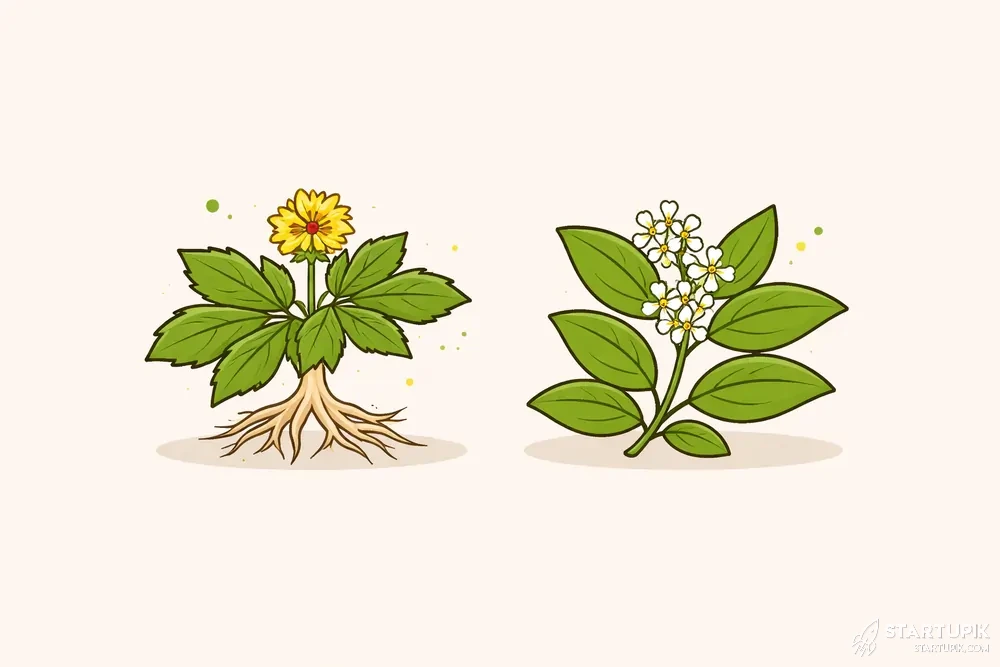
Goldenseal vs Gymnema for Pancreas Support is a useful comparison because these two herbs are often mentioned in the same supplement space, yet they are not similar in purpose. Many readers assume both are “blood sugar herbs” and therefore both directly support the pancreas. That is too simple. Gymnema is more often discussed in metabolic and glucose-related contexts. Goldenseal is more often associated with berberine content, broader traditional use, and a much more serious interaction profile. If you want a clear answer, this article breaks down where each herb fits, how they differ, and which claims deserve caution.
What are goldenseal and gymnema, in simple terms?

Goldenseal and gymnema are both botanical ingredients, but they come from different traditions and are used for different reasons. Goldenseal is usually the root and rhizome of Hydrastis canadensis, a North American plant. Gymnema usually refers to the leaves of Gymnema sylvestre, a climbing plant long used in Ayurvedic practice.
Goldenseal at a glance
Goldenseal is best known for its alkaloids, especially berberine and hydrastine. In the supplement world, people often connect it with antimicrobial traditions, digestive formulas, and berberine-related interest. But goldenseal also stands out for one more reason: it has a higher risk of drug interactions than many consumers expect.
Gymnema at a glance
Gymnema is commonly positioned around sweet taste perception, sugar cravings, and healthy glucose metabolism. In modern supplement language, it is the more pancreas-adjacent herb of the two, because it is more directly tied to glucose handling and pancreatic beta-cell discussions in early research.
Why are both herbs mentioned in pancreas support products?
They show up together because supplement marketing often groups herbs by broad metabolic themes. Once a formula mentions blood sugar, insulin, glucose balance, or metabolic support, the pancreas enters the conversation. But that does not mean both herbs play the same role.
The marketing shortcut
The shortcut works like this: if an herb is discussed in relation to glucose, people assume it supports the pancreas. That is a partial truth at best. Some herbs may be relevant to broader metabolic pathways without showing strong direct pancreatic effects in humans.
The formula logic
In mixed formulas, gymnema is often there because of its reputation in glucose support. Goldenseal may appear because of berberine-related interest or because it was traditionally included in broader herbal combinations. This means the two herbs may sit in the same bottle for different reasons.
Which herb has the clearer pancreas-related connection?
Gymnema has the clearer pancreas-related connection. Even then, the most careful wording is still limited to metabolic support language, early human evidence, and preclinical discussion rather than strong direct clinical proof of pancreas support.
Why gymnema is closer to the topic
Gymnema is more often studied for glucose metabolism, sweet taste modulation, insulin-related pathways, and beta-cell function. That makes it a more natural fit for conversations about pancreatic relevance, even if the evidence still needs careful interpretation.
Why goldenseal is a weaker fit
Goldenseal may enter the conversation because it contains berberine, and berberine is widely discussed in metabolic research. But that does not make goldenseal itself a pancreas-focused herb. In practical terms, goldenseal is often less attractive for beginners because the safety and interaction concerns are more prominent.
| Herb | Main modern positioning | Pancreas-related relevance | Beginner takeaway |
|---|---|---|---|
| Goldenseal | Berberine-containing botanical with traditional digestive and antimicrobial use | Indirect and less specific | Use extra caution because of interaction risk |
| Gymnema | Metabolic and glucose-support botanical | More direct conceptual fit | More relevant to the topic, but still not a proven pancreas solution |
How do their mechanisms differ?
The difference starts with how people think each herb works. Gymnema is linked with glucose handling and sweet taste response. Goldenseal is linked more with berberine-driven metabolic interest, but also with enzyme inhibition that can affect medications.
Gymnema’s better-known mechanism profile
Gymnema is often discussed for its gymnemic acids and its ability to reduce sweet taste intensity, influence glucose absorption pathways, and interact with insulin-related physiology. Some early studies and reviews also discuss pancreatic beta-cell relevance, but this is still an area that needs careful reading.
Goldenseal’s mechanism profile
Goldenseal gets much of its attention from berberine. Berberine is a widely studied plant alkaloid in metabolic research. But when consumers choose goldenseal, they are not choosing purified berberine. They are choosing a whole botanical with a different safety profile, variable composition, and more interaction concerns.
Why this matters for product comparison
Many consumers compare these herbs as if they are interchangeable. They are not. One is closer to sweet taste and glucose-related support language. The other is more burdened by interaction risk and broader traditional use that does not map neatly onto pancreas support.
What does the evidence suggest for gymnema?
Gymnema has the stronger evidence base for this specific topic, but the quality of the evidence still varies. Some human studies and many reviews discuss its potential relevance to glucose control, insulin function, or pancreatic beta-cell biology. That makes gymnema more relevant, not fully proven.
What is fair to say
It is fair to say that gymnema is commonly used in metabolic wellness supplements and has more direct conceptual relevance to pancreas support than goldenseal. It is also fair to say that research has explored beta-cell pathways and glucose-related effects.
What is not fair to say
It is not careful to say that gymnema restores the pancreas, rebuilds pancreatic tissue in people, or acts as a proven clinical solution for pancreatic disorders. Those statements overreach.
What does the evidence suggest for goldenseal?
Goldenseal is less convincing in this exact comparison. Interest often comes from berberine-related research rather than from goldenseal-specific pancreas evidence.
Where the confusion comes from
Because berberine appears in discussions of blood sugar and metabolic health, some readers assume any berberine-containing herb belongs in a pancreas support formula. But the leap from berberine research to “goldenseal for pancreas support” is not clean.
What matters more with goldenseal
With goldenseal, safety often matters more than mechanism. The herb is known for clinically relevant interaction concerns because it can inhibit major drug-metabolizing enzymes. That changes the risk-benefit picture, especially for beginners or people who already take medication.
| Comparison point | Goldenseal | Gymnema |
|---|---|---|
| Closer fit to pancreas-support topic | Weaker | Stronger |
| Typical modern use context | Berberine interest, traditional digestive formulas | Glucose balance, sweet taste, metabolic support |
| Interaction concerns | Higher | Still relevant, but generally less central to its public profile |
| Best framing | Indirect and cautious | More topic-relevant, but still careful |
Which herb raises more safety concerns?
Goldenseal raises more immediate safety concerns for many users because of its interaction potential. This is one of the most important differences in the Goldenseal vs Gymnema for Pancreas Support comparison.
Why goldenseal needs extra caution
Goldenseal has been shown to inhibit CYP3A4 and CYP2D6, two major enzymes involved in drug metabolism. That matters because it can change how the body processes many medications, including some people may take for metabolic conditions.
What to watch with gymnema
Gymnema also deserves caution, especially for people using glucose-lowering medications or managing diabetes. If a supplement may affect blood sugar handling, combining it with medication deserves careful review.
Why “natural” is not the key issue
The real issue is pharmacology, not whether something comes from a plant. Botanicals can affect enzymes, absorption, glucose response, or liver-related pathways. That is why label reading and context matter more than the word natural.
How should beginners read pancreas support claims on labels?
Start by separating general metabolic language from direct pancreatic claims. Most labels blur those lines.
Helpful wording
Reasonable wording includes support for healthy glucose metabolism, sweet taste modulation, metabolic wellness, or support for a healthy routine. That stays closer to supplement structure-function language.
Wording that should make you skeptical
Be skeptical of phrases that imply organ repair, reversal, direct restoration, or disease-specific pancreatic outcomes. Those claims usually move far ahead of the evidence.
Checklist: how to compare a goldenseal or gymnema product
- Check the full botanical name on the label.
- See whether the product uses goldenseal root, gymnema leaf, or both.
- Review whether the claim is about metabolism or directly about the pancreas.
- Look for serving size, extract ratio, and standardization details.
- Be more cautious with goldenseal if you take prescription medication.
- Be careful with gymnema if you already monitor or manage blood sugar.
- Do not assume “berberine-containing” means “best choice for pancreas support.”
- Prefer balanced support language over dramatic promises.
So which herb is the better fit for this topic?
If the topic is strictly Goldenseal vs Gymnema for Pancreas Support, gymnema is the better fit. It aligns more directly with glucose and beta-cell discussions. Goldenseal is the less precise choice and carries more interaction baggage.
The practical answer
Gymnema belongs in the conversation more naturally. Goldenseal belongs only with much more caution and a narrower rationale. In many cases, consumers are really interested in berberine-related questions, not goldenseal itself.
The balanced answer
That does not make gymnema a proven pancreas-support herb in a strong clinical sense. It just makes it the more relevant and less conceptually stretched option in this comparison.
FAQ
Is gymnema more relevant than goldenseal for pancreas support?
Yes. Gymnema has a clearer connection to glucose and beta-cell discussions.
Does goldenseal directly support the pancreas?
There is no strong basis for a direct pancreas claim. Its relevance is more indirect and often tied to berberine interest.
Why is goldenseal riskier for many beginners?
Because it can interact with many medications by affecting major drug-metabolizing enzymes.
Can gymnema be used in metabolic wellness formulas?
Yes. That is one of its most common modern supplement contexts.
Are goldenseal and gymnema interchangeable?
No. They differ in mechanism, safety profile, and how closely they fit the topic.
Does a blood sugar herb automatically support the pancreas?
No. Metabolic relevance does not automatically prove direct pancreatic support.
What is the safest way to read these claims?
Focus on structure-function language, ingredient identity, and safety context rather than bold promises.
Glossary
Goldenseal
A North American herb, usually Hydrastis canadensis, known for alkaloids such as berberine and hydrastine.
Gymnema
An herb from Gymnema sylvestre, commonly used in metabolic wellness supplements.
Berberine
A plant alkaloid studied for metabolic effects and found in several botanicals, including goldenseal.
Gymnemic acids
Compounds in gymnema often linked to sweet taste modulation and glucose-related interest.
Pancreatic beta cells
Cells in the pancreas involved in insulin production.
CYP3A4
A major enzyme that helps the body process many medications.
CYP2D6
Another major drug-metabolizing enzyme that can be affected by some botanicals.
Structure-function claim
Supplement language that describes support for normal body function without making a disease claim.
Metabolic wellness
A broad term for healthy glucose, energy, and related body processes.
Conclusion
In the Goldenseal vs Gymnema for Pancreas Support comparison, gymnema is the more relevant herb and goldenseal is the more caution-heavy one. The smart approach is to separate metabolic support language from direct pancreas claims and read both herbs through that lens.
Sources
Federal guidance on structure-function claims for supplements, Structure/Function Claims — fda.gov/food/nutrition-food-labeling-and-critical-foods/structurefunction-claims
Federal overview of claim categories for supplements and foods, Label Claims for Food & Dietary Supplements — fda.gov/food/nutrition-food-labeling-and-critical-foods/label-claims-food-dietary-supplements
Federal compliance guide distinguishing structure-function and disease claims, Small Entity Compliance Guide on Structure/Function Claims — fda.gov/regulatory-information/search-fda-guidance-documents/small-entity-compliance-guide-structurefunction-claims
NCCIH consumer overview of goldenseal safety and evidence, Goldenseal: Usefulness and Safety — nccih.nih.gov/health/goldenseal
NCCIH summary of herb-drug interaction science noting high interaction risk for goldenseal, Herb-Drug Interactions: What the Science Says — nccih.nih.gov/health/providers/digest/herb-drug-interactions-science
NCCIH consumer guidance noting goldenseal may affect the way the body processes medicines, 6 Tips: How Herbs Can Interact With Medicines — nccih.nih.gov/health/tips/tips-how-herbs-can-interact-with-medicines
NCCIH overview of diabetes and dietary supplements including berberine evidence summary, Diabetes and Dietary Supplements: What You Need To Know — nccih.nih.gov/health/diabetes-and-dietary-supplements-what-you-need-to-know
NCBI review discussing complementary options for type 2 diabetes, Non-Pharmaceutical Intervention Options For Type 2 Diabetes — ncbi.nlm.nih.gov/books/NBK279062
NIH Dietary Supplement Label Database ingredient entry for gymnema, Gymnema Sylvestre Ingredient Entry — dsld.od.nih.gov/ingredient/GYMNEMA%2BSYLVESTRE
Systematic review of gymnema literature, An Evidence-Based Systematic Review of Gymnema sylvestre — pubmed.ncbi.nlm.nih.gov/22432729
Review of gymnema phytochemical and pharmacological properties, Phytochemical and Pharmacological Properties of Gymnema sylvestre — pmc.ncbi.nlm.nih.gov/articles/PMC3912882
Review of plant-derived compounds and pancreatic beta-cell relevance, Plant-Derived Compounds Targeting Pancreatic Beta Cells — pmc.ncbi.nlm.nih.gov/articles/PMC4637477
Recent review exploring beta-cell-directed screening and Gymnema sylvestre extract, Identification of Potential Plant-Derived Pancreatic Beta-Cell Agents — pmc.ncbi.nlm.nih.gov/articles/PMC10780566
NCBI LiverTox overview for gymnema safety context, Gymnema — ncbi.nlm.nih.gov/books/NBK610217

