Introduction
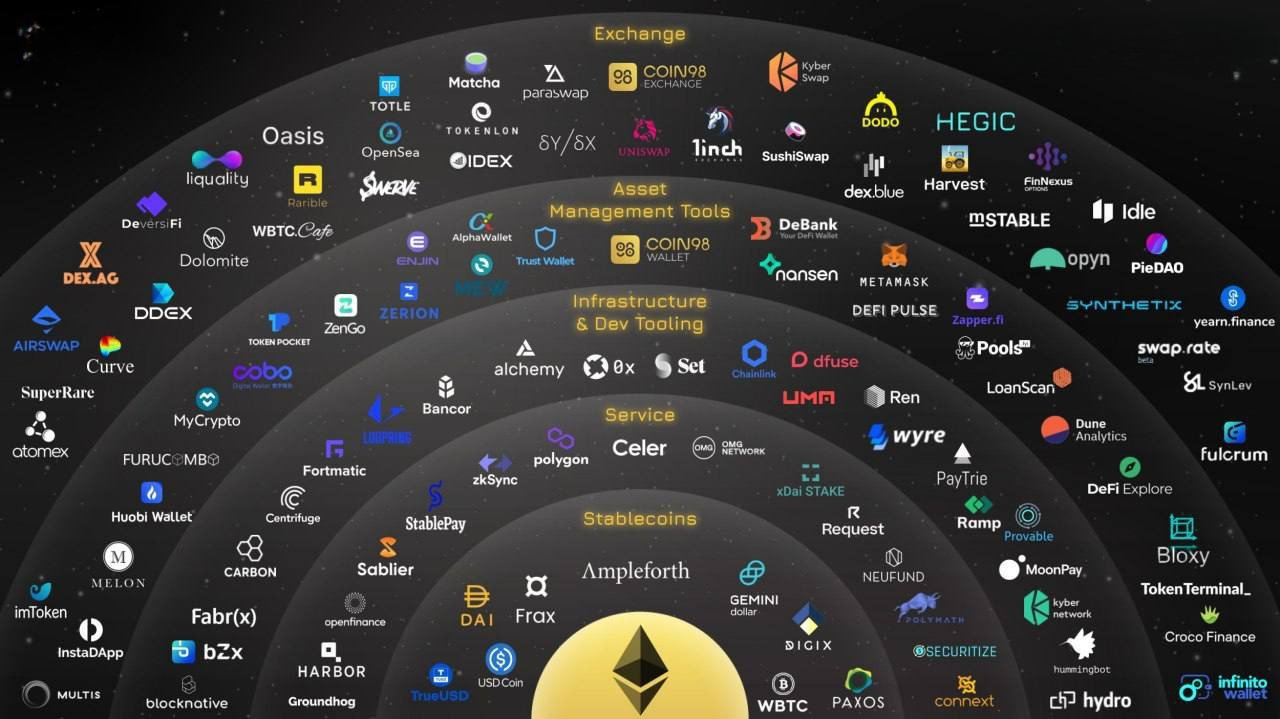
The Ethereum ecosystem is the largest programmable blockchain economy in crypto. It includes the base chain, Layer 2 networks, wallets, developer tools, DeFi protocols, NFT infrastructure, stablecoin rails, staking systems, enterprise integrations, and a fast-growing set of consumer and AI-connected applications.
This ecosystem matters because Ethereum is still the main coordination layer for onchain finance, tokenized assets, developer activity, and institutional blockchain adoption. Even when users transact on rollups instead of Ethereum mainnet, the broader network effect still compounds around Ethereum standards, liquidity, tooling, and security.
This guide is for founders, investors, analysts, operators, and researchers who want a clear map of the Ethereum ecosystem in 2026. The goal is not to list projects randomly. It is to explain how the ecosystem is structured, who the key players are, how value moves across layers, and where the best startup opportunities are emerging.
Ecosystem Overview (Quick Summary)
- Ethereum in 2026 is a multi-layer ecosystem, not just a single chain. Mainnet, Layer 2s, staking systems, and middleware all matter.
- Ethereum mainnet remains the settlement and security layer for high-value activity, asset issuance, and final trust.
- Layer 2 networks drive user growth by lowering fees and improving speed for trading, gaming, payments, and consumer apps.
- DeFi, stablecoins, and tokenized real-world assets are the strongest demand engines in the ecosystem.
- Developer tooling and interoperability are core strategic moats because builders need better abstraction, compliance, and cross-chain UX.
- Institutional adoption is rising through custody, staking, tokenization, and Ethereum-compatible infrastructure.
- The biggest startup opportunities are in user experience, onchain distribution, compliance tooling, data, and vertical applications built on Ethereum rails.
How the Ecosystem Is Structured
Infrastructure Layer
The infrastructure layer is the technical base of the Ethereum ecosystem. It includes Ethereum mainnet, rollups, data availability systems, validators, node providers, interoperability protocols, and security services.
- Ethereum mainnet acts as the settlement layer. It provides finality, asset security, and strong decentralization.
- Layer 2s such as Optimistic and ZK rollups handle execution at lower cost and higher speed.
- Staking and validator systems secure Ethereum through proof of stake.
- RPC and node infrastructure make applications usable by connecting wallets, dApps, and backend services to chains.
- Bridges and interoperability rails move assets and messages between chains and rollups.
- Data indexing and analytics infrastructure turns raw blockchain data into usable application logic.
This layer is where network security, scaling, and reliability are decided. If this layer fails, the rest of the ecosystem slows down or fragments.
Application Layer
The application layer is where users see value. This includes wallets, DeFi, NFT systems, onchain social products, games, payments, identity tools, prediction markets, and tokenized asset platforms.
- DeFi remains the most mature category, including exchanges, lending, staking, derivatives, and yield products.
- Stablecoin-based applications power payments, treasury management, remittances, and embedded finance.
- Consumer applications increasingly use Ethereum-compatible rails in the background instead of exposing raw crypto complexity.
- Enterprise and institutional applications use Ethereum for issuance, settlement, and tokenization workflows.
This layer creates demand for blockspace, wallets, liquidity, and infrastructure. It is also where product-market fit is tested.
Developer Tools
Developer tools are the productivity layer of the ecosystem. They reduce the cost of building and maintaining applications.
- Smart contract frameworks help teams write, test, and deploy contracts.
- Indexing services make blockchain data queryable.
- Oracle systems bring external data onchain.
- Monitoring and security tools track contract risk, exploits, and infrastructure performance.
- Account abstraction and wallet SDKs simplify onboarding and transaction flows.
In 2026, this category is strategically important because better tooling directly improves user experience, reduces security risk, and shortens product launch cycles.
Users / Demand Side
The demand side includes everyone using Ethereum-based products or infrastructure.
- Retail users use wallets, trading apps, games, NFT products, and social platforms.
- Power users provide liquidity, use leverage, bridge assets, and optimize yields across chains.
- Developers create new protocols and applications.
- Institutions use Ethereum for custody, tokenization, settlement, and treasury operations.
- Enterprises integrate Ethereum-based systems into payments, loyalty, and digital asset products.
The strongest demand in the Ethereum ecosystem comes from finance first, then infrastructure, then new consumer use cases.
Capital / Funding Layer
The capital layer funds innovation and bootstraps growth. It includes venture capital, ecosystem funds, grants, DAOs, token launches, treasury deployment, and onchain liquidity.
- VC firms back infrastructure, middleware, wallets, and high-growth applications.
- Ecosystem grants support open-source tooling, public goods, and developer education.
- Protocol treasuries fund ecosystem expansion and incentives.
- Liquidity providers and market makers support token utility and capital efficiency.
In Ethereum, capital is not just money. It includes liquidity, governance participation, developer mindshare, and distribution.
Key Players in the Ecosystem
1. Core Protocols
| Name | What they do | Why they matter |
|---|---|---|
| Ethereum | Base settlement layer for smart contracts, assets, and security | Still the core trust and liquidity hub of the ecosystem |
| Arbitrum | Layer 2 rollup focused on scaling Ethereum applications | Major home for DeFi, gaming, and developer activity |
| Optimism | Layer 2 ecosystem and modular scaling framework | Important for app growth, Superchain expansion, and public goods narrative |
| Base | Ethereum Layer 2 with strong consumer and exchange distribution | Shows how large platforms can onboard mainstream users to Ethereum rails |
| zkSync | ZK rollup infrastructure for scalable Ethereum transactions | Important for the long-term zero-knowledge scaling thesis |
| Starknet | ZK-based Layer 2 with a distinct developer stack | Key player in advanced proving systems and next-generation scaling |
| Polygon PoS / Polygon zkEVM | Ethereum-aligned scaling networks and developer infrastructure | Strong enterprise reach and broad app ecosystem |
| EigenLayer | Restaking infrastructure for extending Ethereum security | Expands the design space for middleware, validation, and cryptoeconomic services |
| Lido | Liquid staking protocol for ETH | Critical for staking liquidity and DeFi composability |
| Rocket Pool | Decentralized staking infrastructure | Important for validator decentralization and community-led staking |
2. Tools and Infrastructure
| Name | What they do | Why they matter |
|---|---|---|
| Chainlink | Oracle network and cross-chain messaging infrastructure | Connects smart contracts to real-world data and external systems |
| Infura | RPC and developer connectivity layer | Critical for app uptime and network access |
| Alchemy | Developer platform for node access, analytics, and app infrastructure | Reduces development complexity for startups and enterprises |
| The Graph | Indexing and query protocol for blockchain data | Makes decentralized applications usable and data-rich |
| Safe | Smart account and multisig infrastructure | Core treasury, DAO, and institutional wallet layer |
| Hardhat | Ethereum development environment | Standard tooling for smart contract teams |
| Foundry | Developer toolkit for testing and deploying contracts | Fast-growing standard among advanced Solidity teams |
| LayerZero | Cross-chain messaging protocol | Important for interoperability and omnichain application design |
| Wormhole | Cross-chain bridging and messaging infrastructure | Supports asset mobility and ecosystem connectivity |
| Blocknative | Mempool, transaction, and builder infrastructure | Helps optimize execution and transaction reliability |
3. Applications / Startups
| Name | What they do | Why they matter |
|---|---|---|
| Uniswap | Decentralized exchange and liquidity protocol | Foundational trading venue and liquidity engine for Ethereum assets |
| Aave | Lending and borrowing protocol | Core money market primitive for users and institutions |
| Maker / Sky ecosystem | Stablecoin and collateralized credit system | Important for decentralized dollar infrastructure |
| Curve | Stable asset and liquidity trading protocol | Key venue for stablecoin and correlated asset liquidity |
| Pendle | Yield trading and tokenized yield markets | Expands financialization of onchain income streams |
| OpenSea | NFT marketplace and digital asset platform | Still important for NFT distribution and asset discovery |
| ENS | Decentralized naming and identity layer | Critical for user-readable identity across Ethereum apps |
| Farcaster | Onchain-aligned social network ecosystem | Shows how Ethereum can support social graphs and app distribution |
| Polymarket | Prediction market platform using crypto rails | Demonstrates strong product-market fit for onchain market-based information systems |
| Stripe crypto integrations and stablecoin products | Payment and fiat-crypto connectivity | Push Ethereum-based rails closer to mainstream commerce |
4. Supporting Services
| Name | What they do | Why they matter |
|---|---|---|
| MetaMask | Wallet and user access layer | Main gateway for Ethereum users and developers |
| Coinbase Wallet | Self-custody wallet integrated with a large exchange ecosystem | Supports onboarding, asset movement, and app discovery |
| Fireblocks | Institutional custody and treasury infrastructure | Critical for enterprise and institutional adoption |
| Consensys | Ethereum software company across wallets, infrastructure, and tooling | Important ecosystem builder with broad developer influence |
| Trail of Bits | Security research and smart contract auditing | Security remains central to trust and capital formation |
| OpenZeppelin | Security frameworks, contract libraries, and audits | Widely used standards reduce developer risk |
| Dune | Blockchain analytics and dashboards | Turns onchain data into market intelligence and product insights |
| Nansen | Onchain analytics and wallet intelligence | Helps funds, teams, and traders understand user and capital flows |
How It All Connects
The Ethereum ecosystem works as a layered economic machine.
- Ethereum mainnet provides trust, settlement, and security.
- Layer 2s absorb user activity and lower transaction costs.
- Wallets connect users to applications and manage identity, signatures, and assets.
- Developer infrastructure powers data access, contract deployment, monitoring, and interoperability.
- Applications create user demand through trading, payments, yield, gaming, social, and tokenization.
- Stablecoins and liquidity protocols move value across the whole system.
- Staking and restaking deepen the security and economic utility of ETH.
The flow of value usually follows this path:
- Users enter through exchanges, wallets, or payment rails.
- Capital moves into stablecoins, ETH, or tokenized assets.
- Applications capture activity through swaps, lending, minting, or payments.
- Infrastructure providers earn through usage, subscriptions, MEV-related services, or token incentives.
- Settlement and security demand ultimately reinforce Ethereum itself.
The most important strategic point is this: Ethereum no longer wins only by mainnet usage. It wins when its standards, liquidity, security, and developer base remain the default coordination center across many execution environments.
Opportunities for Founders
Ethereum is mature in core finance, but still early in product abstraction, enterprise workflows, and vertical consumer experiences. That creates room for new startups.
1. Better User Experience Layers
- Wallet abstraction for mainstream users
- Gasless onboarding and session keys
- Cross-rollup asset management without confusing bridges
- Recovery, permissions, and secure identity flows
Most users still do not want to think about chains, gas, signatures, or bridges. Teams that hide complexity can capture large distribution.
2. Stablecoin-Native Products
- Cross-border payments
- Merchant settlement
- Payroll and treasury tools
- Yield-enabled business banking layers
Stablecoins are one of the clearest product-market-fit zones in crypto. Ethereum-aligned rails remain central to that market.
3. Tokenized Real-World Assets
- Treasuries and fixed-income products
- Private credit infrastructure
- Compliance-enabled issuance tools
- Secondary market liquidity systems
The opportunity is not just tokenization. It is building the full stack around issuance, reporting, compliance, custody, and distribution.
4. AI x Crypto Middleware
- Agent wallets and programmable spending controls
- Autonomous onchain execution systems
- AI-driven risk monitoring for DeFi and treasury management
- Data layers for machine-readable onchain activity
As AI agents become transactional actors, Ethereum-based wallet logic and payment rails become more relevant.
5. Institutional Enablement
- Compliance tooling
- Policy engines for wallets and treasuries
- Risk dashboards
- Tokenized asset operations software
Institutions do not need more protocols. They need operational software and trust layers.
6. Vertical Applications with Hidden Crypto
- Gaming economies
- Creator monetization
- Loyalty and rewards systems
- Ticketing and membership
The best founders will not sell “Web3” as a category. They will solve a real problem and use Ethereum in the background.
7. Security, Monitoring, and Governance Tooling
- Smart contract risk management
- DAO operations and treasury controls
- MEV-aware execution systems
- Insurance and coverage infrastructure
As more value moves onchain, security and control software become more valuable than speculative front ends.
Challenges in This Ecosystem
Fragmentation
Ethereum’s scaling success creates a new problem: users, liquidity, and developer attention are spread across many Layer 2s. This hurts discovery, wallet simplicity, and network coherence.
Complex User Experience
Even with better wallets, onboarding is still hard for non-crypto users. Seed phrases, gas tokens, bridging, and transaction approvals remain friction points.
Security Risk
Smart contract exploits, bridge failures, oracle problems, and governance attacks still create systemic risk. Security is a growth bottleneck, not just a technical issue.
Regulatory Pressure
Stablecoins, tokenized assets, privacy systems, and DeFi interfaces face rising compliance pressure in major markets. Teams need legal strategy early.
Competition from Other Ecosystems
Solana, Cosmos-linked app chains, and exchange-backed networks offer simpler user experiences or more integrated distribution. Ethereum’s advantage is strong, but not automatic.
Value Capture Questions
As more execution moves to Layer 2s, the market keeps debating where fees, liquidity, and governance value should concentrate. This affects token models and long-term incentives.
How This Ecosystem Compares
Compared with other blockchain ecosystems, Ethereum remains the strongest in four areas:
- Developer depth
- Institutional trust
- DeFi liquidity
- Composable standards
Compared with Solana, Ethereum is more modular and institutionally legible, but often less unified in user experience. Compared with app-chain ecosystems, Ethereum offers stronger shared liquidity and brand trust, but more complexity. Compared with newer chains, Ethereum has slower cultural novelty but far stronger infrastructure maturity.
Future of the Ecosystem
The Ethereum ecosystem in 2026 is moving toward a modular but coordinated structure.
- Layer 2s will continue absorbing most user activity.
- Mainnet will become even more important as the settlement and high-trust issuance layer.
- Account abstraction will improve UX and reduce chain-level complexity for users.
- Stablecoins and tokenized assets will expand Ethereum’s role in global finance.
- Restaking and shared security systems will create new infrastructure categories, though with risk.
- Consumer applications will grow slowly but meaningfully where crypto is invisible and incentives are clear.
- Institutional adoption will likely outpace retail speculation in strategic importance.
The biggest long-term question is not whether Ethereum survives. It is whether Ethereum can turn technical dominance into a cleaner user and developer experience across a fragmented execution landscape.
Frequently Asked Questions
What is the Ethereum ecosystem?
The Ethereum ecosystem is the full network of protocols, Layer 2s, wallets, developer tools, applications, users, capital providers, and services built around Ethereum and Ethereum-compatible standards.
Why is Ethereum still important in 2026?
Ethereum remains important because it is still the leading settlement layer for smart contracts, tokenized assets, DeFi liquidity, and institutional blockchain adoption. Its network effects extend beyond mainnet into Layer 2s and ecosystem standards.
What are the main layers of the Ethereum ecosystem?
The main layers are infrastructure, applications, developer tools, users and demand, and capital. Each layer depends on the others for growth and value creation.
Are Layer 2s part of the Ethereum ecosystem?
Yes. Layer 2s are a central part of Ethereum’s scaling strategy. They handle execution and user activity while relying on Ethereum for settlement, security, and ecosystem coordination.
What are the biggest startup opportunities in Ethereum?
The biggest opportunities are in user experience, stablecoin products, tokenized asset infrastructure, institutional tooling, AI-agent transaction layers, and vertical applications that hide crypto complexity.
What is the biggest risk in the Ethereum ecosystem?
The biggest risks are ecosystem fragmentation, poor user experience, security failures, and difficulty capturing value across many layers and chains.
Who should build on Ethereum in 2026?
Founders should build on Ethereum if they need deep liquidity, strong developer tools, institutional credibility, interoperability, and access to the broadest smart contract economy.
Expert Insight: Ali Hajimohamadi
The Ethereum opportunity in 2026 is no longer in creating “another protocol” unless it unlocks a new coordination advantage. The market is shifting from primitive creation to workflow ownership. That means the best companies will control a repeated user behavior, a regulated operational process, or a strategic distribution surface.
Founders should think in three layers. First, where does trust sit? On Ethereum, trust still concentrates around settlement, standards, and high-value assets. Second, where does usage happen? Increasingly on Layer 2s and embedded interfaces. Third, where does value accrue? Usually to the layer that owns user flow, data visibility, or mission-critical tooling.
This creates a clear positioning framework:
- Do not compete head-on with mature DeFi primitives unless you have a structural edge.
- Build where fragmentation creates pain. That is where budgets and urgency exist.
- Target businesses and users who need outcomes, not crypto exposure.
- Use Ethereum’s credibility as infrastructure, but differentiate through product, compliance, or distribution.
The strongest founders in this cycle will not ask, “What can I build on Ethereum?” They will ask, “Which market becomes better if Ethereum is used invisibly in the background?” That is where durable companies will emerge.
Final Thoughts
- Ethereum is now a network of networks, with mainnet and Layer 2s playing different but connected roles.
- Mainnet still anchors trust, while rollups increasingly capture day-to-day execution.
- DeFi, stablecoins, and tokenized assets remain the strongest economic engines.
- Developer tools and wallet UX are strategic leverage points for ecosystem growth.
- The best startup opportunities are in abstraction and workflow ownership, not generic protocol cloning.
- Fragmentation and security are the biggest structural challenges the ecosystem must solve.
- Ethereum’s long-term strength comes from standards, liquidity, and institutional trust, not just chain-level metrics.
Useful Resources & Links
- Ethereum
- Arbitrum
- Optimism
- Base
- zkSync
- Starknet
- Polygon
- EigenLayer
- Lido
- Rocket Pool
- Chainlink
- Infura
- Alchemy
- The Graph
- Safe
- Hardhat
- Foundry
- LayerZero
- Wormhole
- Blocknative
- Uniswap
- Aave
- MakerDAO
- Curve
- Pendle
- OpenSea
- ENS
- Farcaster
- Polymarket
- MetaMask
- Coinbase Wallet
- Fireblocks
- Consensys
- Trail of Bits
- OpenZeppelin
- Dune
- Nansen